All species › Passerines › Cardinals and allies › Rose-breasted Grosbeak
Rose-breasted Grosbeak | Pheucticus ludovicianus
Roodborstkardinaal | Picogrueso pechirrosado | Rei-do-bosque-de-peito-rosa
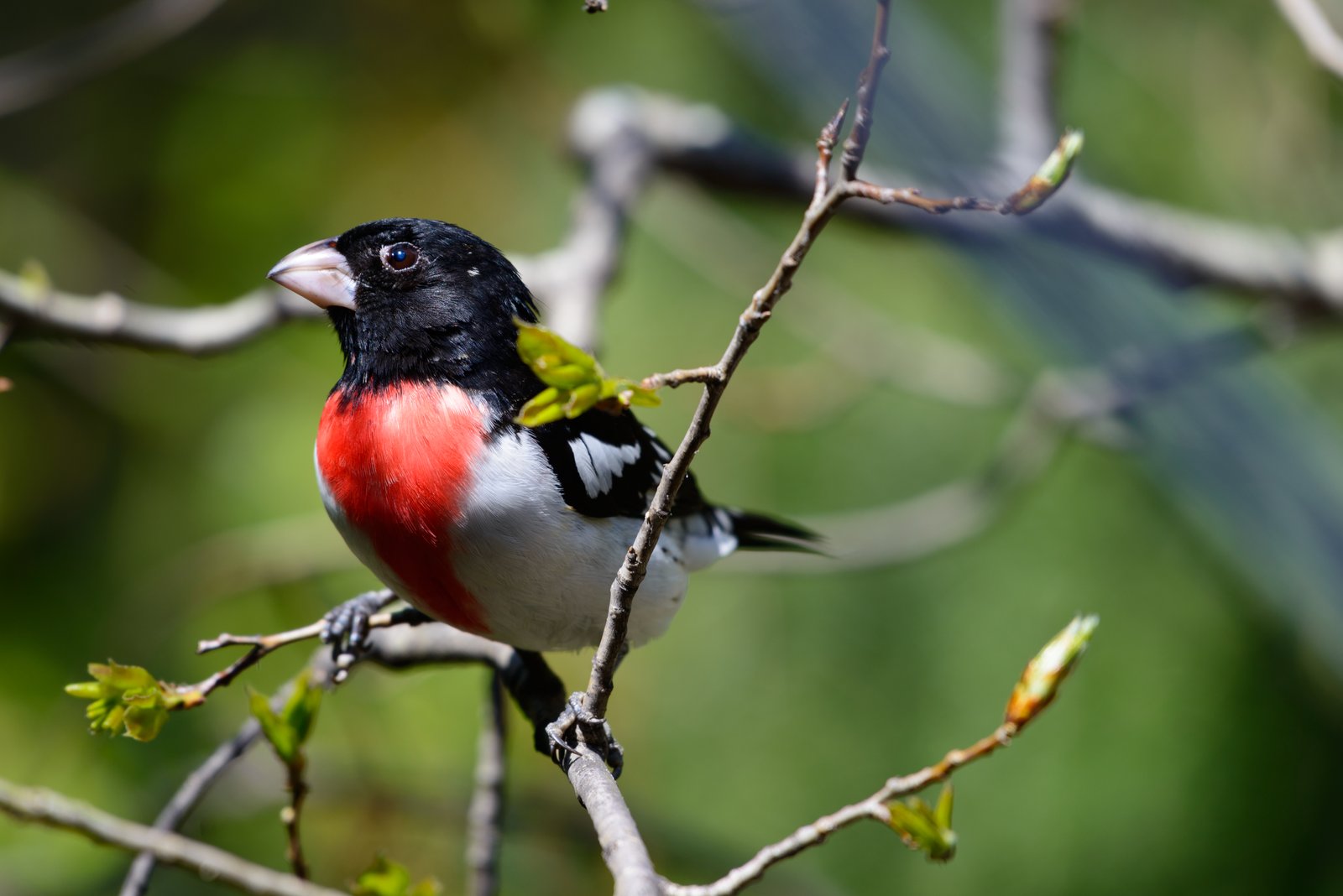
The Rose-breasted Grosbeak breeds in deciduous forests of eastern North America and winters from Mexico to north-western South America. The male is marked by the rose-red triangle on its white breast. In the guide area it is a regular winter visitor mainly on the Andean slopes of Colombia; farther south it quickly becomes scarcer.
Voice
The call is a sharp, squeaky eek, like a sneaker on a smooth floor. The song is a rich, robin-like series of whistles; in the guide area heard mainly in spring.
Recording: David Darrell-Lambert — CC BY-NC-SA 4.0 · xeno-canto
Identification
18–20 cm, with a heavy, pale, pinkish-white conical bill. The breeding male has a black head, throat and back, a rose-red triangle on the breast, a white belly, black wings with white spots and a white rump; the underwing coverts are rose-red. In winter many males are browner, with pale streaks on the head and back and a wash of pink on the breast. The female is brown with dark streaks, a broad white supercilium, a pale crown stripe, a streaked buff breast, white wing bars and yellowish underwing coverts. Juveniles resemble the female.
Confusion species
Females of Golden Grosbeak Pheucticus chrysogaster and Black-backed Grosbeak Pheucticus aureoventris are yellower and less streaked. Streaked Saltator Saltator striatipectus has an olive back, a shorter white supercilium and a dark bill. Female Dickcissels Spiza americana are much smaller, with a yellowish breast.
Habitat
In winter in forest edges, secondary forest, open woodland, shade coffee, gardens and semi-open country with fruiting trees, mainly between about 500 and 2500 m, locally lower. It eats fruit, seeds, buds and insects, often in treetops and sometimes in small groups. It does not breed in the guide area; the nest is placed in trees in North America.
Where the bird is most at home, classified by the vegetation units of the Andes and the west coast.


Range and movements
Colombia: fairly common winter visitor in the Andes, the Sierra Nevada de Santa Marta and the adjacent lowlands. Ecuador: scarce, mainly in the north, on both slopes. Peru: rare, mainly in the north. Bolivia: at most isolated records. Galápagos: a few records of vagrants. Outside the guide area the species breeds in southern Canada and the north-eastern and central United States and winters from Mexico to Venezuela.
- Winter visitor (c. Oct–Mar)
- Passage (Mar–Apr, Oct–Nov)
- dark = core range, pale = thinly spread
How and when to look
Look between November and March at fruiting trees and along forest edges on the lower and middle slopes of the Colombian Andes. The sharp, squeaky call often gives the bird away before its plumage does.
Conservation status
Least Concern. The population has declined somewhat in the long term; forest on the slopes is being lost in the winter range.
Scientific name
Pheucticus ludovicianus | (Linnaeus, 1766)
Linnaeus described the species in 1766 as Loxia ludoviciana; because it was later moved to another genus, the author and year stand in brackets. The genus Pheucticus was introduced in 1850 by Reichenbach. The genus name comes from Ancient Greek pheuktikos, 'shy' or 'inclined to avoid'. The species name refers to Louisiana (Latin Ludovicia), not necessarily the type locality. The specimen the first description was based on came from Louisiana, United States.