All species › Passerines › Cardinals and allies › Black-backed Grosbeak
Black-backed Grosbeak | Pheucticus aureoventris
Zwartrugkardinaal | Picogrueso dorsinegro | Rei-do-bosque
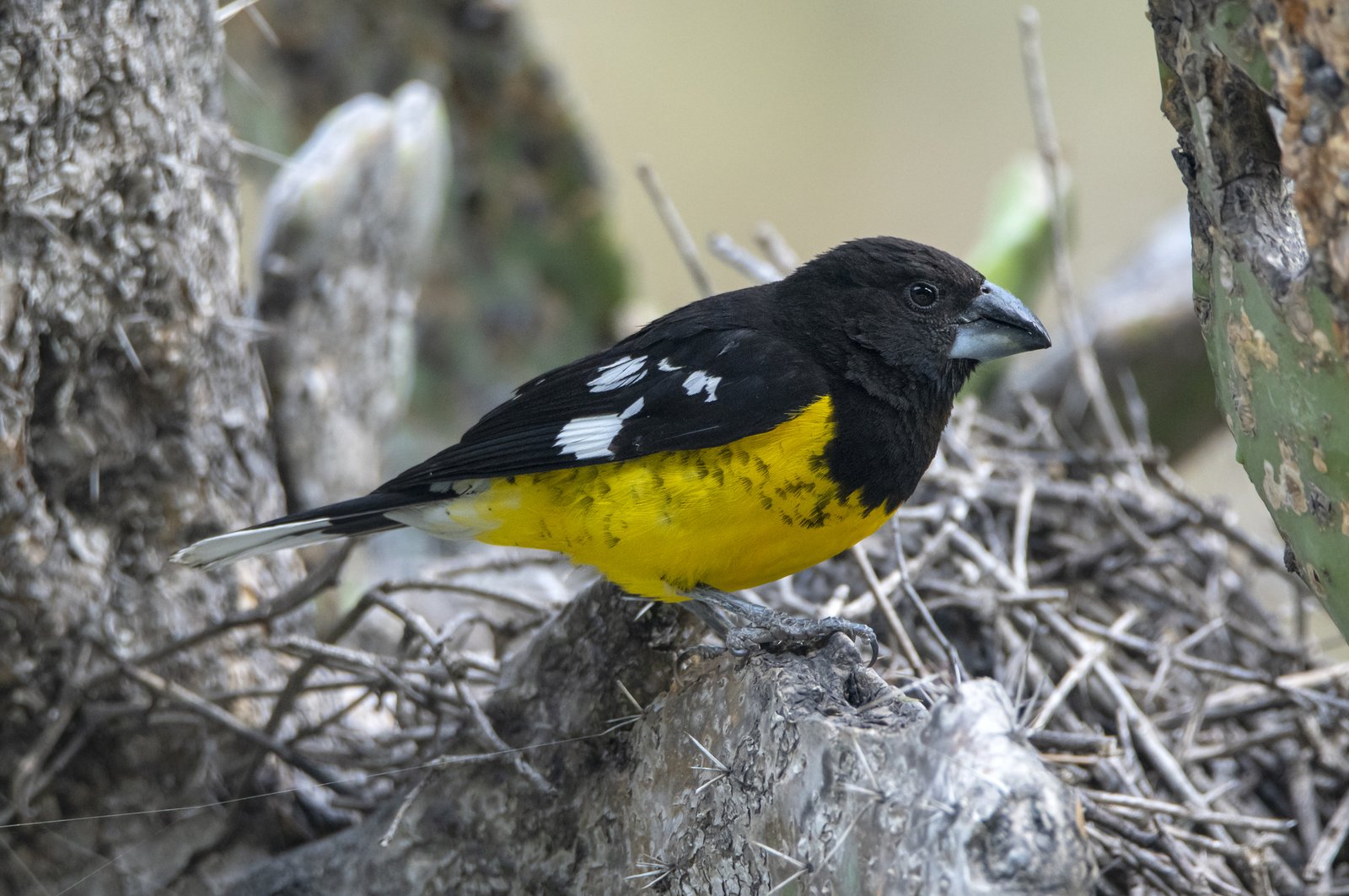
The Black-backed Grosbeak is the southern counterpart of the Golden Grosbeak: a large grosbeak with a heavy bill, the male with a black head and back and bright yellow underparts. It lives in dry valleys and on shrubby slopes of the Andes of Bolivia and southern Peru. Its song is a rich, whistled phrase.
Voice
The song is a series of rich, clear whistles in fairly long phrases, similar to that of Golden Grosbeak. The call is a sharp, metallic peek.
Recording: David F. Belmonte — CC BY-NC-SA 4.0 · xeno-canto
Identification
21–22 cm, with a very heavy, blackish conical bill. The male has a black head, throat, back and tail; the breast and belly are bright yellow, often with some black spots on the flanks. The wings are black with a large white patch at the base of the primaries and white tips to the coverts; the tail has white corners. The female has brownish-black instead of black areas, with pale spots on the head and back and a yellowish, often dark-spotted throat and breast. Juveniles resemble the female.
Confusion species
Male Golden Grosbeak Pheucticus chrysogaster has a yellow head and throat; the ranges meet in southern Peru. Hooded Siskin Spinus magellanicus also has a black head and yellow underparts but is much smaller, with a thin bill and yellow wing bands. Female orioles such as Yellow Oriole Icterus nigrogularis have a pointed bill.
Habitat
Dry and semi-humid scrub, open woodland, forest edges and riparian woodland in the dry valleys, also around fields, hedgerows and villages, mostly between about 1000 and 3500 m; in winter partly lower. It eats seeds, fruit, buds and insects. The nest is a loose cup of twigs in a shrub or tree.
Where the bird is most at home, classified by the vegetation units of the Andes and the west coast.


Range and movements
Peru: in the Andes of the south, mainly in the dry valleys. Bolivia: in the Andes and the dry valleys of the eastern slope, from La Paz to Tarija. Absent from Colombia, Ecuador and the Galápagos. Outside the guide area in north-western Argentina and rarely farther east.
- Resident
- dark = core range, pale = thinly spread
How and when to look
Search the dry valleys of Bolivia, for example around Cochabamba and in the valleys of Chuquisaca and Tarija, along forest edges and hedgerows; the male often sings from a high bare branch.
Conservation status
Least Concern. The species tolerates small-scale farmland well, but is trapped locally as a cage bird.
Scientific name
Pheucticus aureoventris | (d'Orbigny, ACVMD & de Lafresnaye, 1837)
D'Orbigny, ACVMD & de Lafresnaye described the species in 1837 as Pitylus aureoventris; because it was later moved to another genus, the author and year stand in brackets. The genus Pheucticus was introduced in 1850 by Reichenbach. The genus name comes from Ancient Greek pheuktikos, 'shy' or 'inclined to avoid'. The species name comes from Latin aureus, 'golden', and venter, 'belly', for the yellow belly. The specimen the first description was based on came from Yungas of Sica Sica, La Paz, Bolivia.