All species › Passerines › Cardinals and allies › Golden Grosbeak
Golden Grosbeak | Pheucticus chrysogaster
Geelbuikkardinaal | Picogrueso ventriamarillo | Rei-do-bosque-dourado
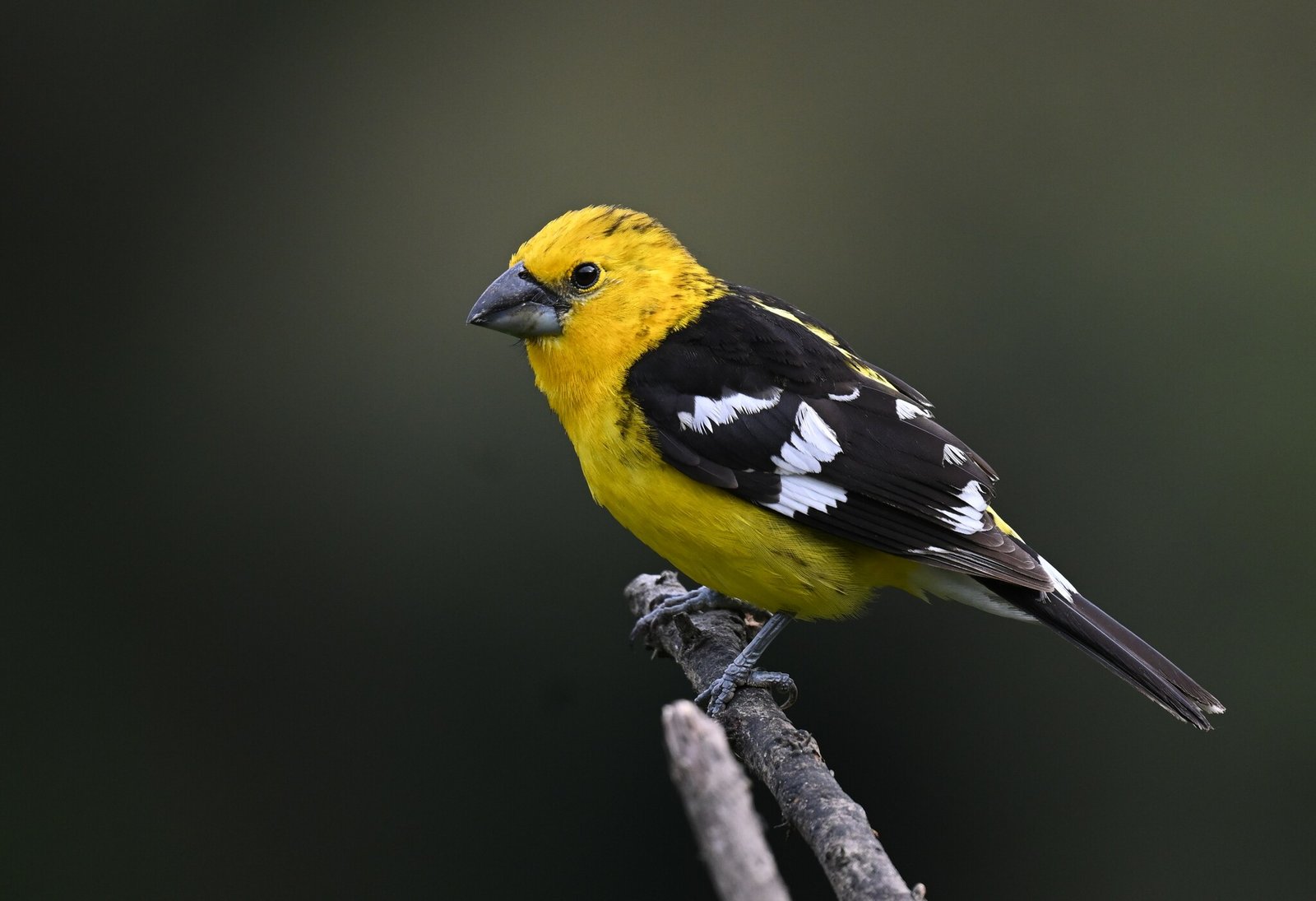
The Golden Grosbeak is the large yellow-and-black grosbeak of the northern Andes, with a heavy, dark conical bill. It lives in semi-open, often dry country with shrubs and trees and is also found in gardens, hedgerows and around villages. Its rich, whistled song is a familiar sound in dry valleys.
Voice
The song is a series of rich, clear, whistled phrases, fairly slow and melodious, often delivered at length from a high perch. The call is a sharp, metallic peek.
Recording: Juan Freile — CC BY-NC-SA 4.0 · xeno-canto
Identification
21–22 cm, with a very heavy, blackish conical bill. The male has a bright yellow head and underparts; the back is yellow with black spots to nearly black (especially in the north), the wings are black with a large white patch at the base of the primaries and white tips to the coverts, and the tail is black with white corners. The female is duller olive-yellow, with dark streaks on the crown and back and brownish-black wings with smaller white spots. Young males first resemble the female.
Confusion species
Male Black-backed Grosbeak Pheucticus aureoventris has an entirely black head, throat and back; the ranges meet in southern Peru. Yellow Oriole Icterus nigrogularis has a black throat and a pointed, thin bill. The female Rose-breasted Grosbeak Pheucticus ludovicianus is brown and streaked and lacks yellow.
Habitat
Dry and semi-humid scrub, forest edges, second growth, riparian woodland, hedgerows, orchards and gardens, from the western lowlands up to about 3000 m in the Andes, most often between 1000 and 2500 m. It eats seeds, fruit, buds and insects, often in the middle levels of trees and shrubs. The nest is a loose cup of twigs in a shrub or tree.
Where the bird is most at home, classified by the vegetation units of the Andes and the west coast.


Range and movements
Colombia: in the Andes and the Sierra Nevada de Santa Marta, mainly in dry and semi-open valleys. Ecuador: in the dry and semi-humid regions of the west and in the inter-Andean valleys. Peru: along the western slope, in the Marañón valley and in the dry valleys, south to the south of the country. Absent from Bolivia, where Black-backed Grosbeak occurs, and from the Galápagos. Outside the guide area in northern Venezuela.
- Resident
- dark = core range, pale = thinly spread
How and when to look
Listen in the morning in dry valleys and around fields and villages in the Andes for the whistled song; the male often sings from the top of a tree or shrub. In flight note the large white wing patches.
Conservation status
Least Concern. The species tolerates farmland with hedgerows and trees well, but is trapped locally as a cage bird.
Scientific name
Pheucticus chrysogaster | (Lesson, 1832)
Lesson described the species in 1832 as Pitylus chrysogaster; because it was later moved to another genus, the author and year stand in brackets. The genus Pheucticus was introduced in 1850 by Reichenbach. The genus name comes from Ancient Greek pheuktikos, 'shy' or 'inclined to avoid'. The species name comes from Greek khrusos, 'gold', and gastēr, 'belly', for the golden-yellow underparts. The specimen the first description was based on came from Quito, Ecuador.