All species › Passerines › New World warblers › Wilson's Warbler
Wilson's Warbler | Cardellina pusilla
Wilsons zanger | Reinita de Wilson | Mariquita-de-wilson
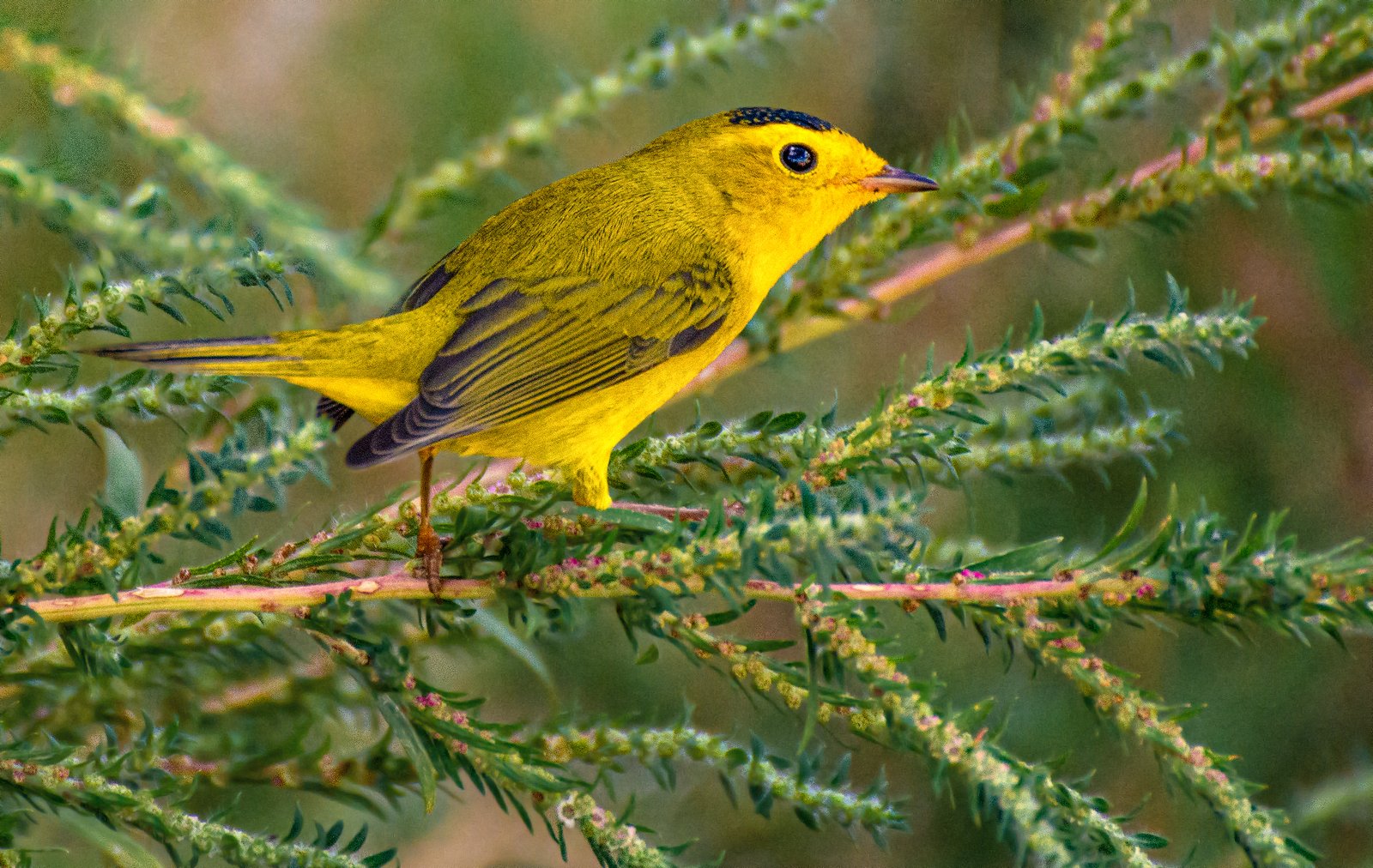
The Wilson's Warbler is a small, active warbler, olive-green above and yellow below; the male has a glossy black cap. It breeds in shrubbery from Alaska and Canada to the mountains of the western United States and winters mainly from Mexico to Panama. The guide area lies just south of its winter range; it is reported there only rarely, mainly in Colombia.
Voice
The call is a somewhat nasal, flat chet or chimp. The song is a fast, slightly accelerating series of dry, chipping notes on one pitch, often dropping at the end; rarely heard on the wintering grounds.
Recording: Greg Irving — CC BY-NC-SA 4.0 · xeno-canto
Identification
11–12 cm, with a fairly long, unspotted tail that it often moves. The upperparts are olive-green without wing bars, the underparts bright yellow. The face is yellow with a dark eye and no eye-line. The male has a sharply defined black cap; in the female the cap is smaller and duller or absent, and young females have an olive-green crown.
Confusion species
American Yellow Warbler Setophaga aestiva has yellow edges to the wing feathers, yellow spots in the tail and no cap. Hooded Warbler Setophaga citrina is larger, with white tail spots; the male has a black hood enclosing the yellow face. Canada Warbler Cardellina canadensis is grey above and has spectacles and a breast necklace.
Habitat
In winter in scrub, forest edges, old secondary forest, riparian growth and shade coffee, from the lowlands into the mountains. It forages actively at low to middle levels for insects, often with short sallies, and sometimes joins mixed flocks. It does not breed in the guide area.
Where the bird is most at home, classified by the vegetation units of the Andes and the west coast.


Range and movements
Colombia: rare winter visitor with a few records, mainly in the north-west and north. No regular records are known from Ecuador, Peru, Bolivia or the Galápagos. Breeds in Alaska, Canada and the western and north-eastern United States and winters from Mexico to Panama, where it is common.
How and when to look
The best chance is between November and March in scrub and forest edges in north-western Colombia, close to the border with Panama; watch for a small yellow warbler with a black cap moving its tail.
Conservation status
Least Concern. Common, but the population has declined in the long term, especially in the west of the breeding range.
Scientific name
Cardellina pusilla | (Wilson, 1811)
Wilson described the species in 1811 as Muscicapa pusilla; because it was later moved to another genus, the author and year stand in brackets. The genus Cardellina was introduced in 1850 by Bonaparte. The genus name is a diminutive of cardella, an Italian dialect word for the European goldfinch. The species name comes from Latin pusillus, 'very small'. The specimen the first description was based on came from southern New Jersey, United States.