All species › Passerines › New World warblers › Townsend's Warbler
Townsend's Warbler | Setophaga townsendi
Townsends zanger | Reinita de Townsend | Mariquita-de-townsend
Townsend's Warbler breeds in the coniferous forests of western North America and winters along the Pacific coast of the United States and in the montane forests of Mexico and Central America, south to Costa Rica. In the guide area it is an exceptional vagrant, with only a few reports from Colombia.
Voice
A sharp, high tsip. The song on the breeding grounds is a series of buzzy notes ending higher and faster.
Recording: Paul Marvin — CC BY-NC-SA 4.0 · xeno-canto
Identification
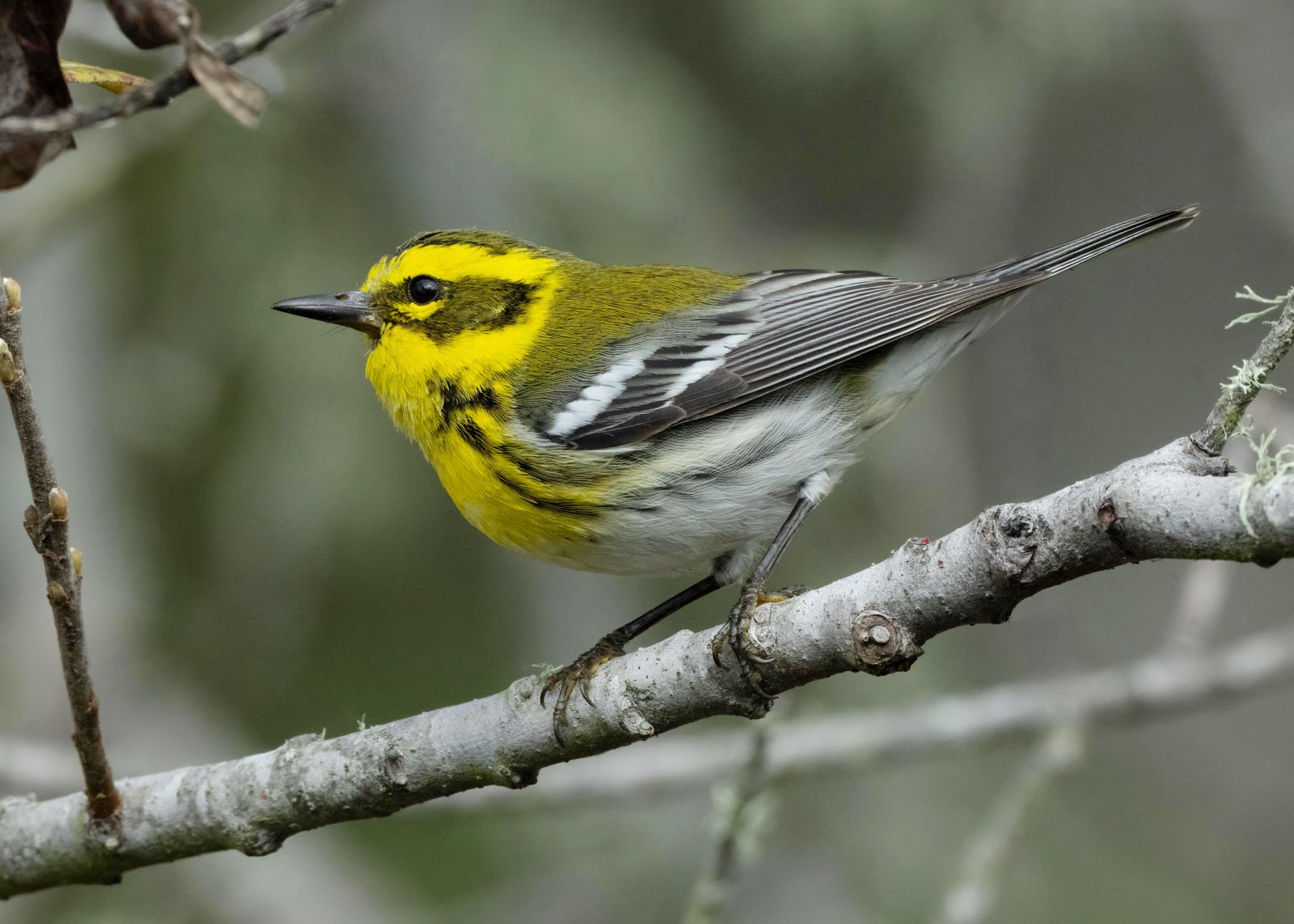
12–13 cm. The male has a black crown, a black ear patch bordered with yellow, a black throat and a yellow breast with black streaks on the flanks. The back is olive-green with dark spots, the wings grey with two white wing bars, and the belly white. The female and young birds have an olive-green crown and ear patch, a yellow throat and less black on the breast and flanks.
Confusion species
Black-throated Green Warbler Setophaga virens has a yellow face with an olive-green, not black, ear patch, and a white breast below the black throat. Female and young Blackburnian Warblers Setophaga fusca have a yellow-orange throat, pale stripes on the back and a white wing patch or broad wing bars.
Habitat
In winter quarters pine-oak forest and cloud forest in the mountains, where it searches foliage for insects in mixed flocks. It breeds in tall coniferous forest in western Canada and the north-western United States.
Where the bird is most at home, classified by the vegetation units of the Andes and the west coast.


Range and movements
Colombia: only a few reports, in the north of the country. Not known from Ecuador, Peru, Bolivia or the Galápagos. Outside the guide area it breeds from Alaska to the north-western United States and winters from the Pacific coast of the United States to the mountains of Costa Rica, rarely to Panama.
How and when to look
A bird in the guide area is most likely between November and March in mixed flocks with North American warblers in the montane forests of northern Colombia.
Conservation status
Least Concern. The population is large and fairly stable.
Scientific name
Setophaga townsendi | (Townsend, 1837)
Townsend described the species in 1837 as Sylvia townsendi; because it was later moved to another genus, the author and year stand in brackets. The genus Setophaga was introduced in 1827 by Swainson. The genus name comes from Greek sēs (genitive sētos), 'moth', and -phagos, '-eating', so 'moth-eater'. The species name honours the American naturalist and ornithologist John Kirk Townsend (1809–1851); the name was chosen by his travelling companion Thomas Nuttall. The specimen the first description was based on came from Fort Vancouver, Washington, United States.