All species › Passerines › New World warblers › Pine Warbler
Pine Warbler | Setophaga pinus
Dennenzanger | Reinita del pinar | Mariquita-dos-pinheiros
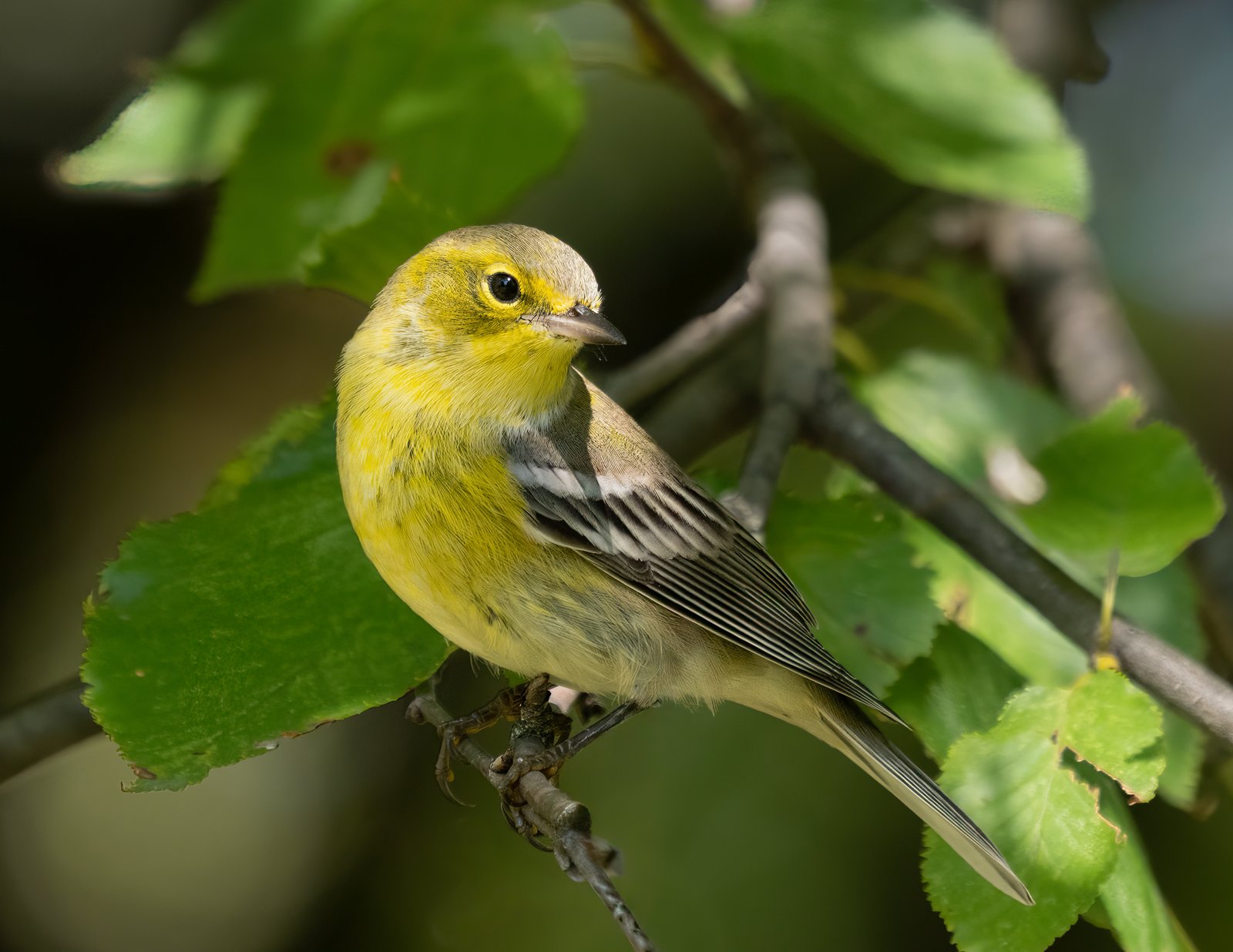
The Pine Warbler is a rather stout, plain warbler of the pine forests of eastern North America that winters largely within the United States. It migrates less far than almost any other warbler. In the guide area it is an exceptional vagrant: a female in the Sierra Nevada de Santa Marta in November 2002 was the first record for South America.
Voice
A soft, sweet tsip. The song on the breeding grounds is a musical, rather slow trill on one pitch.
Recording: Rory Nefdt — CC BY-NC-SA 4.0 · xeno-canto
Identification
13–14 cm, with a rather thick bill for a warbler and a long tail. The upperparts are plain olive-green, unstreaked, with two white wing bars. The throat and breast are yellow, with faint dark streaks on the breast sides; the belly and undertail coverts are white. A faint yellow supercilium and a broken pale eye-ring. The female is duller; young females are greyish brown with hardly any yellow.
Confusion species
Bay-breasted Warbler Setophaga castanea in autumn plumage has a finely streaked back, often a wash of chestnut on the flanks and buffy undertail coverts. Blackpoll Warbler Setophaga striata in autumn plumage has a streaked back, streaked breast sides and pale legs. Yellow-throated Warbler Setophaga dominica is grey with a black mask.
Habitat
It breeds and winters in pine and mixed forest, searching branches and trunks for insects and also eating seeds and berries in winter. The bird in Colombia was feeding in a mixed flock in montane forest.
Where the bird is most at home, classified by the vegetation units of the Andes and the west coast.


Range and movements
Colombia: one record, a wintering female at Vista Nieve in the Sierra Nevada de Santa Marta on 20 November 2002, in a mixed flock with Blackburnian and Tennessee Warblers. Not known from Ecuador, Peru, Bolivia or the Galápagos. Outside the guide area it breeds in eastern North America and on Hispaniola and the Bahamas, and winters mainly in the south-eastern United States.
How and when to look
A new record is most likely between November and March in mixed flocks with wintering North American warblers in the montane forests of northern Colombia.
Conservation status
Least Concern. The population is large and increasing.
Scientific name
Setophaga pinus | (Linnaeus, 1766)
Linnaeus described the species in 1766 as Certhia pinus; because it was later moved to another genus, the author and year stand in brackets. The genus Setophaga was introduced in 1827 by Swainson. The genus name comes from Greek sēs (genitive sētos), 'moth', and -phagos, '-eating', so 'moth-eater'. The species name comes from Latin pinus, 'pine', for the pine woods it inhabits. The specimen the first description was based on came from Georgia, United States.