All species › Passerines › New World warblers › Yellow-throated Warbler
Yellow-throated Warbler | Setophaga dominica
Geelkeelzanger | Reinita gorjiamarilla | Mariquita-de-garganta-amarela
The Yellow-throated Warbler is a grey, long-billed warbler with a bright yellow throat that breeds in the south-eastern United States. It winters from the Gulf Coast and the Caribbean islands to Costa Rica. The guide area lies far outside that winter range; in Colombia one bird wintered for several years at the El Dorado reserve in the Sierra Nevada de Santa Marta.
Voice
A high, soft tsip. The song on the breeding grounds is a series of clear, descending whistles, rising slightly at the end.
Recording: Rory Nefdt — CC BY-NC-SA 4.0 · xeno-canto
Identification
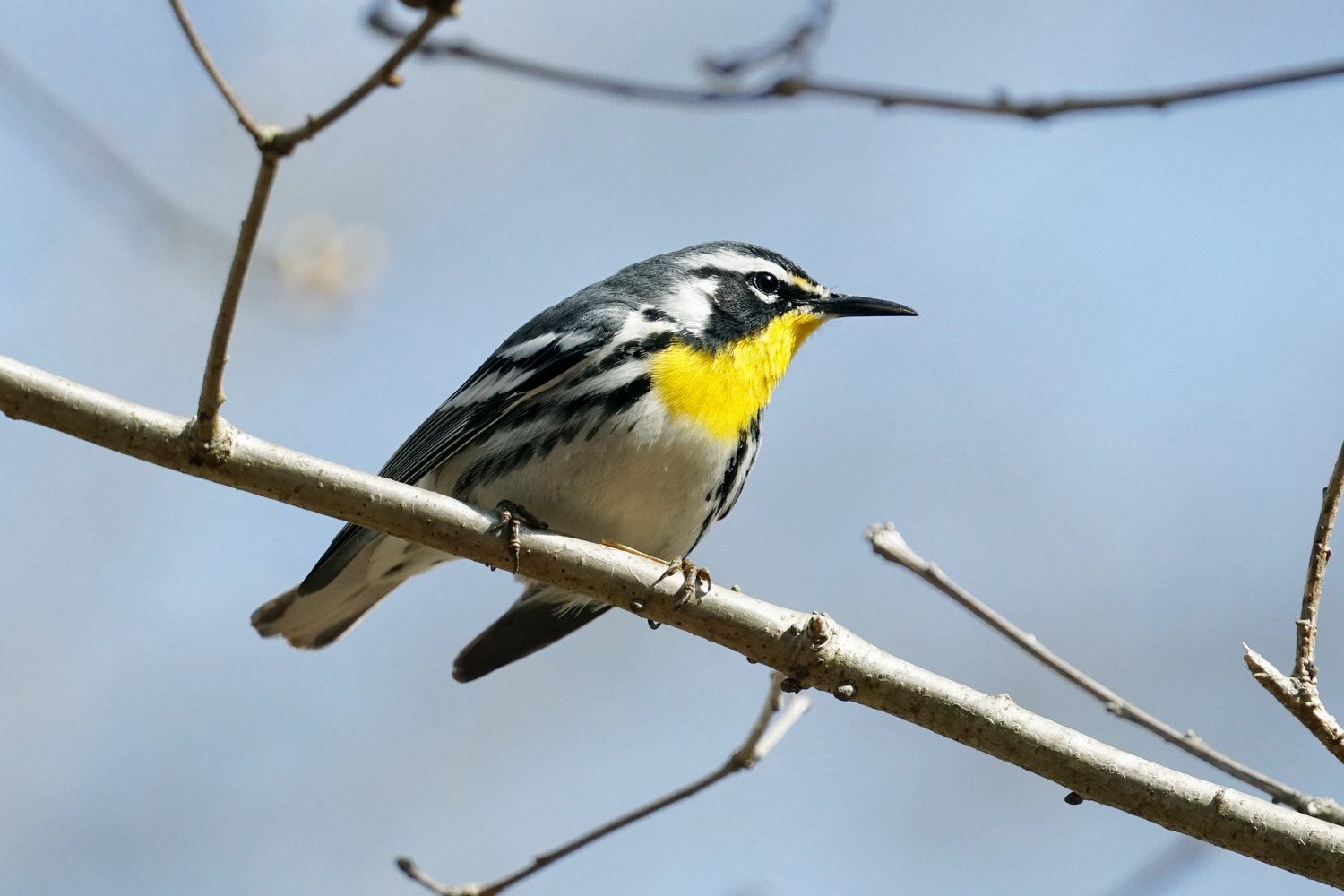
13–14 cm, with a long, pointed bill. The upperparts are plain grey, with two white wing bars. The throat and upper breast are bright yellow. A black triangle runs from the eye to the side of the neck, with a white supercilium above and a white neck patch behind it. The flanks are streaked black and the belly is white. The female shows a little less black on the face; young birds are similar but tinged brownish.
Confusion species
Northern Parula Setophaga americana also has a yellow throat, but is blue-grey with a green back patch, a broken white eye-ring and no black mask. Female and young Blackburnian Warblers Setophaga fusca have a yellow-orange throat, a dark ear patch bordered with yellow and a streaked back. Black-throated Green Warbler Setophaga virens has an olive-green back and a yellow face with a black throat.
Habitat
In winter quarters woodland, parks and gardens, often in palms and conifers; the Colombian bird stayed in cloud forest and gardens at about 2000 m. It creeps slowly along branches and trunks, searching bark, leaves and epiphytes for insects. It breeds in pine forest, cypress swamps and woodland with Spanish moss Tillandsia usneoides in the south-eastern United States.
Where the bird is most at home, classified by the vegetation units of the Andes and the west coast.


Range and movements
Colombia: very rare winter visitor; one bird at the El Dorado reserve in the Sierra Nevada de Santa Marta (November 2007 and January 2009), and a few other reports in the north. Not known from Ecuador, Peru, Bolivia or the Galápagos. Outside the guide area it breeds in the eastern and south-eastern United States and winters from the southern United States and the Greater Antilles to Costa Rica.
How and when to look
A new record is most likely between November and March in the Sierra Nevada de Santa Marta; check mixed flocks for a grey warbler creeping along branches with its long bill.
Conservation status
Least Concern. The population is stable to slightly increasing, and the breeding range is expanding northwards.
Scientific name
Setophaga dominica | (Linnaeus, 1766)
Linnaeus described the species in 1766 as Motacilla dominica; because it was later moved to another genus, the author and year stand in brackets. The genus Setophaga was introduced in 1827 by Swainson. The genus name comes from Greek sēs (genitive sētos), 'moth', and -phagos, '-eating', so 'moth-eater'. The species name refers to Santo Domingo (Hispaniola). Linnaeus based his name in 1766 on a bird that Brisson had described in 1760; the type locality was later restricted to Santo Domingo. The specimen the first description was based on came from Hispaniola.