All species › Passerines › Antbirds › Chestnut-crested Antbird
Chestnut-crested Antbird | Rhegmatorhina cristata
Kastanjekuifmiervogel | Hormiguero cresticastaño | Mãe-de-taoca-castanha
The Chestnut-crested Antbird is an ant-follower with a small range in north-western Amazonia, between the Japurá and the Rio Negro. In the guide area it occurs only in the far south-east of Colombia. It is tied to forest on sandy soils and forages almost exclusively at army-ant swarms.
Voice
The song is a slow, slightly accelerating series of eight to ten fluted notes. Calls are a harsh, vibrant chirr and a short chip.
Recording: GABRIEL LEITE — CC BY-NC-SA 4.0 · xeno-canto
Identification
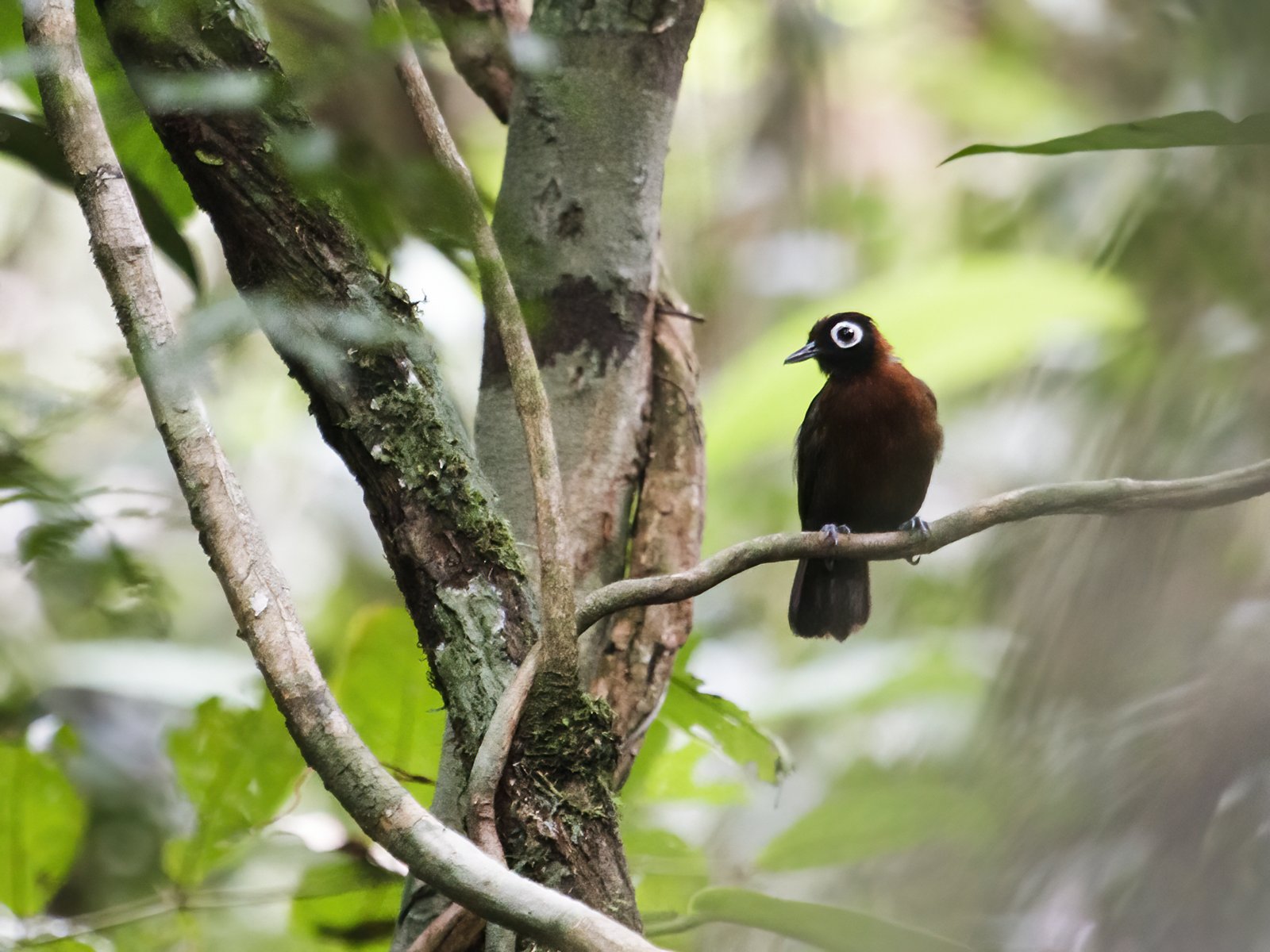
15 cm, with a short tail and a laterally compressed bill. The crown, crest and nape are rufous to chestnut; the forehead, lores, face and throat are black. Around the eye a ring of bare, pale skin. The upperparts, wings and tail are dark olive-brown, with rufous edges to the wing feathers. The breast is rufous-chestnut, grading into a dark olive-brown belly. The female resembles the male, but has short black bars on the back and lesser wing coverts.
Confusion species
Hairy-crested Antbird Rhegmatorhina melanosticta has a grey rather than a rufous crest and a dark olive-brown breast. White-cheeked Antbird Gymnopithys leucaspis has a white throat and underparts and no crest. Reddish-winged Bare-Eye Phlegopsis erythroptera is larger and mostly black, with rufous wing bars.
Habitat
Understorey of humid terra firme lowland forest, especially on sandy soils, below about 350 m. It follows army-ant swarms and catches flushed insects and other arthropods. Usually in pairs or family groups. Little is known about its breeding.
Where the bird is most at home, classified by the vegetation units of the Andes and the west coast.

Range and movements
Colombia: very local in the far south-east, in eastern Caquetá and the adjacent border area with Brazil. Ecuador: absent. Peru: absent. Bolivia: absent. Absent from the Galápagos. Outside the guide area in north-western Amazonian Brazil, between the Vaupés, the Rio Negro and the Japurá.
- Resident
- dark = core range, pale = thinly spread
How and when to look
Its occurrence in the guide area is limited to remote forest in south-eastern Colombia. There, follow army-ant swarms in terra firme forest on sandy soils; the species perches low among the other ant-followers.
Conservation status
Least Concern. The range is small, but lies largely in little-disturbed forest; deforestation is the main potential threat.
Scientific name
Rhegmatorhina cristata | (Pelzeln, 1868)
Pelzeln described the species in 1868 as Pithys cristata; because it was later moved to another genus, the author and year stand in brackets. The genus Rhegmatorhina was introduced in 1888 by Ridgway. The genus name comes from Greek rhēgma, 'cleft', and rhis, 'nose', meaning with slit-like nostrils. The species name comes from Latin cristatus, 'crested'. The specimen the first description was based on came from Rio Uaupés, Amazonas, Brazil.