All species › Passerines › Antbirds › Chestnut-shouldered Antwren
Chestnut-shouldered Antwren | Euchrepomis humeralis
Kastanjeschoudermiersluiper | Hormiguerito hombricastaño | Zidedê-de-encontro
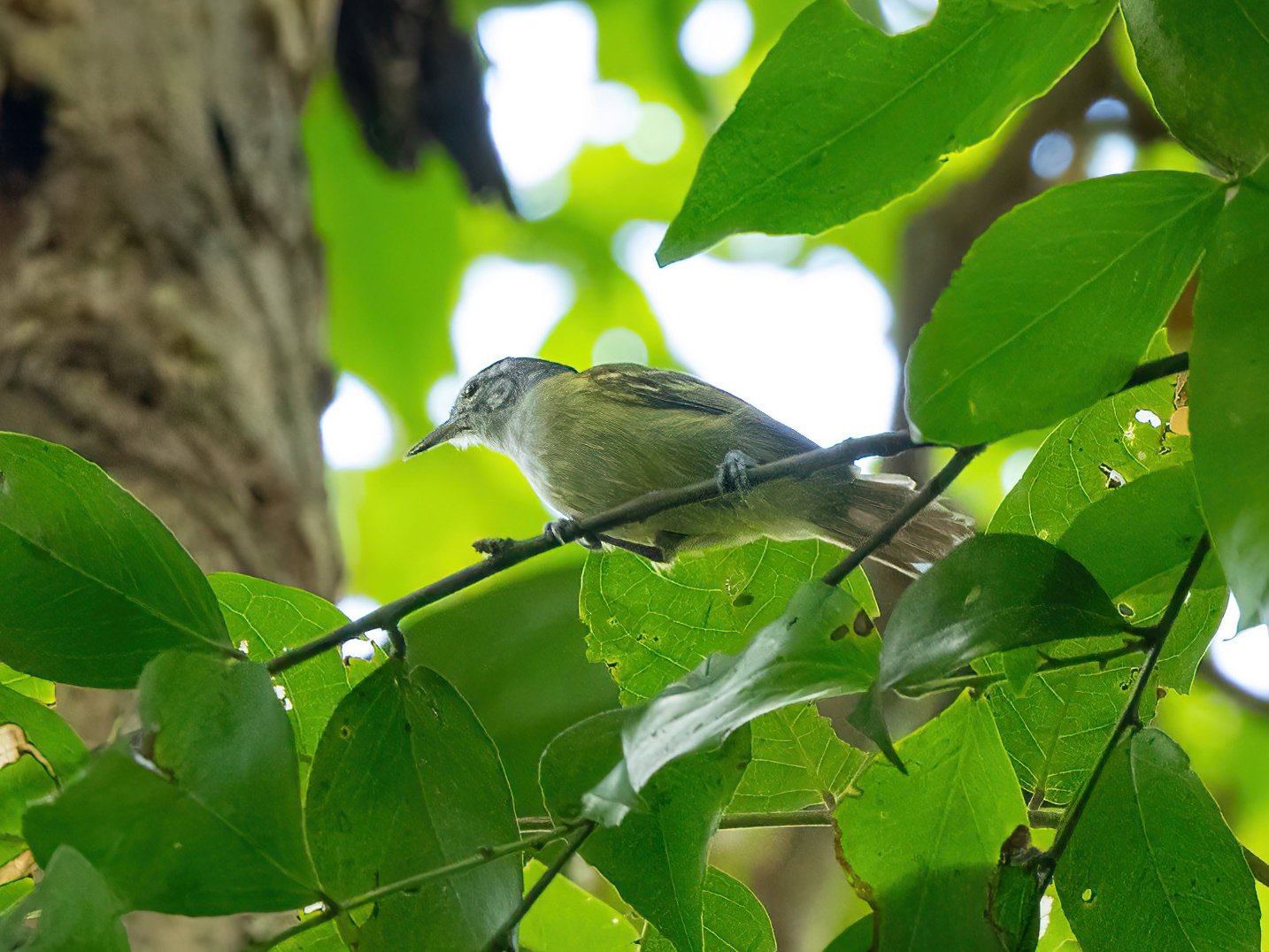
The Chestnut-shouldered Antwren is a small, slender antwren of the canopy of Amazonian rainforest in the western Amazon basin. Pairs and family groups almost always travel with mixed flocks high in the trees. The chestnut bend of the wing gives the species its name.
Voice
The song is a very high, thin, slightly descending series that gradually accelerates into a rattle. Calls are short, high notes.
Recording: Mitch Lysinger — CC BY-NC-SA 4.0 · xeno-canto
Identification
10–11 cm, slender, with a thin bill and a fairly long tail. The male has a black crown and nape, a whitish supercilium and a thin dark eyeline on an otherwise pale grey face. The mantle is greenish olive, the rump rufous-chestnut and the tail greyish olive. The wing coverts are blackish grey with whitish tips forming two wing bars, and the bend of the wing is chestnut. Throat and breast are pale grey, the belly pale yellow. The female has an olive-brown crown, nape and eyeline, a pale grey supercilium and at most a trace of chestnut at the bend of the wing.
Confusion species
Ash-winged Antwren Euchrepomis spodioptila lives mainly north of the Napo, has a rufous back and lacks the chestnut bend of the wing. Rufous-rumped Antwren Euchrepomis callinota and Yellow-rumped Antwren Euchrepomis sharpei live higher, in montane forest. Dot-winged Antwren Microrhopias quixensis is largely black with white wing spots and a longer tail.
Habitat
Canopy and upper mid-storey of humid lowland rainforest on terra firme and in drier parts of floodplain forest. It gleans arthropods acrobatically from leaves and twig tips, in pairs or family groups, usually with mixed flocks. Nothing is known about its breeding biology.
Where the bird is most at home, classified by the vegetation units of the Andes and the west coast.


Range and movements
Ecuador: in the east, south of the Napo. Peru: in the Amazonian lowlands. Bolivia: in the northwest. Absent from Colombia and the Galápagos. Outside the guide area in western Amazonian Brazil, east to the Rio Madeira.
- Resident
- dark = core range, pale = thinly spread
How and when to look
Canopy mixed flocks in terra firme forest are best followed from towers and canopy walkways, such as at lodges in the Amazonian lowlands of Ecuador and Peru. Listen for the high, accelerating rattle.
Conservation status
Least Concern. Fairly common in most of its range and present in several protected areas; numbers are thought to be slowly declining.
Scientific name
Euchrepomis humeralis | (Sclater & Salvin, 1880) (GBIF: Terenura humeralis)
Sclater & Salvin described the species in 1880 as Terenura humeralis; because it was later moved to another genus, the author and year stand in brackets. The genus Euchrepomis was introduced in 2012 by Bravo, Remsen, Whitney & Brumfield. The genus name combines Greek euchrōs, 'ruddy, bright-coloured', and epōmis, 'point of the shoulder'. The species name comes from Latin humerus, 'shoulder', meaning 'of the shoulder', for the chestnut shoulders. The specimen the first description was based on came from Sarayacu, Pastaza, Ecuador.