All species › Passerines › Swallows › Chilean Swallow
Chilean Swallow | Tachycineta leucopyga
Chileense zwaluw | Golondrina chilena | Andorinha-chilena
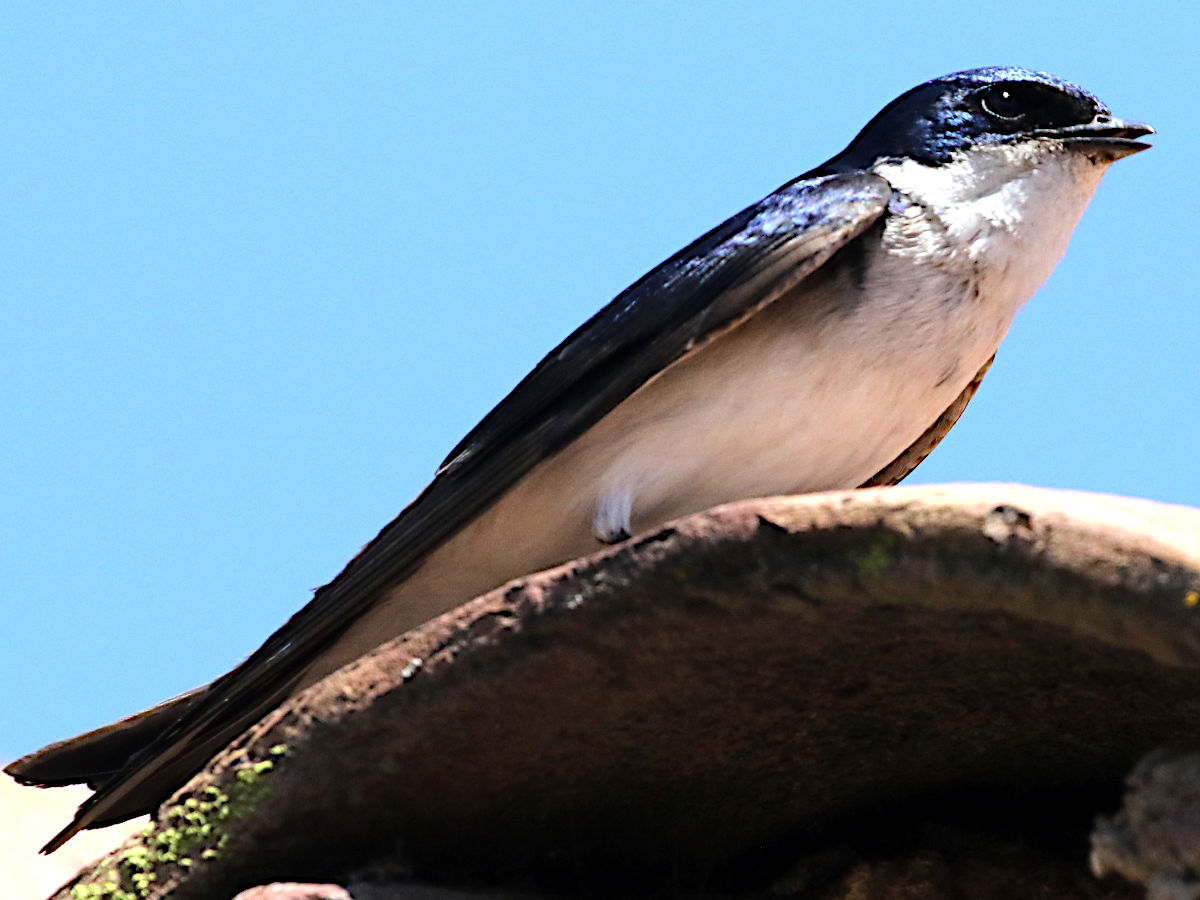
The Chilean Swallow is a steel-blue-and-white swallow that breeds in Chile and Argentina south to Tierra del Fuego. After breeding part of the population moves north, as far as Bolivia, Paraguay and southern Brazil. In the guide area it is a scarce winter visitor to the lowlands of Bolivia.
Voice
A soft, buzzy chreet and a twittering song of short trills, similar to that of White-rumped Swallow.
Recording: Andrew Spencer — CC BY-NC-SA 3.0 · xeno-canto
Identification
13 cm, with a slightly forked tail. The upperparts are dark steel blue, with little green gloss. The rump is white. There is no, or hardly any, white line above the lores. The tertials have narrow white edges. The underparts are white. The sexes are nearly alike. Juveniles are greyish brown above.
Confusion species
White-rumped Swallow Tachycineta leucorrhoa is greener blue above and has a distinct white line from the bill to above the eye; in Bolivia both species occur together in the austral winter. White-winged Swallow Tachycineta albiventer has a large white wing patch. Blue-and-white Swallow Pygochelidon cyanoleuca lacks a white rump and has black undertail coverts.
Habitat
In the guide area open lowland country with water: savanna, pasture, marshes, lakes and riverbanks. It hunts flying insects low over water and open ground, often with other swallows. It does not breed in the guide area; in the breeding range it nests in cavities in trees, rocks and buildings.
Where the bird is most at home, classified by the vegetation units of the Andes and the west coast.


Range and movements
In Bolivia a scarce winter visitor in the lowlands of the east and south, mainly in the austral winter. From Peru there are at most a few records. Absent from Colombia, Ecuador and the Galápagos. It breeds in Chile and Argentina, south to Tierra del Fuego, and winters north to Paraguay, southern Brazil and Bolivia.
- Summer visitor (c. Apr–Sep)
- dark = core range, pale = thinly spread
How and when to look
Between May and September, check flocks of swallows over marshes and pastures in eastern and southern Bolivia, and look at the side of the head of any white-rumped swallow.
Conservation status
Least Concern. The species is common in its breeding range and also nests in villages and towns.
Scientific name
Tachycineta leucopyga | (Meyen, 1834)
Meyen described the species in 1834 as Hirundo leucopyga; because it was later moved to another genus, the author and year stand in brackets. The genus Tachycineta was introduced in 1851 by Cabanis. The genus name comes from Greek takhukinētos, 'moving quickly'. From Greek leukos, 'white', and pugē, 'rump', after the white rump. The specimen the first description was based on came from Santiago, Chile.