All species › Passerines › Swallows › Mangrove Swallow
Mangrove Swallow | Tachycineta albilinea
Mangrovezwaluw | Golondrina manglera | Andorinha-do-mangue
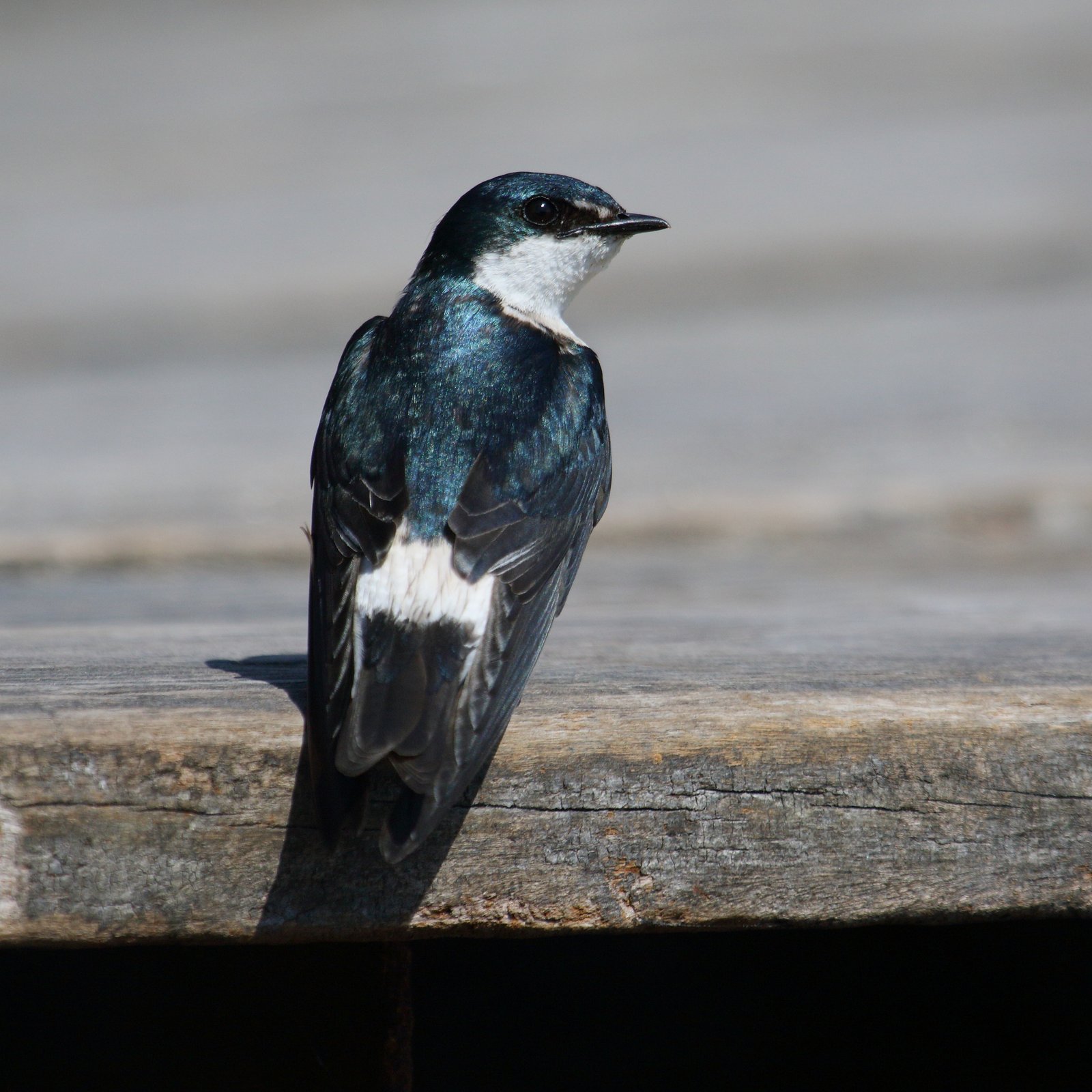
The Mangrove Swallow is a small, blue-green-and-white swallow of coasts, rivers and lakes in Central America. In the guide area it occurs only in the far north-west of Colombia, near the border with Panama. It hunts low over the water and often perches on branches, posts and buoys just above the surface.
Voice
A rolled jeerrt or a short chreet; the song is a soft trill.
Recording: Isain Contreras Rodríguez — CC BY-NC-SA 4.0 · xeno-canto
Identification
12–13 cm, small and compact, with a short, barely forked tail. The upperparts are glossy blue-green, bluer in worn plumage. A narrow white line runs above the black lores. The rump is pure white. The tertials and inner secondaries have white edges, which form a white stripe on the closed wing. The underparts are white. The sexes are nearly alike. Juveniles are greyish brown above and dingy white below.
Confusion species
White-winged Swallow Tachycineta albiventer is slightly larger, with a larger white wing patch and no white line above the lores; in Colombia it lives mainly east of the Andes and in the Magdalena valley. Tumbes Swallow Tachycineta stolzmanni is smaller, with a finely streaked rump, and lives in north-western Peru and south-western Ecuador. Tree Swallow Tachycineta bicolor is larger and has no white rump and no white in the wing.
Habitat
Mangroves, lagoons, estuaries, rivers and lakes in the lowlands, always close to water. It hunts flying insects low over the water and often returns to a perch. It nests in cavities in stumps, dead trees, rock crevices and bridges, usually just above the water.
Where the bird is most at home, classified by the vegetation units of the Andes and the west coast.


Range and movements
In Colombia only in the far north-west, along the coast and the rivers in the border area with Panama. Absent from Ecuador, Peru, Bolivia and the Galápagos. Outside the guide area from Mexico to Panama.
- Resident
- dark = core range, pale = thinly spread
How and when to look
In north-western Colombia, search mangroves, estuaries and rivers around the Gulf of Urabá for swallows perching on branches and posts just above the water.
Conservation status
Least Concern. The species is widespread in Central America; in the guide area it has only a small range.
Scientific name
Tachycineta albilinea | (Lawrence, 1863)
Lawrence described the species in 1863 as Petrochelidon albilinea; because it was later moved to another genus, the author and year stand in brackets. The genus Tachycineta was introduced in 1851 by Cabanis. The genus name comes from Greek takhukinētos, 'moving quickly'. From Latin albus, 'white', and linea, 'line', after the white line above the eye. The specimen the first description was based on came from Panama Railroad, Panama.