All species › Passerines › Swallows › Purple Martin
Purple Martin | Progne subis
Purperzwaluw | Golondrina purpúrea | Andorinha-azul
The Purple Martin is the largest swallow of North America and passes through the guide area on its way to and from its wintering grounds in Amazonia. Large flocks sometimes move along the major lowland rivers. In the guide area it is mainly a passage migrant; the actual wintering range lies largely in Brazil.
Voice
A rich, gurgling and chattering twitter; the call is a low, warm tchew or tchur, often given in flight.
Recording: David A. Brinkman — CC BY-NC-SA 4.0 · xeno-canto
Identification
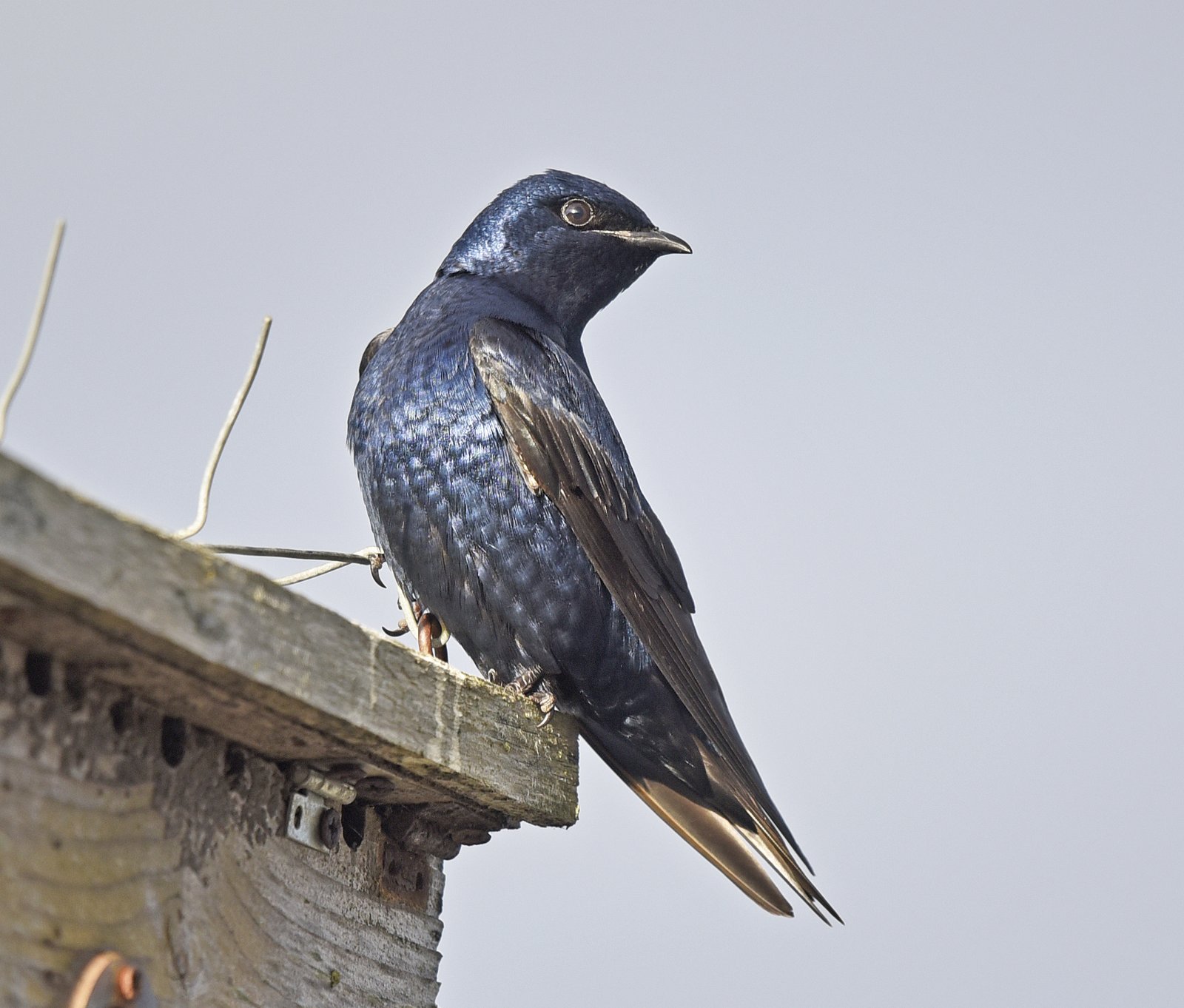
18–20 cm, a sturdy swallow with broad, pointed wings and a moderately forked tail. The adult male is entirely glossy blue-black to purplish blue, including the underparts. The female is duller blue-black above, with a greyish forehead and a faint grey collar; the throat and breast are scaled greyish brown, and the belly is dingy white with dark shaft streaks. Juveniles resemble the female but are browner. Young males already show some dark blue feathers on the underparts.
Confusion species
Southern Martin Progne elegans is very similar; the male is also entirely dark but has a more deeply forked tail, and the female is darker and more uniform below, without a grey collar. Grey-breasted Martin Progne chalybea has a greyish-brown throat and breast and a white belly without streaks in both sexes. Peruvian Martin Progne murphyi is smaller and lives only along the coast. Brown-chested Martin Progne tapera is brown above and white below with a brown breast band.
Habitat
Lowland rivers, riverbanks, river islands, forest edges and open country with scattered trees, also over villages and towns, mainly below 1000 m; migrants are sometimes seen higher in the Andes. It hunts flying insects high in the air. Flocks roost in trees along rivers or in towns. It breeds only in North America.
Where the bird is most at home, classified by the vegetation units of the Andes and the west coast.


Range and movements
In Colombia, Ecuador and Peru mainly a passage migrant in the lowlands east of the Andes, rarely also west of them and in the Andes. In Bolivia a passage migrant and locally a winter visitor in the lowlands. Absent from the Galápagos apart from the odd vagrant. Breeds in southern Canada, the United States and Mexico and winters mainly in Amazonian Brazil.
- Resident
- Winter visitor (c. Oct–Mar)
- Passage (Mar–Apr, Oct–Nov)
- dark = core range, pale = thinly spread
How and when to look
In August–October and February–April watch for large swallow flocks over Amazonian rivers, especially in the evening around roosts in trees or in river towns. The all-dark male with its broad wings stands out among smaller swallows.
Conservation status
Least Concern. In North America the species breeds mostly in nest boxes; numbers there have declined locally through competition for nest sites and poor weather during the breeding season.
Scientific name
Progne subis | (Linnaeus, 1758)
Linnaeus described the species in 1758 as Hirundo subis; because it was later moved to another genus, the author and year stand in brackets. The genus Progne was introduced in 1826 by Boie. The genus name refers to Procne (Greek Proknē), a queen in Greek mythology who was turned into a swallow. Latin subis is a bird mentioned by the Roman author Nigidius Figulus that was said to break eagles' eggs; possibly chosen for the species' aggression towards birds of prey near the nest. The specimen the first description was based on came from Hudson Bay, Canada.