All species › Woodpeckers and allies › Woodpeckers › Crimson-bellied Woodpecker
Crimson-bellied Woodpecker | Campephilus haematogaster
Grote roodbuikspecht | Carpintero ventrirrojo | Pica-pau-de-ventre-carmesim
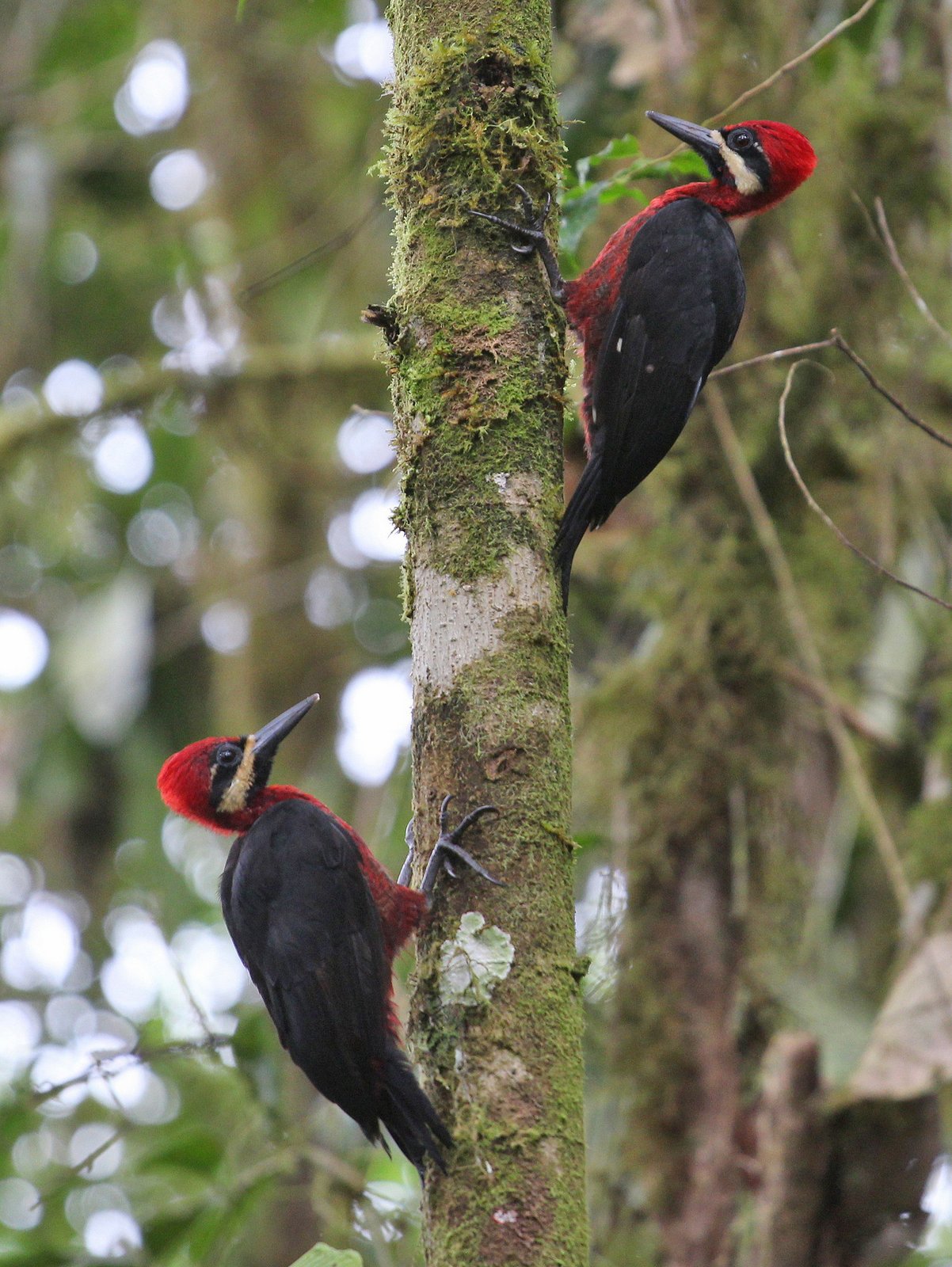
The Crimson-bellied Woodpecker is a large, dark Campephilus woodpecker with deep red underparts, living in the interior of humid foothill and montane forest on the eastern slope of the Andes. It often keeps low and hidden on large trunks. Birds west of the Andes are now often treated as a separate species, the Splendid Woodpecker.
Voice
Repeated nasal, shrill notes and a loud, sharp rattle. It drums with a fast series of three to six loud raps.
Recording: Charlie Vogt — CC BY-NC-SA 4.0 · xeno-canto
Identification
32–35 cm, with a long, straight, dark bill. The crown, crest, nape and hindneck are red. A black eye-stripe crosses the head, with a buff band below it towards the chin; the chin and throat are black. The upper back is black, the lower back and rump deep red. The underparts are red with dark mottling and barring. The wings are black, with two rows of pale spots on the flight feathers that show only in flight. In the female the buff band continues along the side of the neck to the upper breast.
Confusion species
Red-necked Woodpecker Campephilus rubricollis has an all-red head, neck and breast, but a rufous belly, rufous primaries and a black back. Powerful Woodpecker Campephilus pollens lives higher, and has a white lower back and cinnamon, barred underparts. Crimson-crested Woodpecker Campephilus melanoleucos has a white V on the back and a pale, barred belly.
Habitat
The interior and edges of humid foothill forest and lower montane forest, roughly between 500 and 2200 m. It often forages low, on the lower parts of large trunks and on fallen wood, for beetle larvae and other insects. It nests in a self-excavated cavity in a tree.
Where the bird is most at home, classified by the vegetation units of the Andes and the west coast.


Range and movements
In Colombia along the eastern slope of the Andes. In Ecuador on the eastern slope. In Peru along the eastern slope over much of the country. In Bolivia only in the far north-west. Absent from the Galápagos. In the narrow treatment the species does not occur outside the guide area.
- Resident
- dark = core range, pale = thinly spread
How and when to look
In old foothill forest, listen for the short, fast drums and the nasal calls. Birds often keep low in the dark forest interior and stay on one trunk for a long time.
Conservation status
Least Concern. The population is probably decreasing through deforestation on the eastern slope; the species depends on large, continuous forest.
Scientific name
Campephilus haematogaster | (Tschudi, 1844)
Tschudi described the species in 1844 as Picus haematogaster; because it was later moved to another genus, the author and year stand in brackets. The genus Campephilus was introduced in 1840 by Gray. The genus name combines Greek kampē, 'caterpillar', with philos, 'loving'. The species name combines Greek haima, 'blood', with gastēr, 'belly', meaning 'blood-bellied'. The specimen the first description was based on came from Peru.