All species › Gamebirds › New World quail › Dark-backed Wood Quail
Dark-backed Wood Quail | Odontophorus melanonotus
Zwartrugtandkwartel | Corcovado dorsioscuro | Uru-de-dorso-escuro
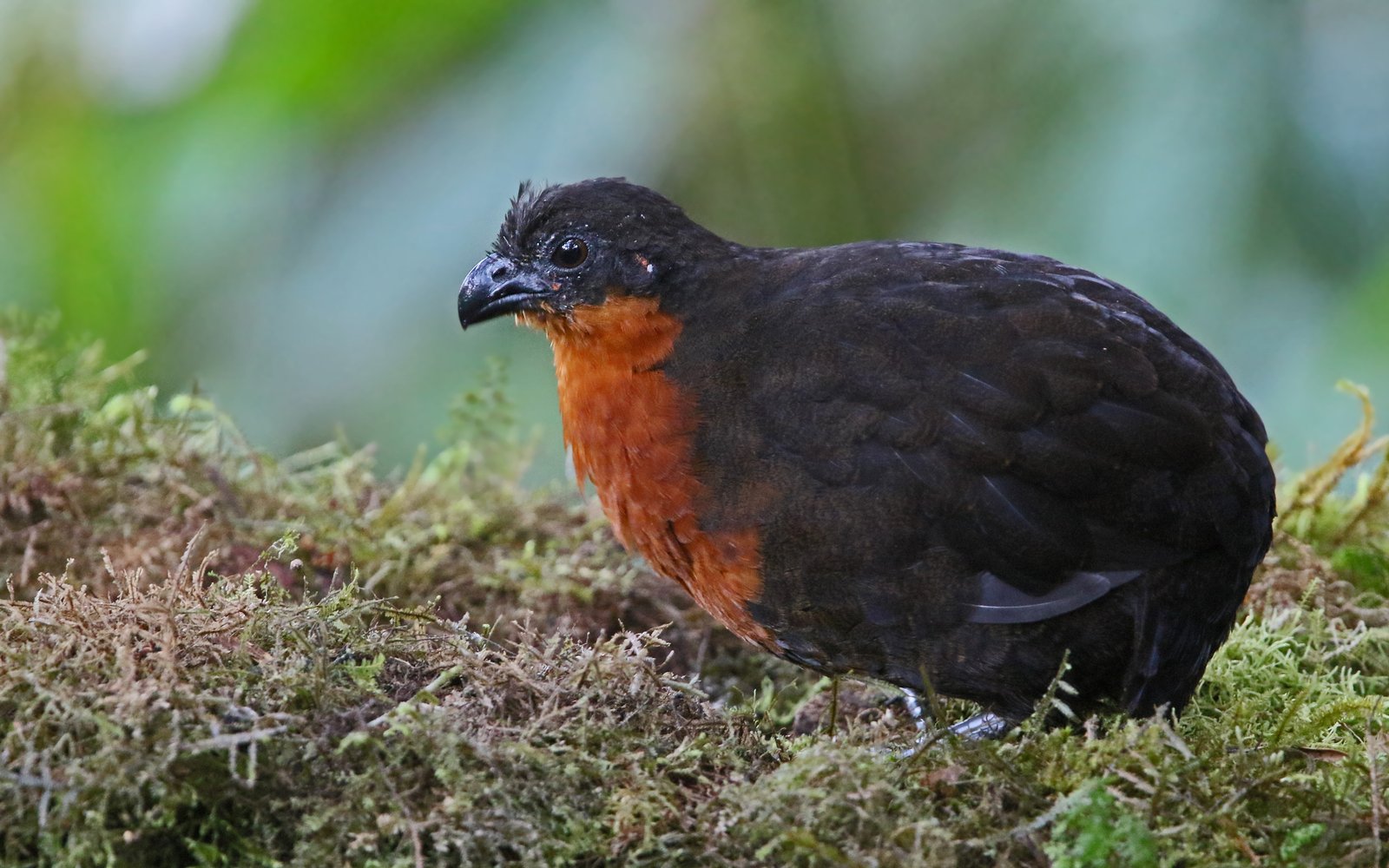
The Dark-backed Wood Quail is a wood quail of montane forest on the western slope of the Andes in south-western Colombia and north-western Ecuador. It is the darkest wood quail of the guide area: blackish brown, with a rufous throat and breast. Groups live on the forest floor and sing loud duets at dawn.
Voice
A loud, fast and rhythmic duet of repeated, rolling notes, mainly at dawn and dusk. Also soft, squeaky contact notes within the group.
Recording: José María Loaiza B. — CC BY-NC-SA 4.0 · xeno-canto
Identification
24–26 cm, compact, with a short tail and a short, dark crest. The upperparts are blackish brown, finely vermiculated, without clear pale spots. The throat, breast and upper belly are uniform rufous to chestnut; the rest of the underparts is dark greyish brown. The bare skin around the eye is dark. The sexes are similar; the female is slightly duller. Juveniles are duller and less rufous on the breast.
Confusion species
Rufous-fronted Wood Quail Odontophorus erythrops lives lower on the western slope and has a rufous forehead and a black throat with a white band. Chestnut Wood Quail Odontophorus hyperythrus of the Central and Western Andes of Colombia has a white stripe behind the eye and a paler, brown back. Tinamous such as Great Tinamou Tinamus major have a thin bill, no crest and almost no tail.
Habitat
The floor of humid montane forest and cloud forest, also old secondary forest and forest edge, at roughly 1000 to 2300 m. It lives in groups of a few birds that scratch in the leaf litter for seeds, fruit and invertebrates. The nest is on the ground.
Where the bird is most at home, classified by the vegetation units of the Andes and the west coast.


Range and movements
In Colombia only in the south-west, on the western slope of the Western Andes, mainly in Nariño. In Ecuador on the western slope of the Andes in the north, roughly from Carchi to Pichincha. Absent from Peru, Bolivia and the Galápagos. Endemic to the guide area.
- Resident
- dark = core range, pale = thinly spread
How and when to look
At some private reserves near Mindo in north-western Ecuador, groups sometimes come to feeding stations early in the morning. Elsewhere the species is mostly heard at dawn in cloud forest on the western slope.
Conservation status
Least Concern, although the species has previously been considered Vulnerable. The range is small and forest on the western slope is heavily fragmented; it is also hunted.
Scientific name
Odontophorus melanonotus | Gould, 1861
Gould described the species in 1861 and placed it straight away in the genus where it still stands. The genus Odontophorus was introduced in 1816 by Vieillot. The genus name comes from Greek odous, odontos, 'tooth', and -phoros, 'bearing', after the serrated edge of the bill. The species name comes from Greek melas, 'black', and nōtos, 'back'. The specimen the first description was based on came from Ecuador.