All species › Passerines › New World blackbirds, troupials and allies › Dusky-green Oropendola
Dusky-green Oropendola | Psarocolius atrovirens
Groensnaveloropendola | Oropéndola verdioscura | Japu-verde-escuro
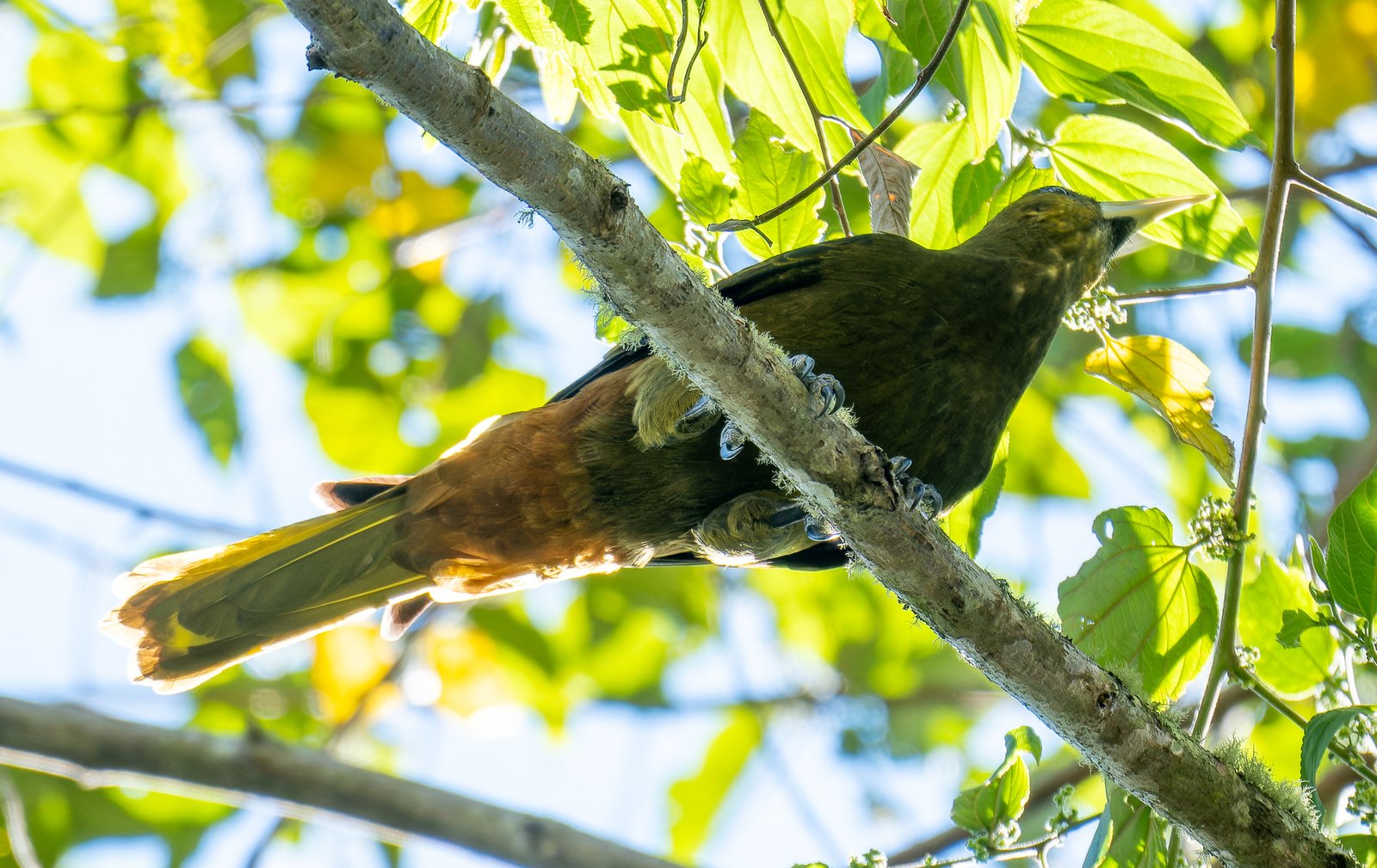
The Dusky-green Oropendola is a dark oropendola of the montane forests on the eastern Andean slope of Peru and Bolivia, and occurs only in the guide area. It usually lives higher than Russet-backed Oropendola. Like its relatives it breeds in colonies of hanging woven nests.
Voice
The male gives a loud, liquid, gurgling display song with a deep bow, like other oropendolas. The call is a harsh chak; groups call frequently in flight.
Recording: Jacob Wijpkema — CC BY-NC-SA 4.0 · xeno-canto
Identification
34–42 cm; the male is clearly larger than the female. The plumage is dark olive-green, slightly yellower on the head and breast, brownish to dark rufous-brown on the belly, rump and undertail. The tail is yellow with dark central feathers. The bill is pale greenish to horn-coloured, the forehead yellowish. The eye is dark. Juveniles are duller.
Confusion species
Russet-backed Oropendola Psarocolius angustifrons is browner, with a russet back and a yellower bill, and usually lives lower. Green Oropendola Psarocolius viridis lives in the lowlands and has an orange-red bill tip and a pale blue eye. Mountain Cacique Cacicus chrysonotus is smaller and black, with a yellow rump and a black tail.
Habitat
Humid montane forest and forest edges, old secondary growth and open country with scattered tall trees on the eastern Andean slope, roughly between 800 and 2400 m. It searches for fruit, nectar and insects in the canopy, often in small groups and together with caciques. It breeds in colonies in isolated trees.
Where the bird is most at home, classified by the vegetation units of the Andes and the west coast.


Range and movements
In Peru on the eastern Andean slope in the centre and south of the country. In Bolivia on the eastern slope, in the Yungas. Absent from Colombia, Ecuador and the Galápagos. Does not occur outside the guide area.
- Resident
- dark = core range, pale = thinly spread
How and when to look
Walk or drive along mountain roads through the Yungas, such as at Manu in Peru or in the Yungas of La Paz in Bolivia, and watch for small groups of dark oropendolas and their colonies in isolated roadside trees.
Conservation status
Least Concern. The species tolerates forest edges and semi-open country, but needs forest nearby; deforestation of the slopes is a local threat.
Scientific name
Psarocolius atrovirens | (d'Orbigny, ACVMD & de Lafresnaye, 1838)
D'Orbigny, ACVMD & de Lafresnaye described the species in 1838 as Cassicus atro-virens; because it was later moved to another genus, the author and year stand in brackets. The genus Psarocolius was introduced in 1827 by Wagler. The genus name combines Greek psar, 'starling', with koloios, 'jackdaw'. The species name comes from Latin ater, 'black, dark', and virens, 'green': dark green. The specimen the first description was based on came from Yungas, Bolivia.