All species › Passerines › Thrushes and allies › Ecuadorian Thrush
Ecuadorian Thrush | Turdus maculirostris
Ecuadorlijster | Zorzal ecuatoriano | Sabiá-equatoriano
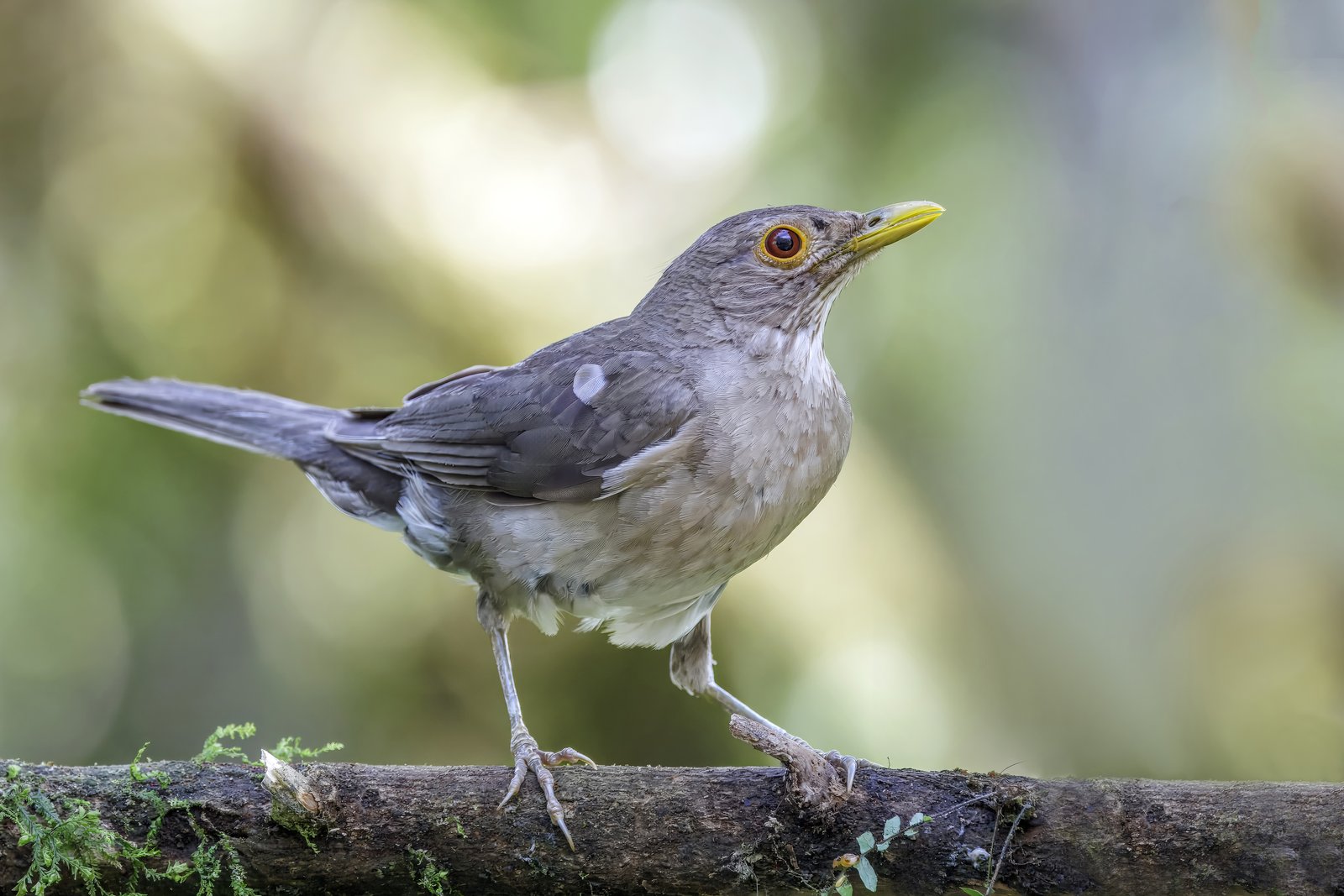
The Ecuadorian Thrush is an olive-brown thrush of forest and forest edges in western Ecuador and the far north-west of Peru. It was long treated as a subspecies of Spectacled Thrush, with which it shares the yellow eye-ring. It occurs only in the guide area.
Voice
The song is a series of clear, fluty phrases, mainly in the rainy season and in the early morning. The call is a plaintive, mewing note.
Recording: Paul Molina Abril — CC BY-NC-SA 4.0 · xeno-canto
Identification
23 cm. The upperparts are uniform olive-brown. The throat is white with dark streaks, the breast and flanks are pale grey-brown and the belly is white. Around the eye is a narrow yellow to yellow-orange ring. The bill is olive-yellow, often with dark spots or a dark tip; the scientific name maculirostris ('spotted bill') refers to this. The legs are grey-brown. The sexes are alike. Young birds are spotted.
Confusion species
Plumbeous-backed Thrush Turdus reevei has a blue-grey back and a pale iris, and lives mainly in dry forest. Pale-vented Thrush Turdus obsoletus is warmer brown, without a yellow eye-ring, and lives in more humid forest. Dagua Thrush Turdus daguae is darker, with a white band below the streaked throat, and lives in the wet forest of the north-west. Chiguanco Thrush Turdus chiguanco is uniform grey-brown, without a streaked throat, and lives higher in open country.
Habitat
Humid and semi-humid forest, taller dry forest, forest edges, secondary forest, coffee plantations and gardens with trees, from sea level to about 1800 m. It searches the ground and trees for invertebrates and fruit. The nest is a cup in a tree or shrub.
Where the bird is most at home, classified by the vegetation units of the Andes and the west coast.


Range and movements
In Ecuador in the west, in the lowlands and Andean foothills, from the north-west south to El Oro and Loja. In Peru only in the far north-west, in Tumbes. Absent from Colombia, Bolivia and the Galápagos. Does not occur outside the guide area.
- Resident
- dark = core range, pale = thinly spread
How and when to look
Search in the early morning along forest edges, coffee plantations and gardens in the foothills of western Ecuador. In the rainy season birds sing from perches in the trees.
Conservation status
Least Concern. The species tolerates secondary forest and wooded farmland, but most of the forest in western Ecuador has been cleared.
Scientific name
Turdus maculirostris | Berlepsch & Taczanowski, 1884
Berlepsch & Taczanowski described the species in 1884 and placed it straight away in the genus where it still stands. The genus Turdus was introduced in 1758 by Linnaeus. The genus name comes from Latin turdus, 'thrush'. The species name comes from Latin macula, 'spot', and rostrum, 'bill': 'spot-billed'. The specimen the first description was based on came from Chimbo, Ecuador.