All species › Passerines › Thrushes and allies › Varzea Thrush
Varzea Thrush | Turdus sanchezorum
Varzealijster | Zorzal de várzea | Sabiá-da-várzea
The Varzea Thrush was described only in 2011; it had long been mistaken for a colour morph of Hauxwell's Thrush. It is a brown thrush of flooded forest along the large rivers of the western and central Amazon basin. Genetically it is closest to the Unicolored Thrush, not to Hauxwell's Thrush.
Voice
The song is a slow, mellow series of short phrases of four to ten notes, each separated by pauses of two seconds or more. The call is a rising, querulous mewing; also rapid series of chuk notes.
Recording: GABRIEL LEITE — CC BY-NC-SA 4.0 · xeno-canto
Identification
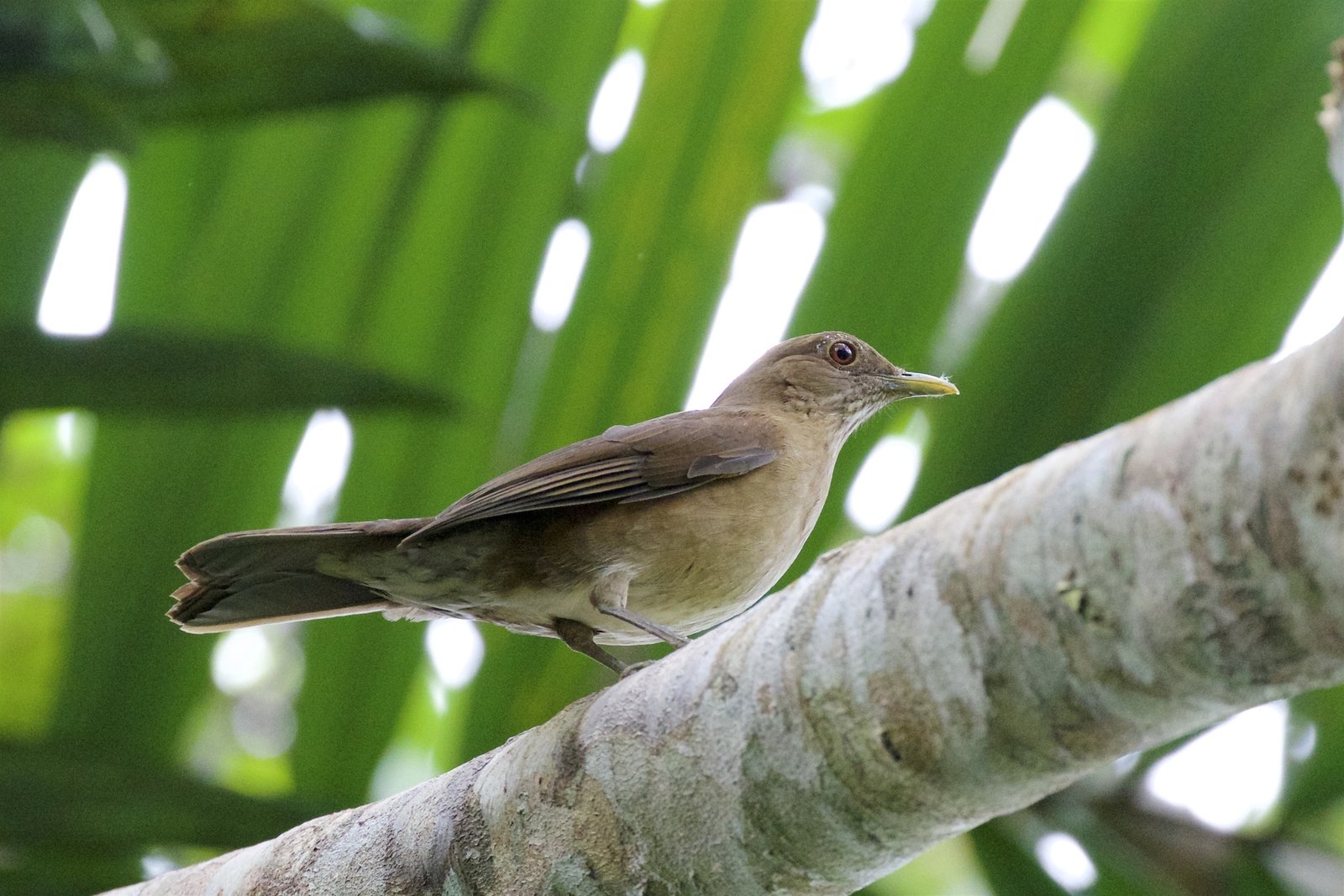
22–24 cm. The head and upperparts are sepia-brown, with a dull orange eye-ring. The throat is buffy white with dark streaks, the breast and flanks are caramel-brown and the belly is whitish. The underwing coverts are bright orange-rufous, visible in flight. The bill is dull yellow with a blackish base; the legs are olive-grey. The sexes are alike.
Confusion species
Hauxwell's Thrush Turdus hauxwelli is warmer rufous-brown all over, without an obvious eye-ring, and has a different song. Black-billed Thrush Turdus ignobilis is greyer, with a dark bill and a white patch below the streaked throat. Creamy-bellied Thrush Turdus amaurochalinus, a winter visitor from the south, is greyer brown, with a white belly and dark lores.
Habitat
Mainly várzea, the seasonally flooded forest along white-water rivers, also on river islands; along the Río Mayo in Peru also in forest and savanna on white sand. From about 80 m to 1100 m; in San Martín only above 800 m. It feeds on insects and fruit. Little is known about the nest.
Where the bird is most at home, classified by the vegetation units of the Andes and the west coast.


Range and movements
In Peru in the north-east and east along the large rivers of Loreto and Ucayali, and in San Martín. In Colombia known only from a few sites in the far south, in Amazonas. In Ecuador possible: two sound recordings from 2022 in the east are not yet confirmed. Absent from Bolivia and the Galápagos. Outside the guide area in western Brazil, along the Amazon and its tributaries.
- Resident
- dark = core range, pale = thinly spread
How and when to look
Search from a boat or along trails in várzea forest around Iquitos, and listen at dawn for the slow song with long pauses and for the mewing call.
Conservation status
Least Concern. The population is unknown and probably declining, but no direct threats are known. Locally fairly common.
Scientific name
Turdus sanchezorum | O'Neill, Lane & Naka, 2011
O'Neill, Lane & Naka described the species in 2011 and placed it straight away in the genus where it still stands. The genus Turdus was introduced in 1758 by Linnaeus. The genus name comes from Latin turdus, 'thrush'. The species name honours Manuel Sánchez S. and Marta Chávez de Sánchez, long-time field companions and friends of the authors in Peru. The specimen the first description was based on came from (per the original description).