All species › Passerines › Tyrant flycatchers and allies › Eye-ringed Flatbill
Eye-ringed Flatbill | Rhynchocyclus brevirostris
Brilbreedbektiran | Picoplano de anteojos | Bico-chato-de-óculos
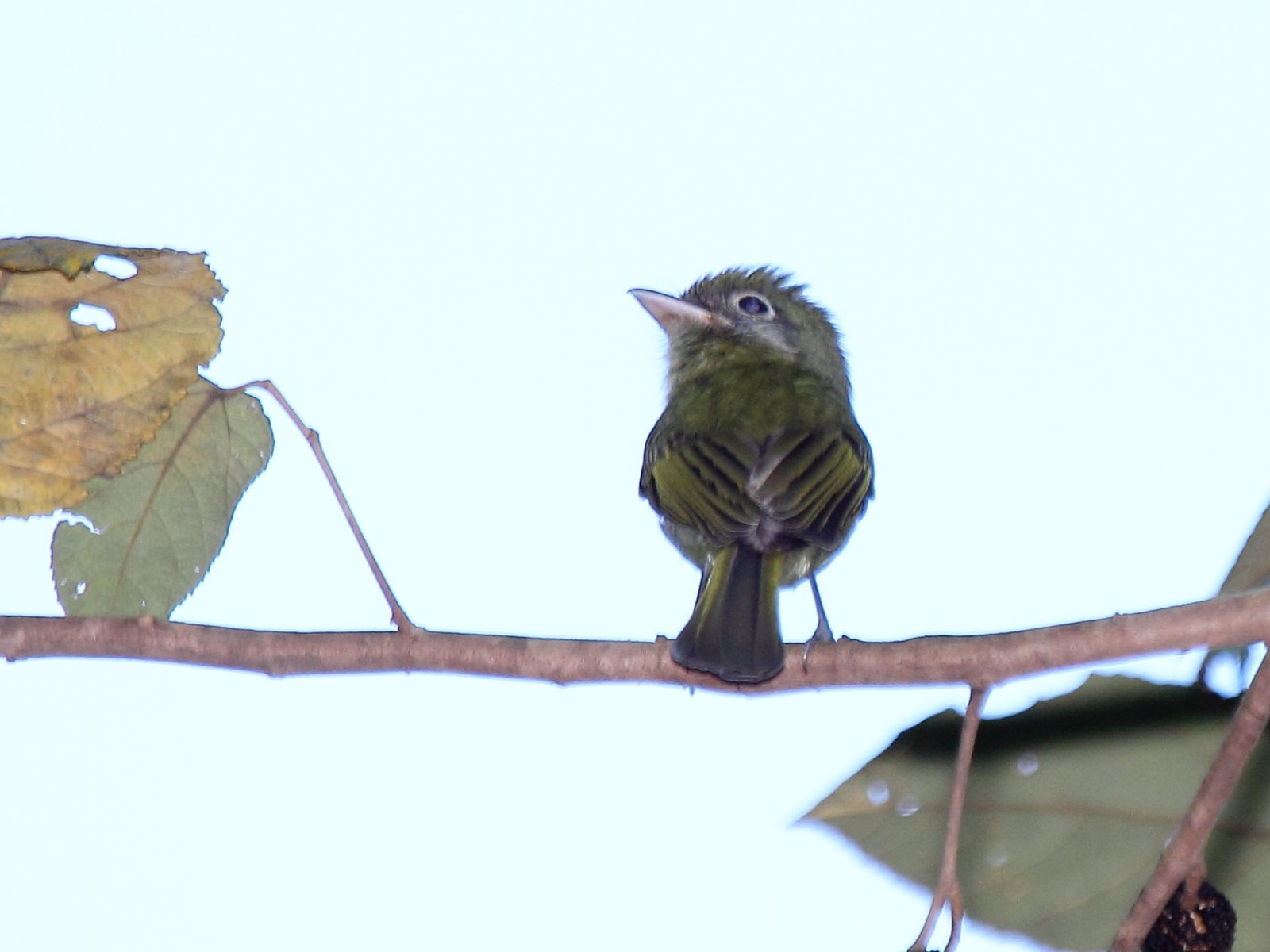
The Eye-ringed Flatbill is an olive-green tyrant with a very broad, flat bill and a conspicuous white eye-ring. It ranges from southern Mexico to Panama and reaches the guide area only in the far north-west of Colombia. It sits still on a branch in the middle storey for long periods and is therefore often noticed only by its call.
Voice
A sharp, rising tseep or sssip, often repeated singly.
Recording: Max Noack — CC BY-NC-SA 4.0 · xeno-canto
Identification
15–16 cm, with a large head and a very broad, flat bill: upper mandible black, lower mandible pale. Head and upperparts olive-green, with a distinct white eye-ring. Wings dark with olive-yellow edges to coverts and flight feathers. Throat and breast olive, faintly streaked, belly pale yellow. Sexes alike.
Confusion species
Pacific Flatbill Rhynchocyclus pacificus is very similar and was formerly treated as the same species; it lives further south on the Pacific side of Colombia and Ecuador and differs mainly in range and voice. Western Olivaceous Flatbill Rhynchocyclus aequinoctialis has a less conspicuous eye-ring and more distinct yellow wing edgings. Yellow-margined Flatbill Tolmomyias assimilis is smaller, with a greyer head and a yellow patch at the base of the primaries.
Habitat
The middle storey and understorey of humid forest, in Central America from the lowlands into the mountains; in the guide area in hill forest on the border with Panama. It catches large insects in a short sally from the perch to the underside of leaves. The nest is a hanging, pear-shaped bag with an entrance at the bottom.
Where the bird is most at home, classified by the vegetation units of the Andes and the west coast.


Range and movements
Colombia: only in the far north-west, in the border area with Panama. Ecuador, Peru and Bolivia: absent; records from Ecuador probably refer to Pacific Flatbill. Absent from the Galápagos. Outside the guide area from southern Mexico to Panama.
- Resident
- dark = core range, pale = thinly spread
How and when to look
In the guide area to be expected only in north-western Colombia near the border with Panama; in humid forest watch for a motionless olive-green bird with a broad bill and a white eye-ring.
Conservation status
Least Concern. Widespread in Central America; in the guide area only at the edge of its range.
Scientific name
Rhynchocyclus brevirostris | (Cabanis, 1847)
Cabanis described the species in 1847 as C[yclorhynchus] brevirostris; because it was later moved to another genus, the author and year stand in brackets. The genus Rhynchocyclus was introduced in 1860 by Cabanis & Heine. The genus name is an anagram of the earlier name Cyclorhynchus, from Greek kuklos, 'circle, shield', and rhunkhos, 'bill'. The species name comes from Latin brevis, 'short', and rostrum, 'bill'. The specimen the first description was based on came from Xalapa, Veracruz, Mexico.