All species › Grebes › Grebes › Great Grebe
Great Grebe | Podiceps major
Reuzenfuut | Zambullidor grande | Mergulhão-grande
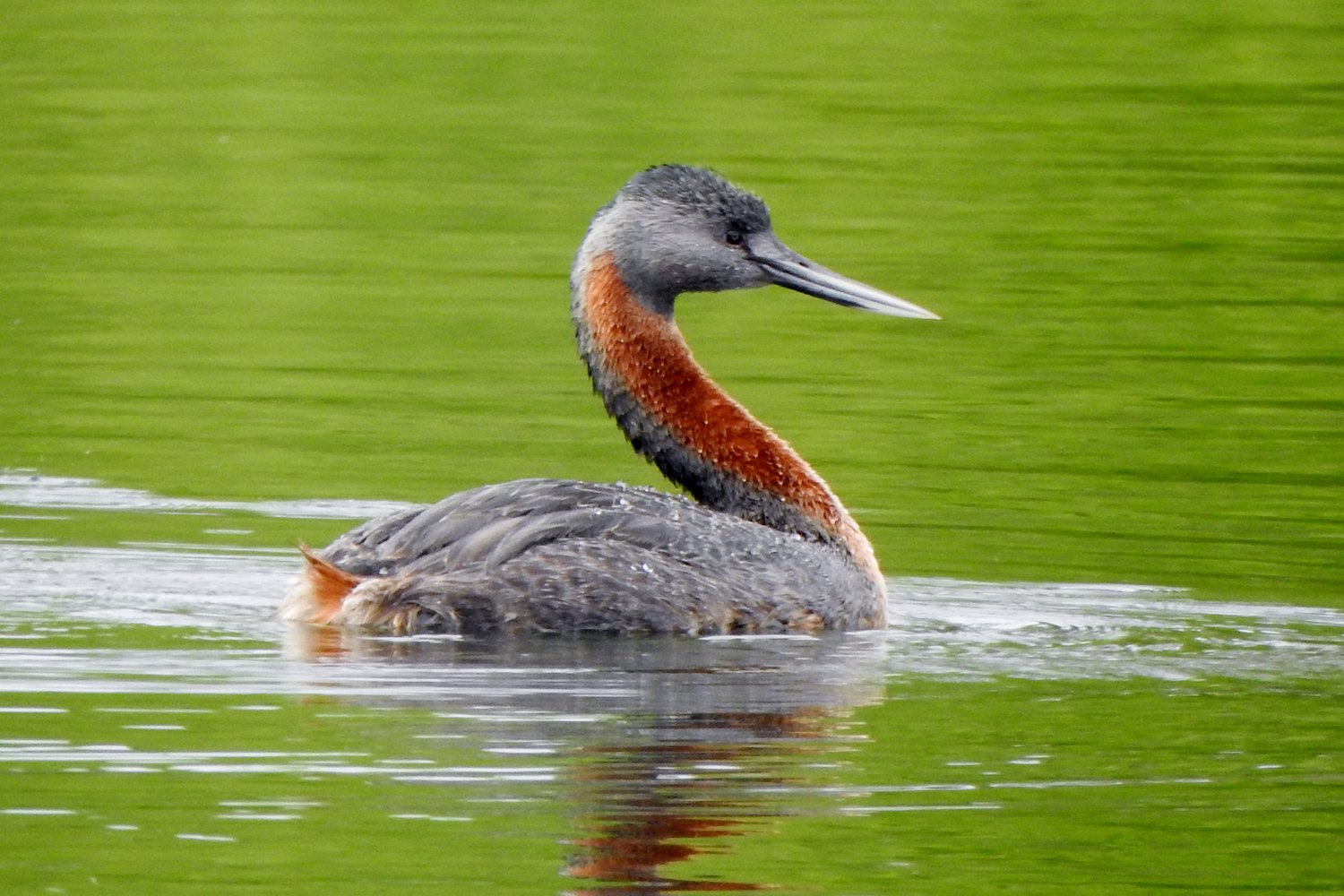
The Great Grebe is the largest grebe in the world, with a long, slender neck and a long, slightly curved bill. In the guide area it lives along the Pacific coast of Peru, in coastal lagoons and at sea. It often fishes beyond the surf.
Voice
A loud, plaintive, drawn-out call that carries over the water, especially in the breeding season; also short, guttural sounds.
Recording: Gabriel Morales — CC BY-NC-SA 4.0 · xeno-canto
Identification
67–78 cm, with a long neck, a small head with a short, dark crest and a long, dagger-shaped, dark bill. In breeding plumage the head and hindneck are dark grey, the cheeks grey, the foreneck and sides of the neck rufous-chestnut and the back blackish; the underparts are white. Outside the breeding season the neck is paler and less rufous. In flight white patches show on the inner wing. The sexes are alike; young birds have a striped head.
Confusion species
Pied-billed Grebe Podilymbus podiceps is much smaller, with a short, thick bill. Cormorants such as Neotropic Cormorant Nannopterum brasilianum are dark, have a hooked bill and swim with the bill slightly raised. Titicaca Grebe Rollandia microptera lives only on the lakes of the altiplano.
Habitat
Coastal lagoons, estuaries, brackish and fresh lakes near the coast and shallow inshore waters, mainly in the lowlands. It eats mainly fish, as well as crustaceans and other invertebrates caught by diving. The nest is a floating platform of aquatic plants in calm, vegetated water.
Where the bird is most at home, classified by the vegetation units of the Andes and the west coast.


Range and movements
In Peru along the coast, from Piura south to the Chilean border, in coastal lagoons and at sea. North of Peru at most exceptional; absent from Colombia, Bolivia and the Galápagos. Outside the guide area in Chile, Argentina, Uruguay and southern Paraguay; rare in southern Brazil.
- Resident
- dark = core range, pale = thinly spread
How and when to look
On the coastal lagoons north and south of Lima, such as Pantanos de Villa and Medio Mundo, and at sea off Paracas. The birds often swim singly or in pairs just beyond the surf.
Conservation status
Least Concern (LC). The species is widespread in southern South America. Along the Peruvian coast the small breeding sites are vulnerable to drainage and disturbance, and birds can drown in fishing nets.
Scientific name
Podiceps major | (Boddaert, 1783)
Boddaert described the species in 1783 as Colymbus major; because it was later moved to another genus, the author and year stand in brackets. The genus Podiceps was introduced in 1787 by Latham. The genus name comes from Latin podex (genitive podicis), 'rump, vent', and pes, 'foot', for the legs set far back on the body. The species name comes from Latin major, 'greater', for its size: it is the largest grebe in the Americas. The specimen the first description was based on came from (per the description).