All species › Grebes › Grebes › Pied-billed Grebe
Pied-billed Grebe | Podilymbus podiceps
Dikbekfuut | Zampullín picogrueso | Mergulhão-caçador
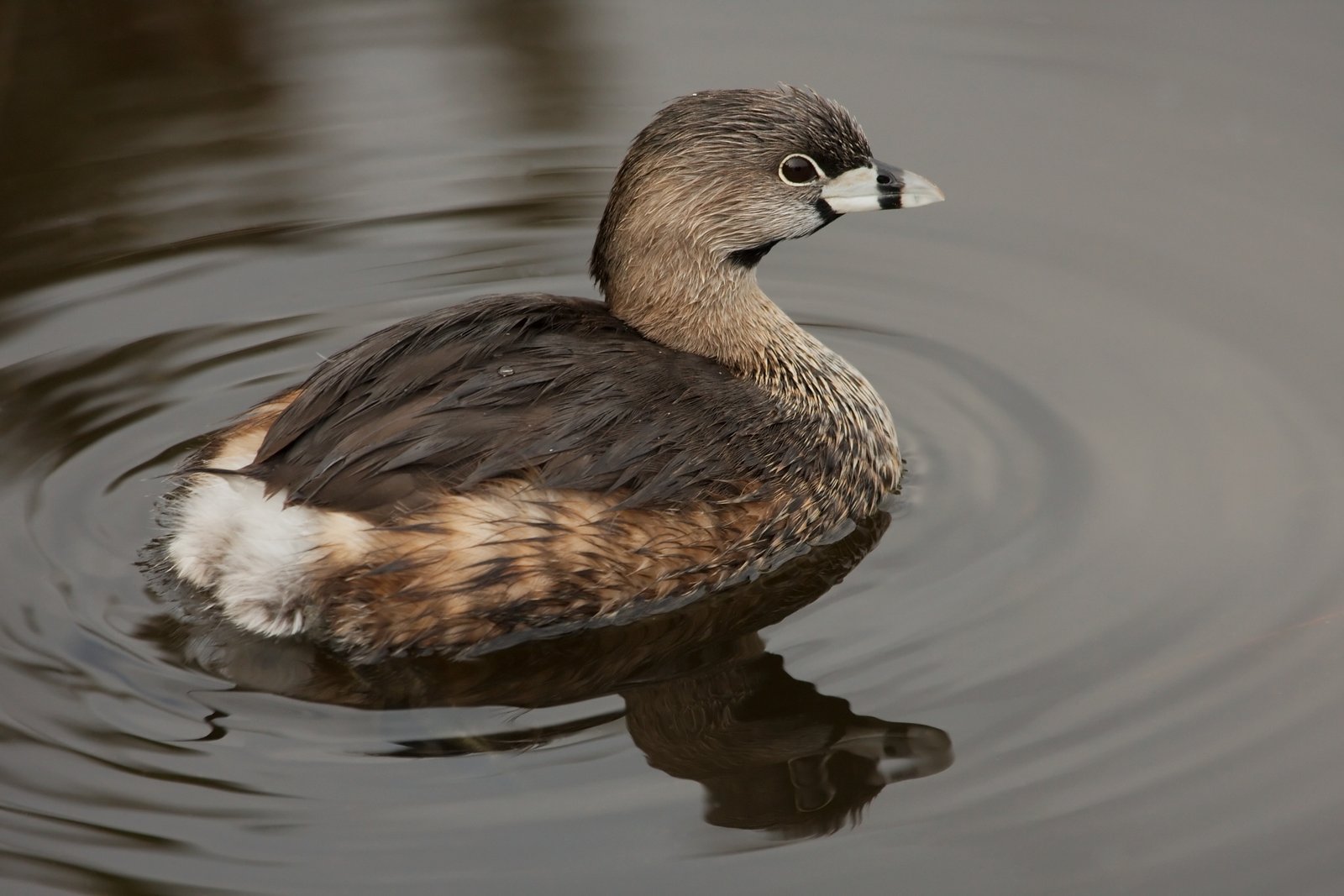
The Pied-billed Grebe is a medium-sized, brown grebe with a short, thick, chicken-like bill. In breeding plumage the pale bill has a black ring, which gives the species its English name. South American birds belong to a separate subspecies that lives on lakes from the coast to high in the Andes.
Voice
A loud, hollow series that starts with rapid notes and turns into drawn-out, cuckoo-like kaow-kaow-kaow calls. Also short, cackling sounds.
Recording: Stanislas Wroza — CC BY-NC-SA 4.0 · xeno-canto
Identification
31–38 cm, with a large head, a short neck and a thick, short bill. In breeding plumage the plumage is grey-brown, with a black throat, a white eye-ring around the dark eye and a whitish bill with a black band. Outside the breeding season the throat is white, the band is absent and the bill is yellowish. The rear end is white and fluffy. The sexes are alike; young birds have a striped head.
Confusion species
Least Grebe Tachybaptus dominicus is smaller and greyer, with a thin, dark bill and a yellow eye. White-tufted Grebe Rollandia rolland has a pointed, dark bill, a red eye and, in breeding plumage, a white ear patch and rufous underparts. Silvery Grebe Podiceps occipitalis is grey-white, with a thin bill.
Habitat
Lakes, lagoons, ponds, marshes and coastal lagoons with shoreline vegetation, from sea level to high in the Andes, locally above 3500 m. It eats mainly crustaceans, aquatic insects and small fish, caught with its strong bill. The nest is a floating heap of plant material among reeds or other shoreline plants.
Where the bird is most at home, classified by the vegetation units of the Andes and the west coast.


Range and movements
In Colombia locally in the lowlands and on Andean lakes. In Ecuador on highland lakes and in coastal wetlands in the west. In Peru in coastal lagoons and on Andean lakes, rare in the east. In Bolivia locally in the lowlands and in Andean valleys. Absent from the Galápagos. Outside the guide area from Canada to southern South America.
- Resident
- dark = core range, pale = thinly spread
How and when to look
On coastal lagoons and ponds with reedbeds, such as the wetlands near Lima, and on highland lakes in Ecuador. When disturbed the bird often sinks slowly until only the head shows above the water.
Conservation status
Least Concern (LC). The species is widespread. Locally wetlands are lost to drainage, urbanisation and pollution.
Scientific name
Podilymbus podiceps | (Linnaeus, 1758)
Linnaeus described the species in 1758 as Colymbus Podiceps; because it was later moved to another genus, the author and year stand in brackets. The genus Podilymbus was introduced in 1831 by Lesson. The genus name is a blend of Podiceps and Colymbus, from Greek kolumbos, 'diving bird'. The species name is the genus name Podiceps, from Latin podex, 'rump', and pes, 'foot', for the legs set far back. The specimen the first description was based on came from South Carolina, United States.