All species › Grebes › Grebes › Least Grebe
Least Grebe | Tachybaptus dominicus
Amerikaanse dodaars | Zambullidor menor | Mergulhão-pequeno
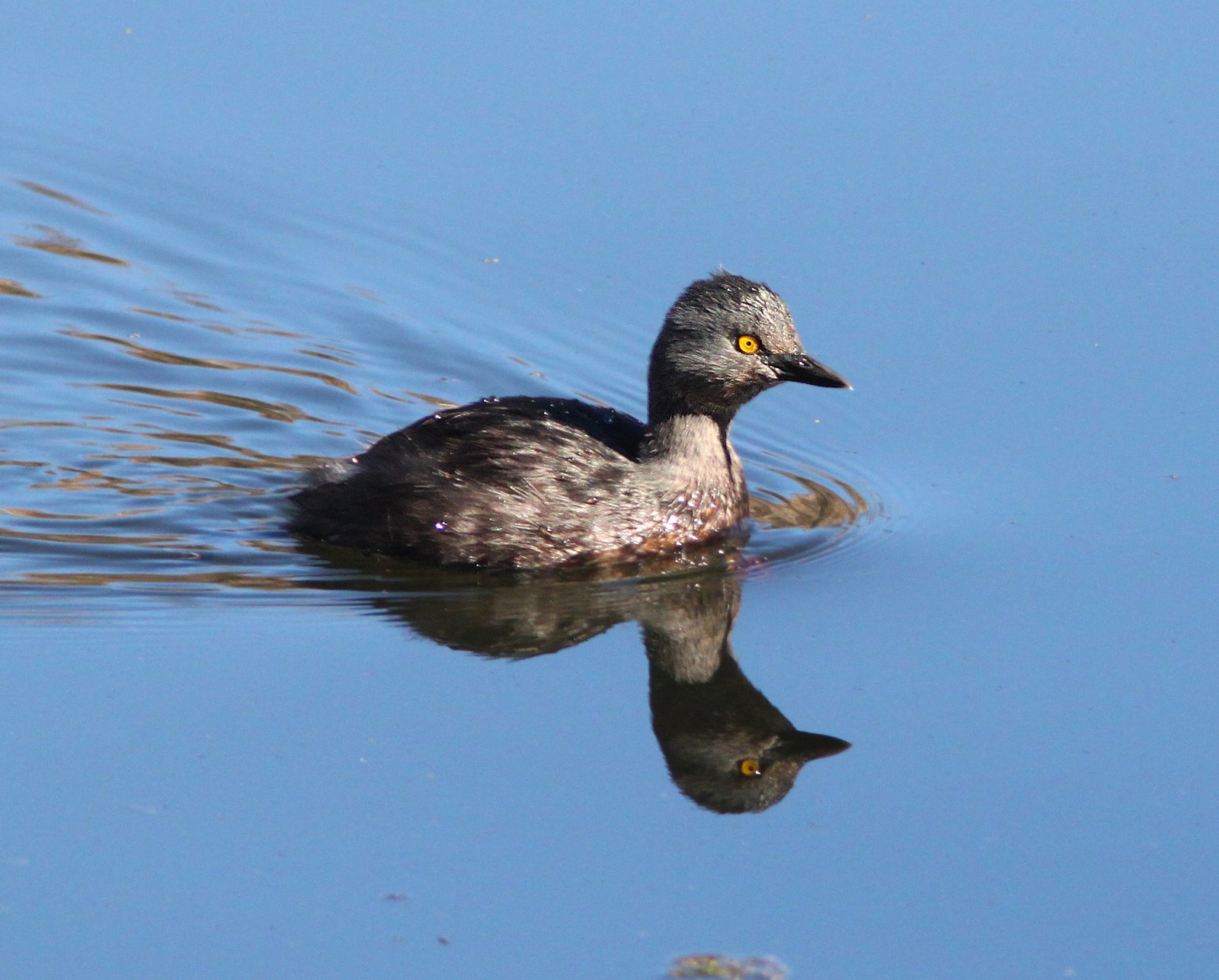
The Least Grebe is the smallest grebe in the guide area. It is a compact, grey bird with a bright yellow eye that lives on small, vegetated pools and quickly finds new waters. It can breed all year round.
Voice
A rapid, rising or falling trill and a short, nasal peep or beeng; pairs often trill together.
Recording: Manuel Grosselet — CC BY-NC-SA 4.0 · xeno-canto
Identification
22–27 cm, rounded, with a short, thin, pointed dark bill and a bright yellow eye. In breeding plumage the head and neck are dark grey with a black throat and a blackish crown; the back is dark brown, the underparts grey with a whitish rear end. Outside the breeding season the throat is white and the plumage paler grey-brown. In flight a white wing patch is visible. The sexes are alike. Young birds have a striped head.
Confusion species
Pied-billed Grebe Podilymbus podiceps is larger and browner, with a thick, pale bill and a dark eye. White-tufted Grebe Rollandia rolland lives higher in the Andes and has a red eye and rufous underparts. Young coots and gallinules have a longer neck and also walk on the shore.
Habitat
Small lakes, ponds, marshes, ditches, rice fields and temporary pools with dense emergent or floating vegetation, mainly in the lowlands and in Andean valleys up to about 2500 m, locally higher. It eats aquatic insects, crustaceans, tadpoles and small fish. The nest is a floating heap of rotting plant material among aquatic plants.
Where the bird is most at home, classified by the vegetation units of the Andes and the west coast.


Range and movements
In Colombia widespread in the lowlands and Andean valleys. In Ecuador mainly in the west and locally in the Amazonian lowlands. In Peru in the north-west and in Amazonia, locally also in other lowland areas. In Bolivia in the lowlands of the north and east. Absent from the Galápagos. Outside the guide area from the southern United States and the Caribbean to Argentina.
- Resident
- dark = core range, pale = thinly spread
How and when to look
On small, vegetated ponds, rice fields and marshy pools, for example in the Cauca Valley in Colombia and in the lowlands of western Ecuador. The bird dives when disturbed and often reappears among the plants.
Conservation status
Least Concern (LC). The species is widespread and also uses man-made waters such as rice fields and ponds.
Scientific name
Tachybaptus dominicus | (Linnaeus, 1766)
Linnaeus described the species in 1766 as Colymbus dominicus; because it was later moved to another genus, the author and year stand in brackets. The genus Tachybaptus was introduced in 1853 by Reichenbach. The genus name comes from Greek takhus, 'fast', and baptō, 'to dip', for the quick dive. The species name refers to Santo Domingo (Hispaniola). The specimen the first description was based on came from Santo Domingo, Dominican Republic.