All species › Grebes › Grebes › White-tufted Grebe
White-tufted Grebe | Rollandia rolland
Witwangfuut | Zambullidor pimpollo | Mergulhão-de-orelha-branca
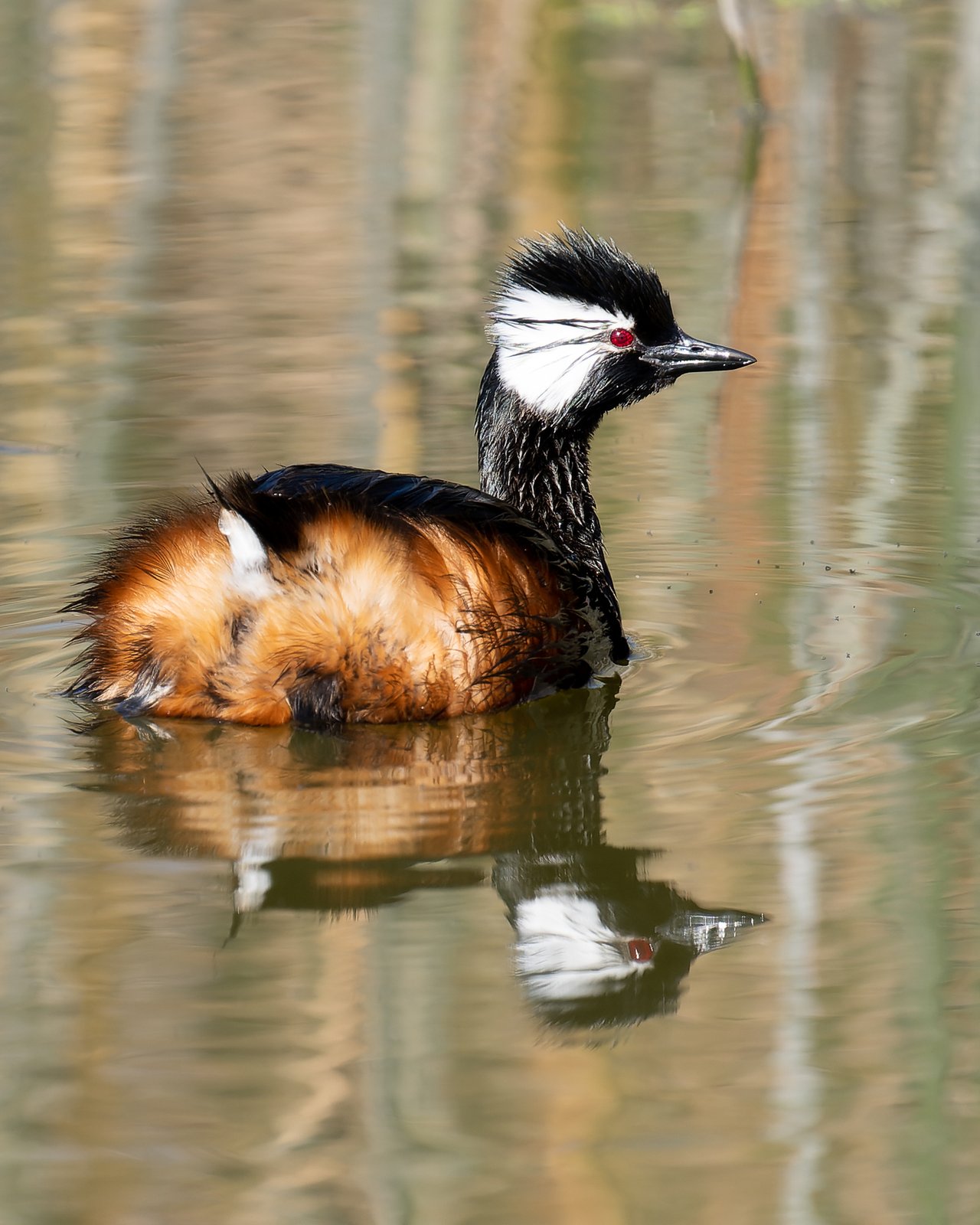
The White-tufted Grebe is a small, dark grebe of the lakes and bogs of the high Andes. In breeding plumage the white, black-streaked patch on the cheek stands out against the black head. A separate, slightly larger subspecies lives on Lake Junín.
Voice
A short, high, rattling trill and soft, squeaky contact calls; during courtship a series of rapid notes.
Recording: Bernabe Lopez-Lanus — CC BY-NC-SA 3.0 · xeno-canto
Identification
25–30 cm, with a short, pointed, dark bill and a red eye. In breeding plumage the head and neck are black, with a triangular white ear patch streaked black; the breast, flanks and belly are rufous-chestnut, the back blackish. Outside the breeding season the upperparts are grey-brown, the throat and cheeks paler and the underparts pale rufous to dull white. The sexes are alike. Young birds have a striped head.
Confusion species
Silvery Grebe Podiceps occipitalis is grey-white, with a grey head and a yellowish plume behind the eye, and lacks rufous underparts. Junin Grebe Podiceps taczanowskii (Junín only) is grey-white, with a long, pointed bill. Pied-billed Grebe Podilymbus podiceps is brown, with a thick, pale bill. Titicaca Grebe Rollandia microptera is much larger, with a long yellow bill.
Habitat
Lakes, lagoons, ponds and bogs (bofedales) with shoreline vegetation in the puna and on the altiplano, mostly between 3000 and 4500 m; locally lower. It feeds on small fish, aquatic insects and other invertebrates caught by diving. The nest is a floating platform of aquatic plants anchored in the shoreline vegetation.
Where the bird is most at home, classified by the vegetation units of the Andes and the west coast.


Range and movements
In Peru in the Andes of the centre and south of the country, from Junín and Áncash south to Puno; the subspecies morrisoni lives only on Lake Junín. In Bolivia on the altiplano and in the western Andes. Absent from Colombia, Ecuador and the Galápagos. Outside the guide area in Chile, Argentina, Uruguay, southern Brazil and the Falkland Islands.
- Resident
- dark = core range, pale = thinly spread
How and when to look
On puna lakes such as Lake Titicaca, Lake Junín and smaller lagoons around Cusco and Arequipa. The birds often stay close to shoreline vegetation and dive when disturbed.
Conservation status
Least Concern (LC). The species is widespread. The Junín subspecies suffers from mining pollution and fluctuating water levels in the lake.
Scientific name
Rollandia rolland | (Gaimard, 1823)
Gaimard described the species in 1823 as Podiceps rolland; because it was later moved to another genus, the author and year stand in brackets. The genus Rollandia was introduced in 1856 by Bonaparte. The genus name derives from the species name of the type species, Podiceps rolland, and honours Thomas Pierre Rolland (1776–1847), master gunner in the French Navy on the corvette L'Uranie. The species name honours Thomas Pierre Rolland (1776–1847), master gunner in the French Navy on the corvette L'Uranie, which circled the globe in 1817–1820, and on La Coquille (1822–1825). The specimen the first description was based on came from Falkland Islands.