All species › Grebes › Grebes › Titicaca Grebe
Titicaca Grebe | Rollandia microptera
Titicacafuut | Zambullidor del Titicaca | Mergulhão-do-titicaca
The Titicaca Grebe is a large, flightless grebe found only on Lake Titicaca and a few nearby lakes, at about 3800 m. Its wings are much reduced; it travels by swimming and diving. The species feeds mainly on small fish and is therefore closely tied to open water.
Voice
A series of loud, whistled notes that speeds up, often given by pairs in duet. Also short, squeaky contact calls.
Recording: GABRIEL LEITE — CC BY-NC-SA 4.0 · xeno-canto
Identification
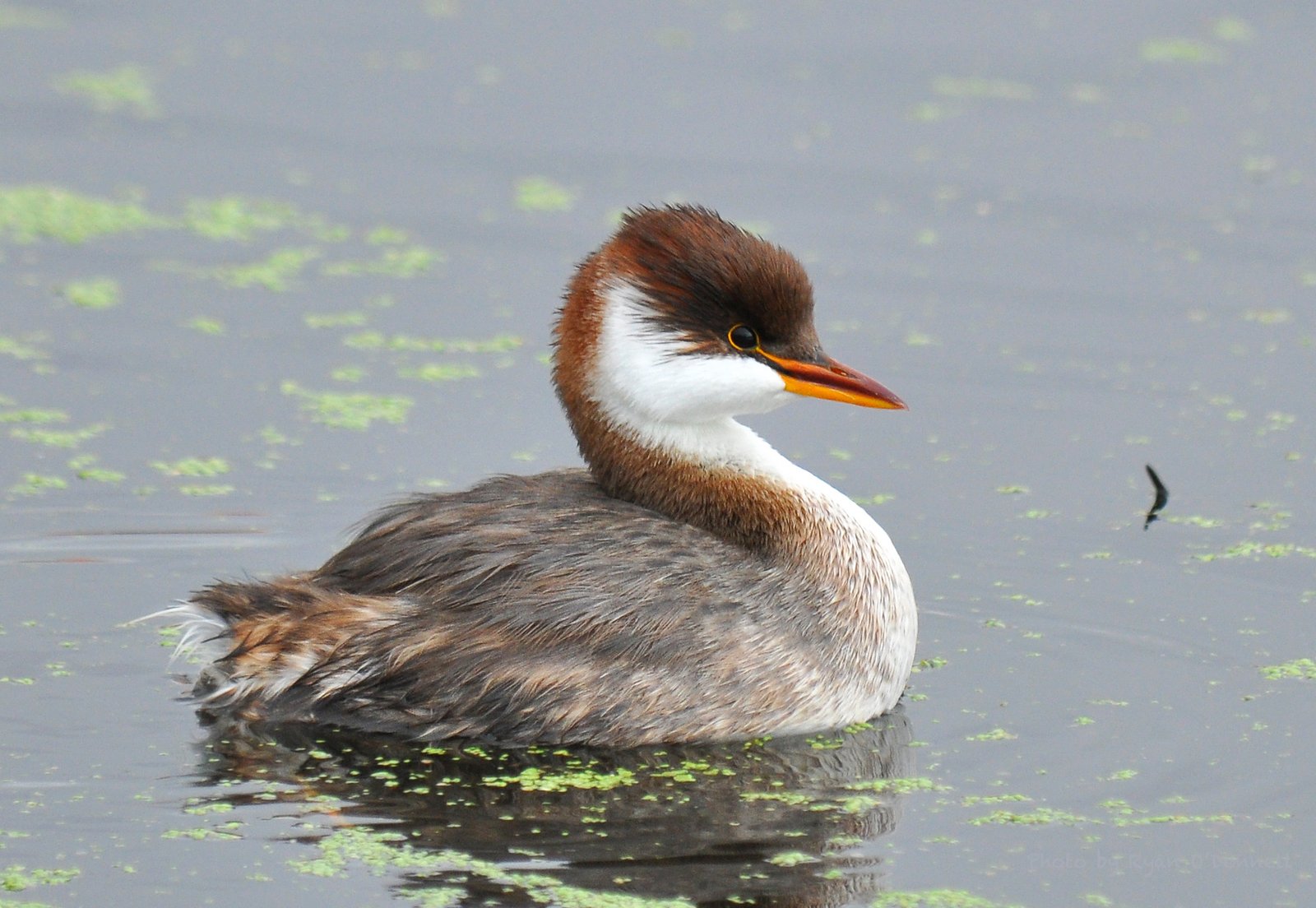
40–45 cm, with a long, slender bill and an elongated body that sits low in the water. In breeding plumage the crown, short crest and hindneck are blackish, the throat and cheeks white and the foreneck and breast rufous-chestnut; the flanks are mottled dark and the belly is white. The bill is yellow with a dark ridge, the eye red. Outside the breeding season the plumage is duller and browner, with less rufous on the neck. The sexes are alike. Young birds have a striped head.
Confusion species
White-tufted Grebe Rollandia rolland is much smaller, with a short bill, a black head with a white, black-streaked ear patch and rufous underparts; it can fly. Silvery Grebe Podiceps occipitalis is smaller and grey-white, with a short, dark bill and a grey head. Great Grebe Podiceps major does not occur on the high-plateau lakes.
Habitat
Open water of large and medium-sized lakes on the altiplano, at about 3800 m, with beds of totora reeds and aquatic plants along the shores. It feeds mainly on small fish, such as species of the genus Orestias, caught by diving, as well as invertebrates. The nest is a floating heap of plant material among totora or other shoreline plants.
Where the bird is most at home, classified by the vegetation units of the Andes and the west coast.


Range and movements
In Peru on Lake Titicaca and the nearby lakes Umayo and Arapa (Puno). In Bolivia on the Bolivian part of Lake Titicaca and on Lake Uru Uru near Oruro; formerly also on Lake Poopó, which has largely dried out. Absent from Colombia, Ecuador and the Galápagos. Does not occur outside the guide area.
- Resident
- dark = core range, pale = thinly spread
How and when to look
On Lake Titicaca near Puno, around the floating islands of the Uros, and on Lake Umayo near Sillustani. In Bolivia along the shores near Huatajata and Copacabana. Look for the birds on open water just beyond the reedbeds.
Conservation status
Endangered (EN). The population has declined sharply over a few decades. The main cause is bycatch in fishing gillnets; pollution of the lake water, totora harvesting and fluctuating water levels also play a part.
Scientific name
Rollandia microptera | (Gould, 1868)
Gould described the species in 1868 as Podiceps micropterus; because it was later moved to another genus, the author and year stand in brackets. The genus Rollandia was introduced in 1856 by Bonaparte. The genus name derives from the species name of the type species, Podiceps rolland, and honours Thomas Pierre Rolland (1776–1847), master gunner in the French Navy on the corvette L'Uranie. The species name comes from Greek mikros, 'small', and pteron, 'wing', for the short wings: the species is flightless. The specimen the first description was based on came from Lake Titicaca, Peru/Bolivia.