All species › Flamingos › Flamingos › American Flamingo
American Flamingo | Phoenicopterus ruber
Rode flamingo | Flamenco del Caribe | Flamingo
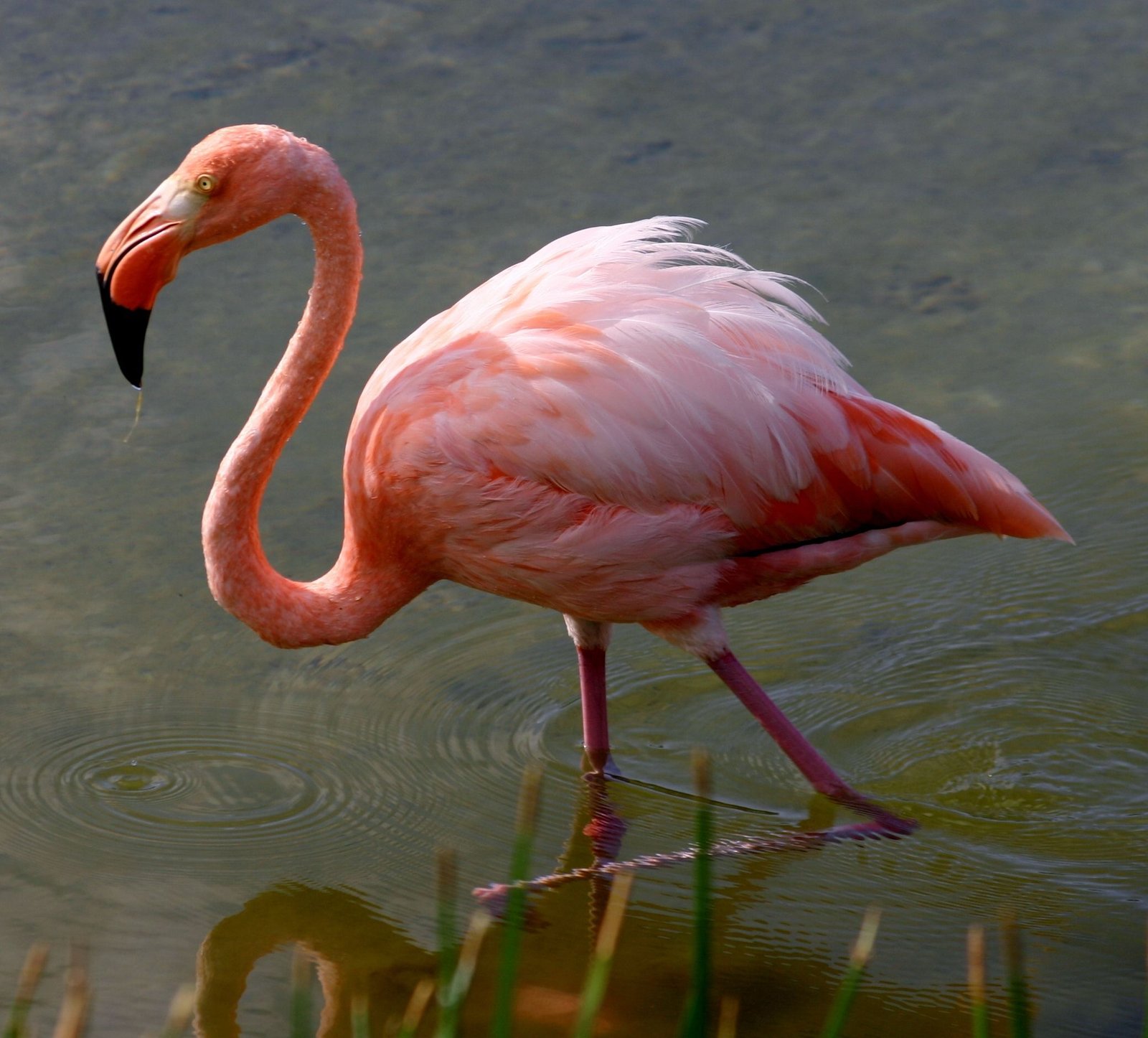
The American Flamingo is the flamingo of the Caribbean and the Galápagos. In the guide area it occurs on the Caribbean coast of Colombia and with a small, isolated population on the Galápagos. It is the flamingo with the deepest pink to orange-red plumage.
Voice
Honking, nasal calls recalling geese; flocks give a continuous gabbling.
Recording: FREDERIC Lionel — CC BY-NC-SA 4.0 · xeno-canto
Identification
120–145 cm, large and slender, with a long neck and long legs. The plumage is deep pink to salmon orange-red, brightest on the neck and wing coverts. The bill is pink with a whitish band and a black tip covering the outer third. The legs are pink, with a small hind toe. In flight the red wing coverts and black flight feathers stand out. The sexes are alike; males are larger on average. Juveniles are greyish brown and turn pink over several years.
Confusion species
Chilean Flamingo Phoenicopterus chilensis, a rare visitor to the coast of Ecuador and Peru, is paler pink, with grey legs with pink 'knees' and a bill more than half black. Roseate Spoonbill Platalea ajaja is also pink, but is smaller, with shorter neck and legs and a flat, spoon-shaped bill.
Habitat
Shallow salt and brackish lagoons, tidal flats, salt pans and estuaries on the coast; on the Galápagos saline lagoons behind the beach. It filters small crustaceans, molluscs, insect larvae and algae from water and mud with its head upside down. It breeds in colonies, with a nest of heaped-up mud.
Where the bird is most at home, classified by the vegetation units of the Andes and the west coast.


Range and movements
In Colombia on the Caribbean coast, mainly in La Guajira, where the Santuario de Fauna y Flora Los Flamencos lies, and locally elsewhere along the coast. On the Galápagos a small population on lagoons of Isabela, Floreana, Santa Cruz, Santiago and Rábida, among others. On mainland Ecuador a very rare vagrant. Absent from Peru and Bolivia. Outside the guide area in the Caribbean, Yucatán, Florida, Venezuela and northern Brazil.
- Resident
- dark = core range, pale = thinly spread
How and when to look
On the Galápagos at the lagoons of Puerto Villamil on Isabela and Punta Cormorant on Floreana. In Colombia at the Santuario Los Flamencos near Camarones in La Guajira.
Conservation status
Least Concern. The Galápagos population numbers only a few hundred birds and is sensitive to disturbance and El Niño. Elsewhere disturbance of colonies, loss of lagoons and formerly hunting are the main threats.
Scientific name
Phoenicopterus ruber | Linnaeus, 1758
Linnaeus described the species in 1758 and placed it straight away in the genus where it still stands. He introduced the genus Phoenicopterus in that same work. The genus name comes from Greek phoinikopteros, 'crimson-feathered'. The species name comes from Latin ruber, 'red'. The specimen the first description was based on came from West Indies.