All species › Flamingos › Flamingos › Chilean Flamingo
Chilean Flamingo | Phoenicopterus chilensis
Chileense flamingo | Flamenco chileno | Flamingo-chileno
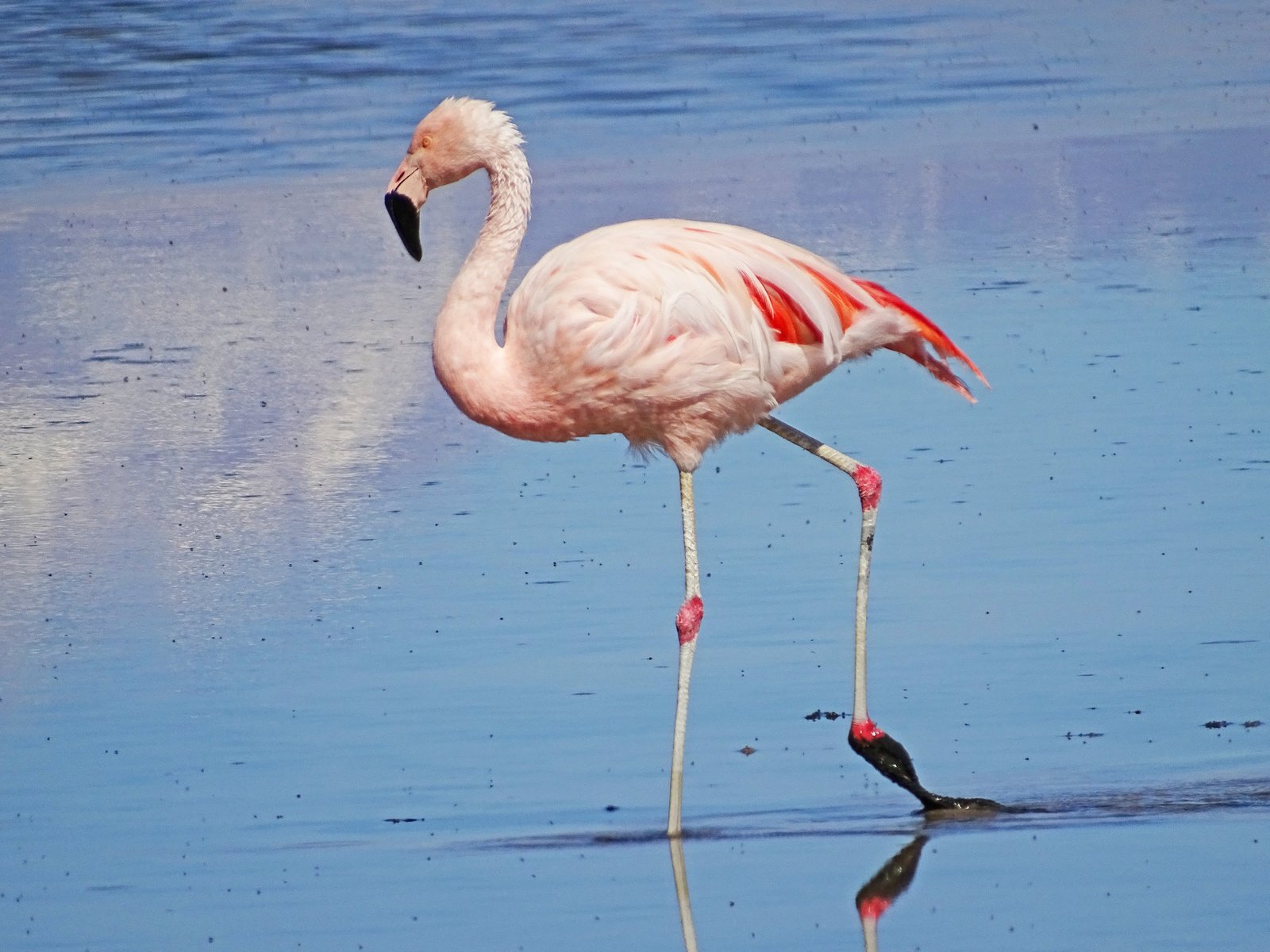
The Chilean Flamingo is the most widespread and numerous flamingo of the guide area. It occurs from the salt lakes of the altiplano to the coastal lagoons of Peru, and is less particular in its habitat than Andean Flamingo and James's Flamingo. It is a pale flamingo best recognised by its grey legs with pink 'knees'.
Voice
A honking, goose-like calling; flocks give a sustained gabbling.
Recording: John V. Moore — CC BY-NC-SA 4.0 · xeno-canto
Identification
110–130 cm, a slender flamingo with a long neck and legs. The plumage is pale pink, with deeper pink to red wing coverts; at rest little of the black flight feathers is visible. The bill is pale whitish pink, with more than the outer half black. The legs are grey, with conspicuous pink to red 'knees' (ankle joints) and feet. In flight the red wing coverts and black flight feathers stand out. The sexes are alike; juveniles are grey with dark streaks.
Confusion species
Andean Flamingo Phoenicoparrus andinus has yellow legs, a wine-pink neck and an obvious black triangle at the rear of the body. James's Flamingo Phoenicoparrus jamesi is smaller, with a bright yellow bill with a small black tip and entirely red legs. American Flamingo Phoenicopterus ruber, which lives on the Galápagos, is much brighter orange-pink and has pink legs.
Habitat
Salt and brackish lakes, salt flats and lagoons of the altiplano and puna, freshwater Andean lakes, and on the coast estuaries, coastal lagoons and salt pans. From sea level to above 4000 m. It feeds head-down in shallow water, filtering small invertebrates and seeds from the mud. It breeds in colonies on mudbanks and islets, with a nest of heaped-up mud.
Where the bird is most at home, classified by the vegetation units of the Andes and the west coast.


Range and movements
In Peru on highland lakes such as Lake Junín and Lake Titicaca, and on the altiplano in the south; outside the breeding season also along the coast, including Paracas Bay and the Mejía lagoons. In Bolivia on the lakes of the altiplano. In Ecuador a rare visitor to the coast. Absent from Colombia and the Galápagos. Outside the guide area in Chile, Argentina, Paraguay, Uruguay and southern Brazil, south to Tierra del Fuego.
- Resident
- dark = core range, pale = thinly spread
How and when to look
The Mejía lagoons near Arequipa and Paracas Bay are the best-known sites on the coast of Peru. On the altiplano of Bolivia and southern Peru all three flamingos can often be compared on the same lake.
Conservation status
Near Threatened. Threats include egg collecting, hunting, disturbance of colonies and the degradation of lakes through mining and water extraction.
Scientific name
Phoenicopterus chilensis | Molina, 1782
Molina described the species in 1782 and placed it straight away in the genus where it still stands. The genus Phoenicopterus was introduced in 1758 by Linnaeus. The genus name comes from Greek phoinikopteros, 'crimson-feathered'. The species name means 'of Chile'; it refers to that country, not necessarily the type locality. The specimen the first description was based on came from Chile.