All species › Flamingos › Flamingos › James's Flamingo
James's Flamingo | Phoenicoparrus jamesi
James' flamingo | Flamenco de James | Flamingo-de-james
James's Flamingo is the smallest of the three flamingos of the high Andes. It lives on the salt lakes of the altiplano, often together with Andean Flamingo and Chilean Flamingo. The species was long considered possibly extinct, until breeding colonies were found in south-western Bolivia in 1957.
Voice
Nasal, honking calls, somewhat higher than those of Andean Flamingo; flocks give a continuous gabbling, especially at the colony.
Recording: Sjoerd Mayer — CC BY-NC-SA 3.0 · xeno-canto
Identification
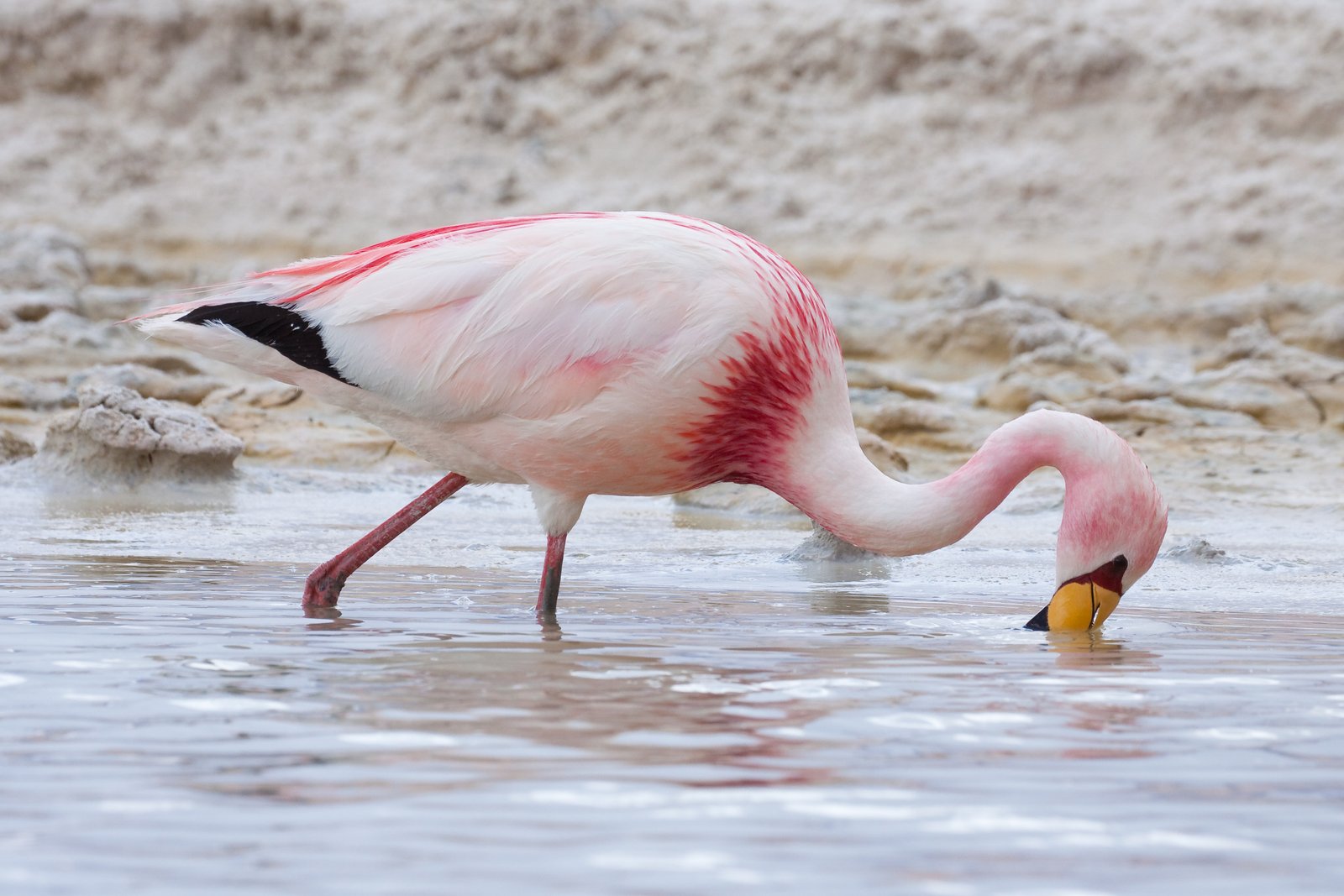
90–92 cm, smaller and shorter in neck and legs than the other flamingos of the altiplano. The plumage is pale pink, with crimson streaks on the back and breast. The bill is relatively short and bright yellow, with a small black tip. The legs are dark red, and the foot lacks a hind toe. In flight the wing coverts are pink and the flight feathers black; little black shows at rest. The sexes are alike; juveniles are grey with dark streaks.
Confusion species
Andean Flamingo Phoenicoparrus andinus is larger, with yellow legs, a bill with more black and a black triangle at the rear of the body at rest. Chilean Flamingo Phoenicopterus chilensis is larger and longer-necked, with grey legs with pink 'knees' and a pale bill whose outer half is black.
Habitat
Salt and brackish lakes on the altiplano, at roughly 3500 to 4800 m, often in shallower water than Andean Flamingo. It filters diatoms and other microscopic food from the water with its head upside down. It breeds in dense colonies on mudbanks and islets in salt lakes, with a nest of heaped-up mud.
Where the bird is most at home, classified by the vegetation units of the Andes and the west coast.


Range and movements
In Peru on the lakes of the southern altiplano, in Arequipa, Moquegua, Tacna and Puno. In Bolivia on the salt lakes of the south-west, where the main breeding sites lie. Absent from Colombia, Ecuador and the Galápagos. Outside the guide area in northern Chile and north-western Argentina.
- Resident
- dark = core range, pale = thinly spread
How and when to look
Laguna Colorada and the other lagoons of south-western Bolivia hold large numbers in the breeding season. In southern Peru the species can be seen locally on high lakes in Arequipa, Moquegua and Tacna.
Conservation status
Near Threatened. The population is large but concentrated on a small number of lakes. Threats include mining and the pumping of water, egg collecting, disturbance of colonies and fluctuating water levels.
Scientific name
Phoenicoparrus jamesi | (Sclater, 1886)
Sclater described the species in 1886 as Phoenicopterus jamesi; because it was later moved to another genus, the author and year stand in brackets. The genus Phoenicoparrus was introduced in 1856 by Bonaparte. The genus name combines Greek phoinix, 'crimson', with Latin parra, an unidentified bird of omen. The species name honours Harry Berkeley James (1846–1892), a British naturalist and manager of a saltpetre mine in Chile who studied the bird. The specimen the first description was based on came from Sitani, Isluga volcano, Tarapacá, Chile.