All species › Swifts › Hummingbirds › Green-throated Mango
Green-throated Mango | Anthracothorax viridigula
Groenkeelmango | Mango gorjiverde | Beija-flor-de-veste-verde
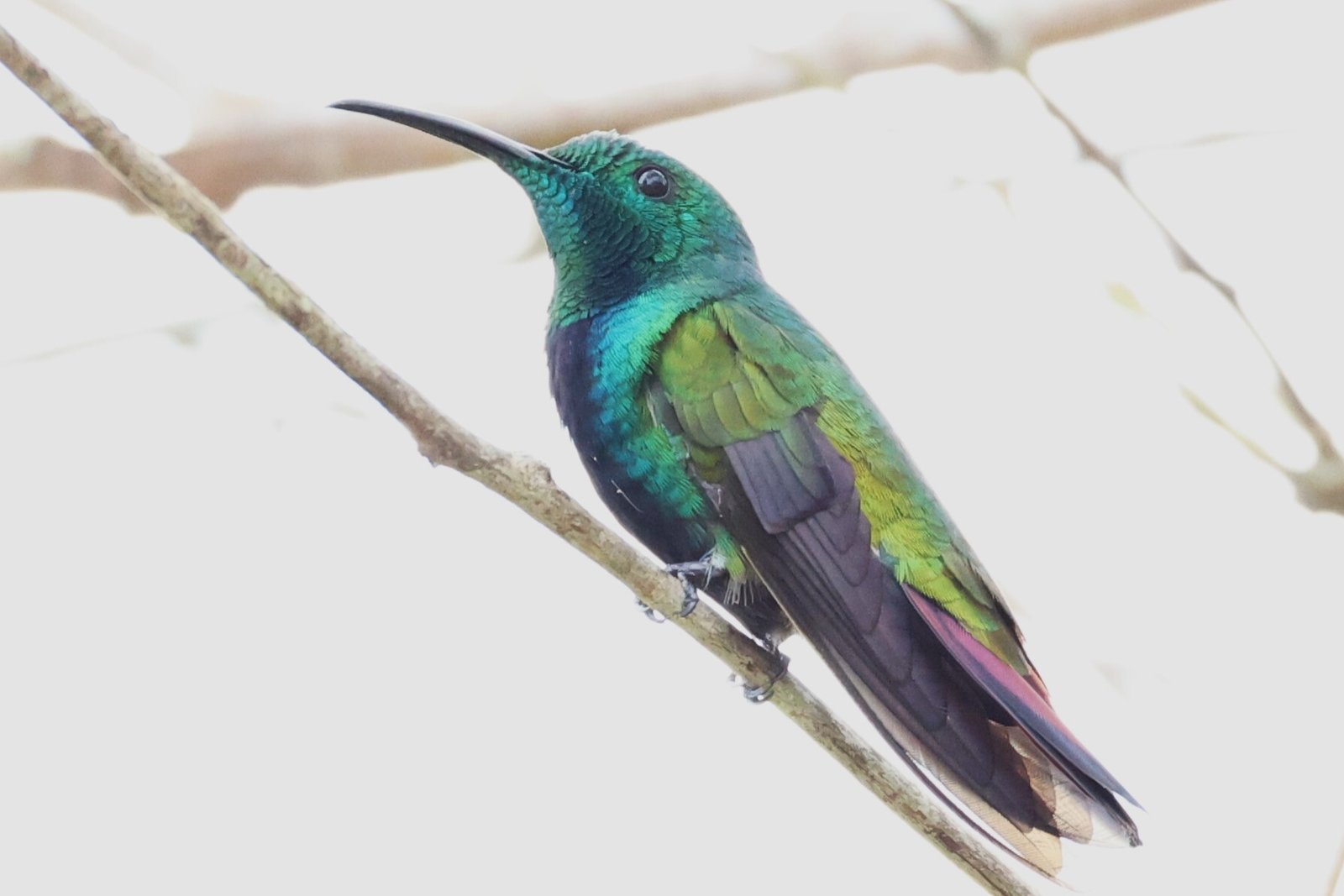
The Green-throated Mango is a mango of coastal mangroves and wet savannas in north-eastern South America. In the guide area it is only a rare vagrant, with no regular site or season. Unlike its relatives, the male has a green throat.
Voice
Not very vocal. When feeding and in flight a dry chep; the song is a very high, slightly descending trill.
Recording: GABRIEL LEITE — CC BY-NC-SA 4.0 · xeno-canto
Identification
11–12 cm, with a long, slightly decurved black bill. The male is bronze-green above, with a glittering green throat and breast and a black central stripe down the breast and belly. The outer tail feathers are purple with dark blue tips, the central ones dark bronze-green. The female is bronze-green above and white below, with a black central stripe and white tips to the outer tail feathers. Young birds resemble the female, with more rufous on the underparts.
Confusion species
Black-throated Mango Anthracothorax nigricollis is widespread in the guide area; the male has a velvety black throat and reddish-purple outer tail feathers. The female Green-throated Mango is barely separable from the female Black-throated Mango, so a record requires a well-documented adult male.
Habitat
Mangroves, wet savannas, marshes and open country with scattered large trees, mainly along the coast and large rivers, from sea level to about 500 m. It takes nectar from flowering trees and catches insects in flight.
Where the bird is most at home, classified by the vegetation units of the Andes and the west coast.


Range and movements
In the guide area only a few isolated records; there is no regular population in Colombia, Ecuador, Peru or Bolivia or on the Galápagos. Outside the guide area along the coast of north-eastern Venezuela, on Trinidad, in the Guianas and in northern Brazil to Maranhão, and inland along the Amazon to the Rio Negro.
How and when to look
A mango with a green throat in the east of the guide area calls for careful documentation: photographs of the throat, breast and tail are needed to exclude Black-throated Mango.
Conservation status
Least Concern. In the guide area only a vagrant.
Scientific name
Anthracothorax viridigula | (Boddaert, 1783)
Boddaert described the species in 1783 as Trochilus viridigula; because it was later moved to another genus, the author and year stand in brackets. The genus Anthracothorax was introduced in 1831 by Boie. The genus name combines Greek anthrax, anthrakos, 'coal', with thōrax, 'breast'. The species name combines Latin viridis, 'green', with gula, 'throat'. The specimen the first description was based on came from Cayenne, French Guiana.