All species › Swifts › Hummingbirds › Blue-chinned Sapphire
Blue-chinned Sapphire | Chlorestes notata
Blauwkinsaffierkolibrie | Zafiro barbiazul | Beija-flor-de-garganta-azul
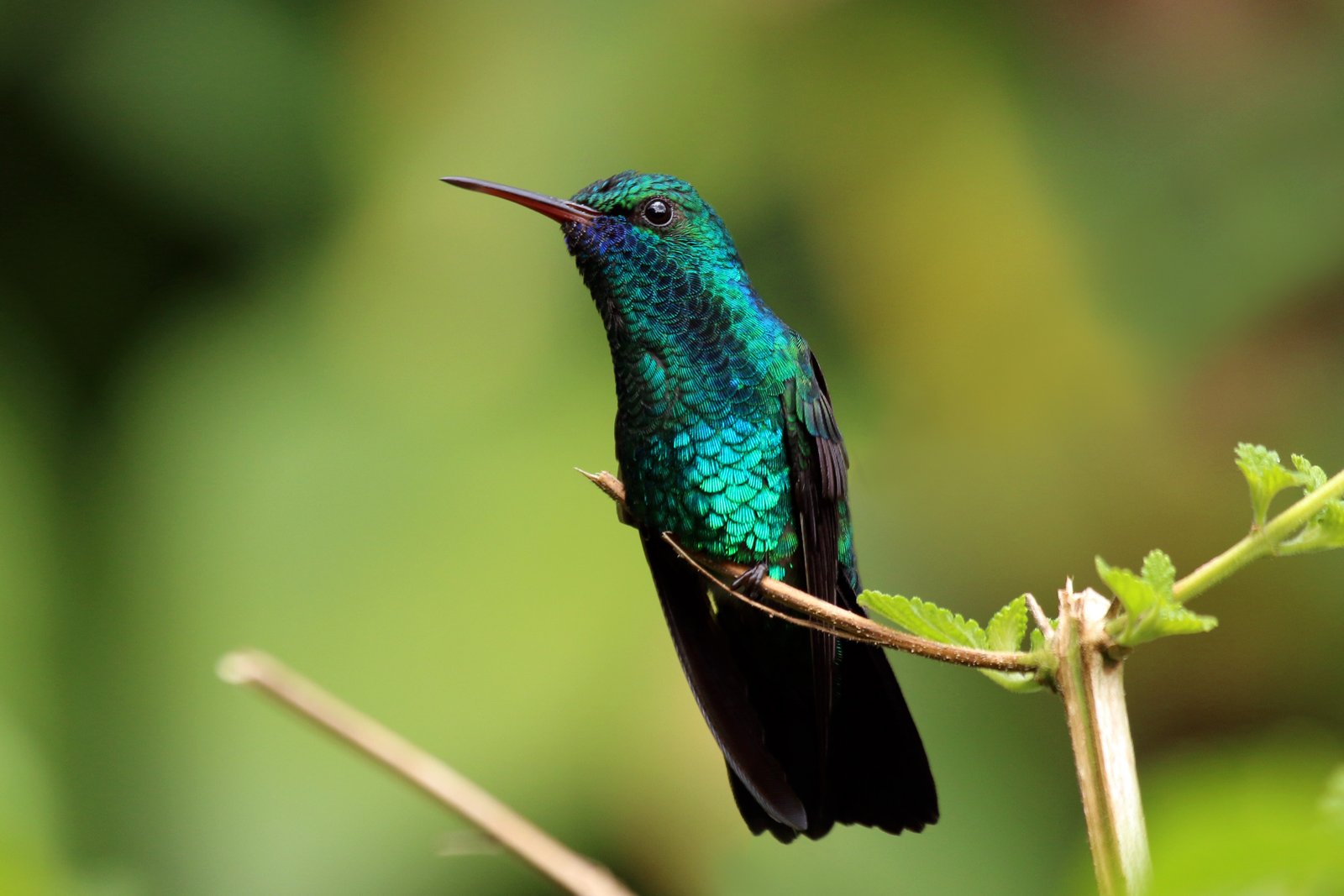
The Blue-chinned Sapphire is an almost entirely green hummingbird of the lowlands east of the Andes and of northern South America. The male is glittering green, with a blue chin and a steel-blue tail. It often feeds high in flowering trees and at forest edges.
Voice
High, thin tsip notes and a dry twittering; the song is a series of high, squeaky notes.
Recording: JAYRSON ARAUJO DE OLIVEIRA — CC BY-NC-SA 4.0 · xeno-canto
Identification
9 cm, with a straight bill: the upper mandible is black, the lower mandible red with a dark tip. The male is green above and glittering green below, with a blue chin and upper throat and a slightly forked, steel-blue tail. The female is green above and white below, with dense green spots on the throat, breast and flanks; the tail is blue-black. Young birds resemble the female.
Confusion species
Glittering-throated Emerald Chionomesa fimbriata has a white central stripe down the belly and a bronzy green tail. Blue-tailed Emerald Chlorostilbon mellisugus is smaller, with an all-black bill. White-chinned Sapphire Chlorestes cyanus has a violet-blue head in the male and a red bill with a black tip. Fork-tailed Woodnymph Thalurania furcata is larger, with a violet belly and a deeply forked tail.
Habitat
Forest edges, clearings, secondary forest, gallery forest, savanna with trees, plantations and gardens in the lowlands, rarely above 500 m. It takes nectar in the middle and upper levels, often in flowering trees, and catches small insects. The nest is a small cup on a branch.
Where the bird is most at home, classified by the vegetation units of the Andes and the west coast.


Range and movements
In Colombia east of the Andes in the llanos and Amazonia, and locally in the Caribbean lowlands in the north. In Ecuador local in the eastern lowlands. In Peru in the north-eastern lowlands, scarcer further south. From Bolivia at most a few records in the north are known. Absent from the Galápagos. Outside the guide area in Venezuela, Trinidad, the Guianas and Amazonian Brazil.
- Resident
- dark = core range, pale = thinly spread
How and when to look
Look at flowering trees along forest edges, riverbanks and in gardens in the lowlands, for example in the Colombian llanos; the male often perches high on a projecting branch.
Conservation status
Least Concern. The species has a large range and tolerates semi-open and man-made landscapes.
Scientific name
Chlorestes notata | (Reich, 1793)
Reich described the species in 1793 as Trochilus notatus; because it was later moved to another genus, the author and year stand in brackets. The genus Chlorestes was introduced in 1854 by Reichenbach. The genus name combines Greek khlōros, 'green', with esthēs, 'clothing', so 'green-clad'. The species name comes from Latin notatus, 'marked', probably referring to the blue chin. The specimen the first description was based on came from Cayenne, French Guiana.