All species › Swifts › Hummingbirds › Violet-bellied Hummingbird
Violet-bellied Hummingbird | Chlorestes julie
Paarsbuikkolibrie | Colibrí de Julia | Beija-flor-de-barriga-violeta
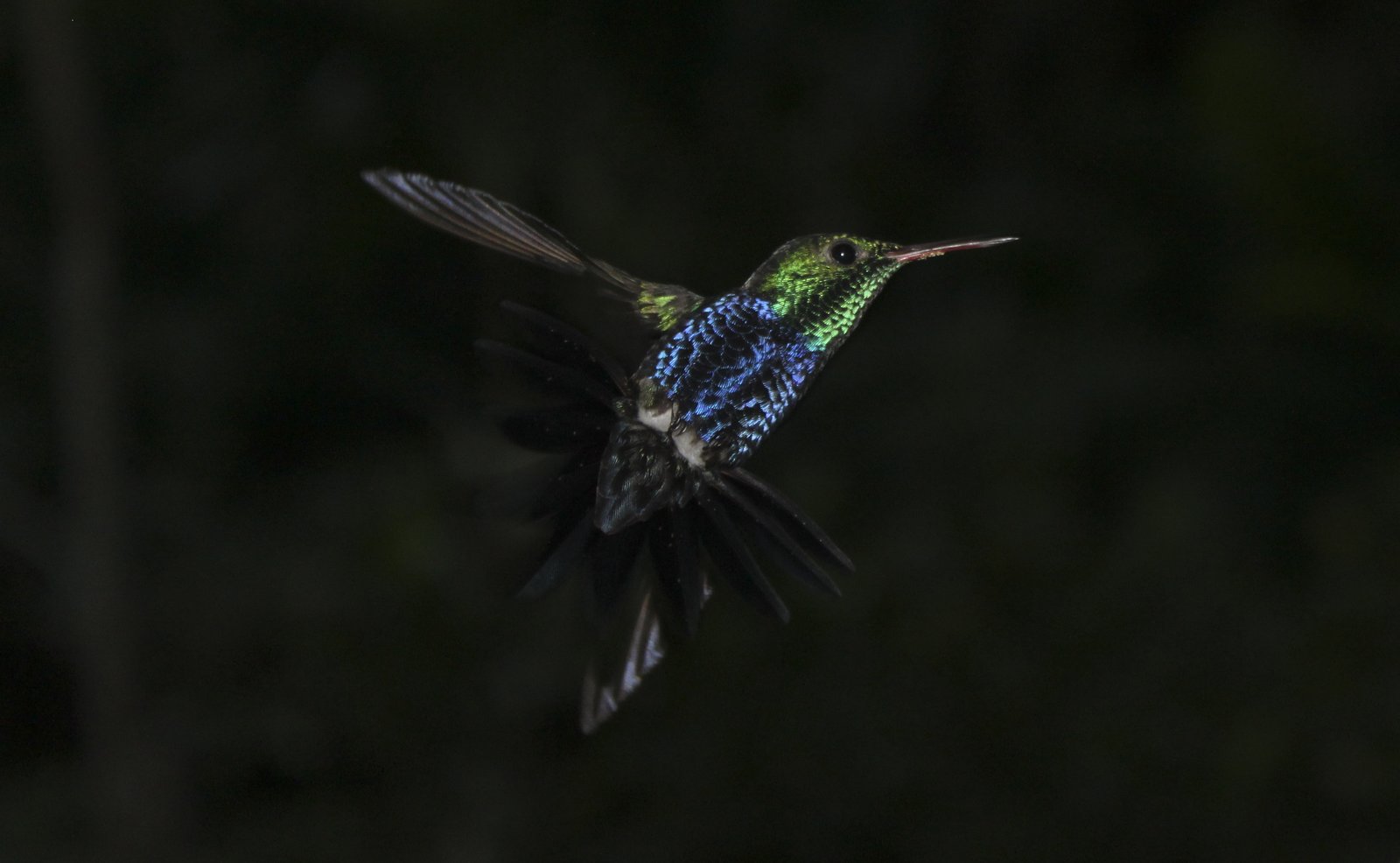
The Violet-bellied Hummingbird is a very small hummingbird of humid and semi-humid lowland forest from Panama to north-western Peru. The male has a glittering green throat and a violet-blue breast and belly. It forages mainly in the lower and middle levels of forest and forest edge.
Voice
Soft, dry tsit calls and a thin, high twittering; the song is a short series of high, squeaky notes.
Recording: Kent Livezey — CC BY-NC-SA 4.0 · xeno-canto
Identification
8 cm, with a short, straight bill and a short, rounded, blue-black tail; the upper mandible is black and the lower mandible flesh-coloured with a dark tip. The male is green above, with a glittering green crown and throat and a glittering violet-blue breast and belly. The female is green above and pale grey below, with green spots on the flanks; the outer tail feathers have grey tips. Young birds resemble the female.
Confusion species
Blue-chested Hummingbird Polyerata amabilis is larger, with a longer bill, only a blue patch on the breast and a grey belly. Crowned Woodnymph Thalurania colombica also has a green throat and a violet belly, but is clearly larger, with violet shoulders and a long, deeply forked tail. Blue-throated Sapphire Chlorestes eliciae has a blue throat, a red bill and a golden tail. Females resemble those of other small hummingbirds; note the short, rounded tail with grey tips.
Habitat
The interior and edges of humid and semi-humid forest, secondary forest, plantations and scrub, in the lowlands and foothills up to about 1000 m; in south-western Ecuador and Tumbes also in drier forest. It takes nectar from small flowers in the lower and middle levels and catches small insects. The nest is a small cup on a branch.
Where the bird is most at home, classified by the vegetation units of the Andes and the west coast.


Range and movements
In Colombia in the Pacific lowlands, the Caribbean lowlands and the Magdalena valley. In Ecuador in the western lowlands and foothills. In Peru only in the far north-west, in Tumbes. Absent from Bolivia and the Galápagos. Outside the guide area in central and eastern Panama.
- Resident
- dark = core range, pale = thinly spread
How and when to look
Look at flowering shrubs and herbs along trails and forest edges in the western lowlands of Ecuador and Colombia; the male often perches low on a thin twig.
Conservation status
Least Concern. The species also occurs in secondary forest and plantations, but disappears where forest is cleared completely.
Scientific name
Chlorestes julie | (Bourcier, 1842)
Bourcier described the species in 1842 as Ornismyia julie; because it was later moved to another genus, the author and year stand in brackets. The genus Chlorestes was introduced in 1854 by Reichenbach. The genus name combines Greek khlōros, 'green', with esthēs, 'clothing', so 'green-clad'. The species name honours Anne-Julie Mulsant, née de Ronchivol (1801–1868), wife of the French ornithologist Martial Étienne Mulsant; Mulsant wrote that the name Julie also recalled other women among his relatives and friends. The specimen the first description was based on came from Tunja, Colombia.