All species › Cranes, rails and allies › Rails, gallinules and coots › Grey-cowled Wood Rail
Grey-cowled Wood Rail | Aramides cajaneus
Cayennebosral | Rascón cuello gris | Saracura-três-potes
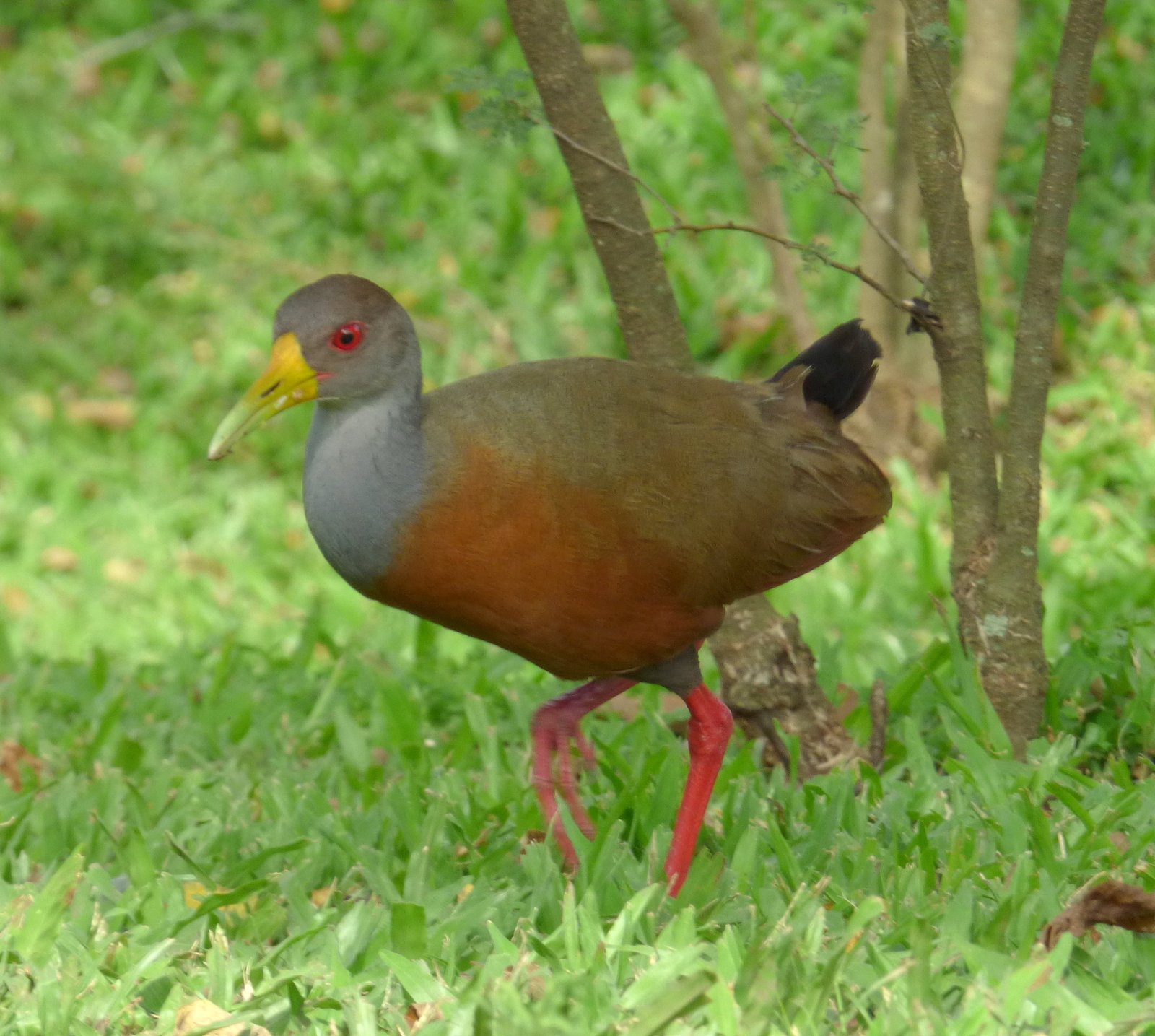
The Grey-cowled Wood Rail is the commonest and most widespread wood rail of the South American lowlands. It lives along banks, in marshes and in humid forest and walks with a flicking tail over mud and leaf litter. At dusk pairs and groups give a loud, rhythmic cackling.
Voice
A loud, rhythmic cackling, roughly po-ko, po-ko, kok-kok-kok, often by pairs or groups in chorus, mainly at dawn and dusk.
Recording: Fabrício Grigolin — CC BY-NC-SA 4.0 · xeno-canto
Identification
33–40 cm, with a green bill with a yellow tip, a red iris and coral-red legs. The head and neck are grey, with a brown patch on the hindcrown. The back and wings are olive-brown. The breast and flanks are warm rufous and contrast sharply with the black belly, rump and tail. The sexes are alike; juveniles are duller.
Confusion species
Red-winged Wood Rail Aramides calopterus has rufous neck sides and wing coverts and a grey breast, and lives in terra firme forest. Rufous-necked Wood Rail Aramides axillaris is smaller, with a rufous head and neck. Brown Wood Rail Aramides wolfi has a brown breast without sharp contrast. Giant Wood Rail Aramides ypecaha is larger, with a yellow bill and a pinkish-brown belly.
Habitat
Banks of rivers, lakes and oxbows, marshes, flooded forest, palm swamps, humid forest and forest edges, also pastures and plantations near water, mainly in the lowlands, locally to roughly 1500 m. It forages on the ground for invertebrates, crabs, small vertebrates, seeds and fruit. The nest is a cup of twigs and leaves in a shrub or tree.
Where the bird is most at home, classified by the vegetation units of the Andes and the west coast.


Range and movements
In Colombia widespread in the lowlands, including the north. In Ecuador mainly east of the Andes. In Peru in the Amazonian lowlands and foothills. In Bolivia in the lowlands of the north and east. Absent from the Galápagos. Outside the guide area from Costa Rica to Argentina and Uruguay.
- Resident
- dark = core range, pale = thinly spread
How and when to look
Along banks of rivers and oxbows in the Amazonian lowlands, especially in the early morning and at dusk; birds then sometimes walk over open mud or cross a trail.
Conservation status
Least Concern. Widespread, and tolerates some disturbance of its habitat.
Scientific name
Aramides cajaneus | (Müller, 1776) (GBIF: Aramides cajanea)
Müller described the species in 1776 as Fulica Cajanea; because it was later moved to another genus, the author and year stand in brackets. The genus Aramides was introduced in 1845 by Pucheran. The genus name combines the genus name Aramus (Limpkin) with Greek -oidēs, 'resembling'. The species name refers to Cayenne, the capital of French Guiana. The specimen the first description was based on came from Cayenne, French Guiana.