All species › Cranes, rails and allies › Rails, gallinules and coots › Rufous-necked Wood Rail
Rufous-necked Wood Rail | Aramides axillaris
Roodnekbosral | Rascón cuello rufo | Saracura-de-pescoço-ruivo
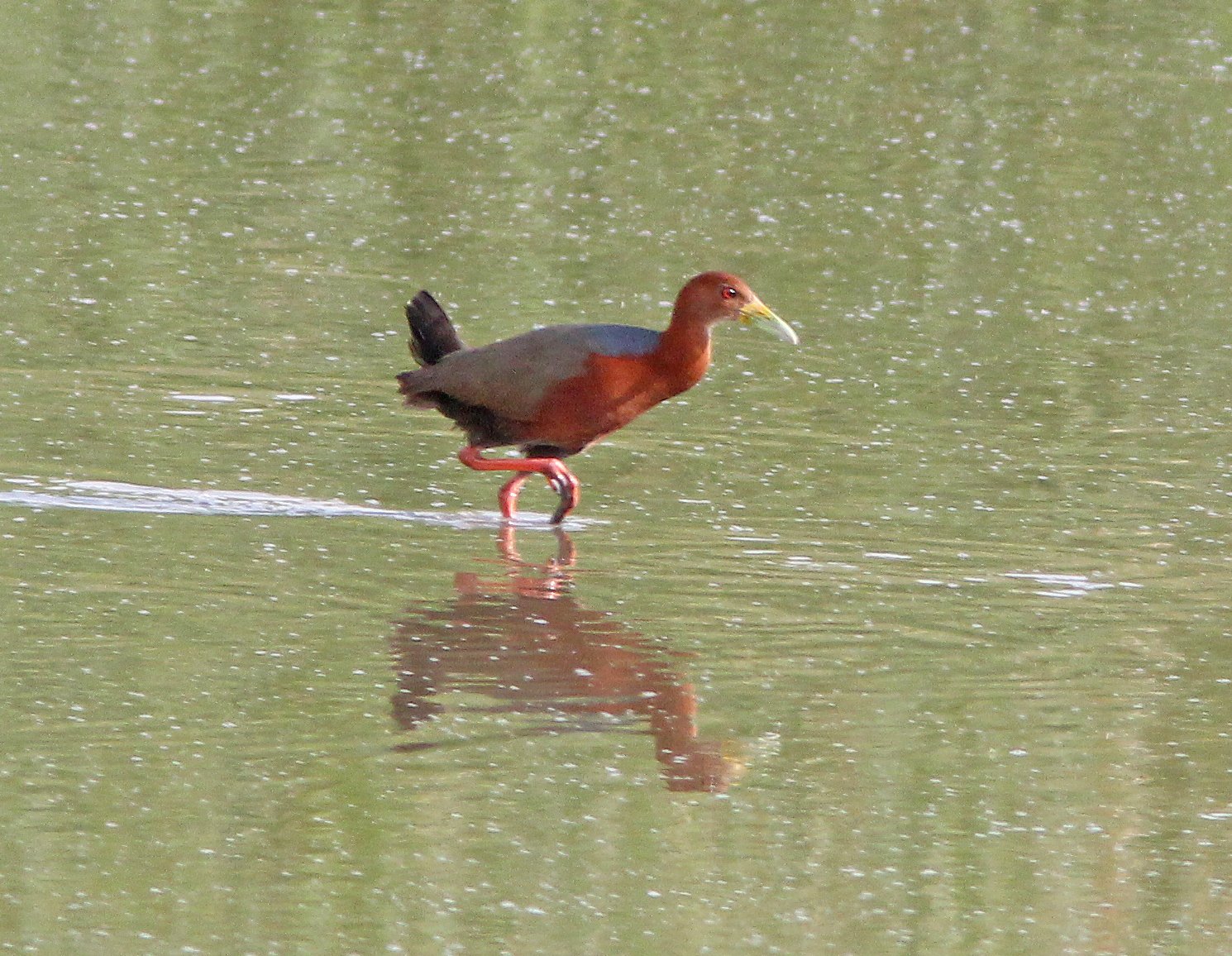
The Rufous-necked Wood Rail is a fairly small wood rail of mangroves and dry to humid coastal forest, with a rufous head and neck. In the guide area it lives in northern Colombia and in western Ecuador and extreme north-western Peru. It is shy and usually stays in dense undergrowth.
Voice
A loud, repeated series of sharp notes, roughly pik-pik-pik or kee-ki-kee, often by two birds, mainly at dusk.
Recording: Roland Rumm — CC BY-NC-SA 4.0 · xeno-canto
Identification
28–30 cm, with a yellow-green bill, a red iris and red legs. The head, neck and breast are rufous, the upper back is grey, the back and wings olive-brown. The belly, rump and tail are black. Rufous shows on the underwing and primaries in flight. The sexes are alike; juveniles are duller, with a greyer head.
Confusion species
Brown Wood Rail Aramides wolfi is larger, with an ashy grey head and neck and a brown breast. Grey-cowled Wood Rail Aramides cajaneus is larger, with a grey head and neck and a rufous breast. Uniform Crake Amaurolimnas concolor is uniformly rufous-brown, without a grey upper back or black rear.
Habitat
Mangroves, dry forest and thorn scrub, humid forest, forest edges and riparian woodland, from sea level into the hills, locally to roughly 1500 m. It walks on the ground in dense vegetation, feeding on crabs, other invertebrates and seeds. The nest is a cup of twigs and leaves in a shrub or tree.
Where the bird is most at home, classified by the vegetation units of the Andes and the west coast.


Range and movements
In Colombia in the north, mainly along the Caribbean coast and around the Sierra Nevada de Santa Marta. In Ecuador in the west, in mangroves and in dry and humid forest on the coastal plain and in the hills. In Peru only in the extreme north-west (Tumbes). Absent from Bolivia and the Galápagos. Outside the guide area from Mexico to Panama, in Venezuela, the Guianas and on Trinidad.
- Resident
- dark = core range, pale = thinly spread
How and when to look
Listen at dawn and dusk along mangroves and dry forest in western Ecuador and near Tumbes for the sharp call series; birds sometimes cross a creek at low tide.
Conservation status
Least Concern. Locally vulnerable to clearance of mangroves and dry forest.
Scientific name
Aramides axillaris | Lawrence, 1863
Lawrence described the species in 1863 and placed it straight away in the genus where it still stands. The genus Aramides was introduced in 1845 by Pucheran. The genus name combines the genus name Aramus (Limpkin) with Greek -oidēs, 'resembling'. The species name comes from Latin axillaris, 'of the armpit', referring to the axillary feathers under the wing. The specimen the first description was based on came from Barranquilla, Colombia.