All species › Cranes, rails and allies › Rails, gallinules and coots › Brown Wood Rail
Brown Wood Rail | Aramides wolfi
Bruine bosral | Rascón montés moreno | Saracura-parda
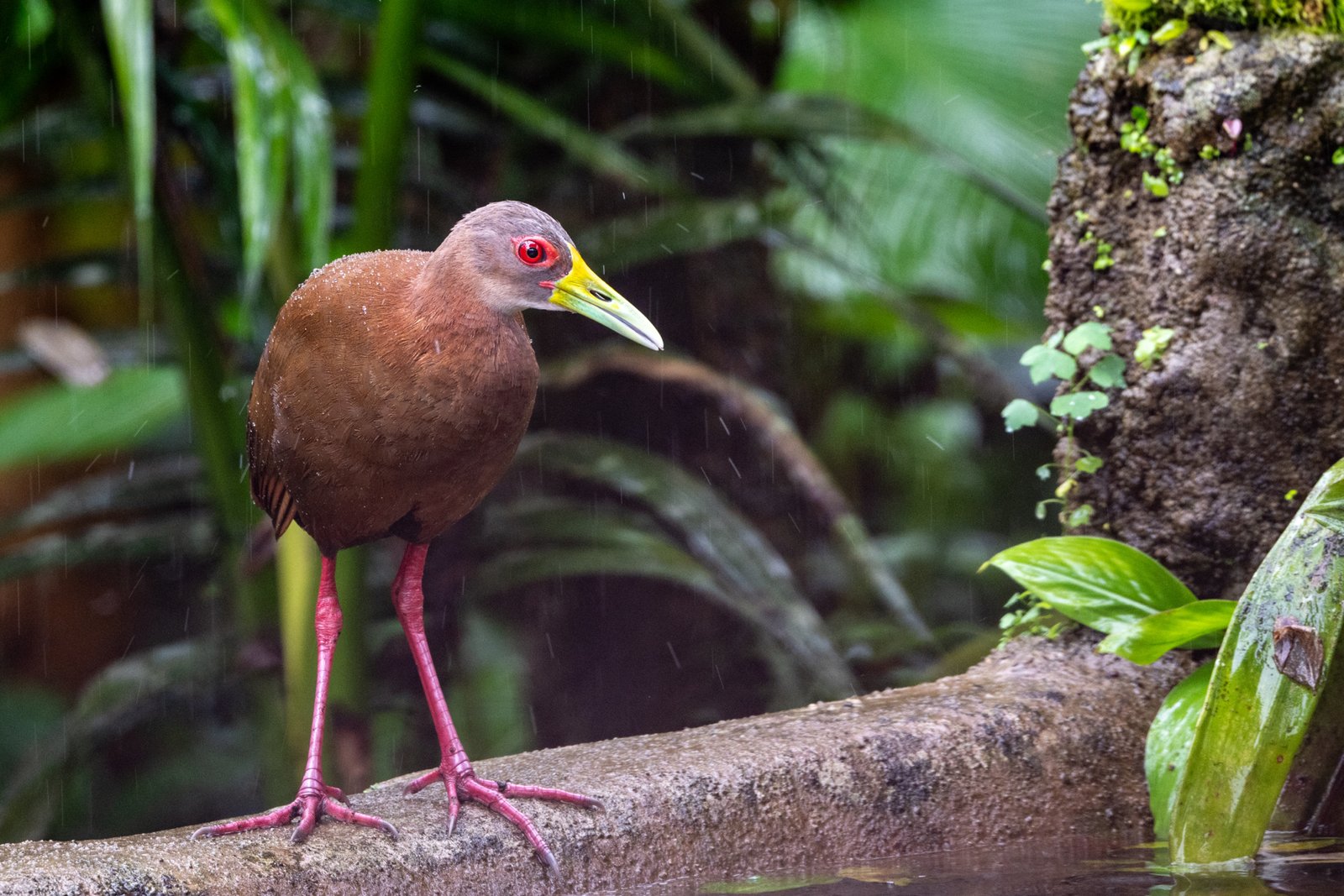
The Brown Wood Rail is a medium-sized wood rail of western Colombia and Ecuador, west of the Andes. It lives hidden in mangroves, swampy woodland and humid forest and is mostly heard. It is the only wood rail in its range with a mainly brown body and no rufous neck.
Voice
A loud, repeated series, roughly kwee-ko-mwee, often in duet or by several birds, mainly at dusk.
Recording: Karl S. Berg — CC BY-NC-SA 4.0 · xeno-canto
Identification
33–36 cm, with a yellow-green bill, a red iris and pink legs. The head and neck are ashy grey, with a pale throat and a small yellow spot on the forehead. The back, breast and wings are chestnut to warm brown. The flanks, belly, rump and tail are black. The sexes are alike; juvenile plumage is not well described.
Confusion species
Rufous-necked Wood Rail Aramides axillaris is smaller, with a rufous head, neck and breast and a grey upper back. Grey-cowled Wood Rail Aramides cajaneus has a grey neck and a rufous breast sharply contrasting with the black belly, and a green bill with a yellow tip. Uniform Crake Amaurolimnas concolor is smaller and uniformly rufous-brown, without a grey head or black rear.
Habitat
Mangroves, freshwater marsh, swampy woodland, river valleys and humid primary and secondary forest, from sea level to about 900 m. It walks on the ground in dense vegetation, feeding on invertebrates, crabs, small vertebrates and seeds. The nest is a cup of plant material in a shrub or low tree.
Where the bird is most at home, classified by the vegetation units of the Andes and the west coast.


Range and movements
In Colombia in the west, in the Pacific lowlands; local. In Ecuador in the west, scattered from north to south, mainly along the coast. Absent from Peru (an old report has been retracted), Bolivia and the Galápagos. Does not occur outside the guide area.
- Resident
- dark = core range, pale = thinly spread
How and when to look
Listen at dusk along mangroves and swampy woodland on the coast of Ecuador and Colombia for the loud call series; birds sometimes walk out onto open mud at the forest edge at low tide.
Conservation status
Least Concern; assessed as Vulnerable until 2025. The population is thought to be declining through clearance of mangroves and forest for farming and shrimp ponds.
Scientific name
Aramides wolfi | Berlepsch & Taczanowski, 1884
Berlepsch & Taczanowski described the species in 1884 and placed it straight away in the genus where it still stands. The genus Aramides was introduced in 1845 by Pucheran. The genus name combines the genus name Aramus (Limpkin) with Greek -oidēs, 'resembling'. The species name honours Theodor Wolf (1841–1924), a German naturalist and geologist who worked in Ecuador and surveyed its geology. The specimen the first description was based on came from Chimbo, Ecuador.