All species › Cranes, rails and allies › Rails, gallinules and coots › Giant Wood Rail
Giant Wood Rail | Aramides ypecaha
Reuzenbosral | Cotara ipacaá | Saracuruçu
The Giant Wood Rail is the largest wood rail in South America, a bulky, long-legged rail of marshes and wet forest edges in the lowlands. In the guide area it occurs only in eastern Bolivia, at the edge of its range. It is best known for the loud joint screaming of small groups at dusk.
Voice
Very noisy, mainly at dusk and in the evening: small groups give together a powerful, shrill chorus of screams, shrieks and wheezing notes that carries far.
Recording: Luciano Buck — CC BY-NC-SA 4.0 · xeno-canto
Identification
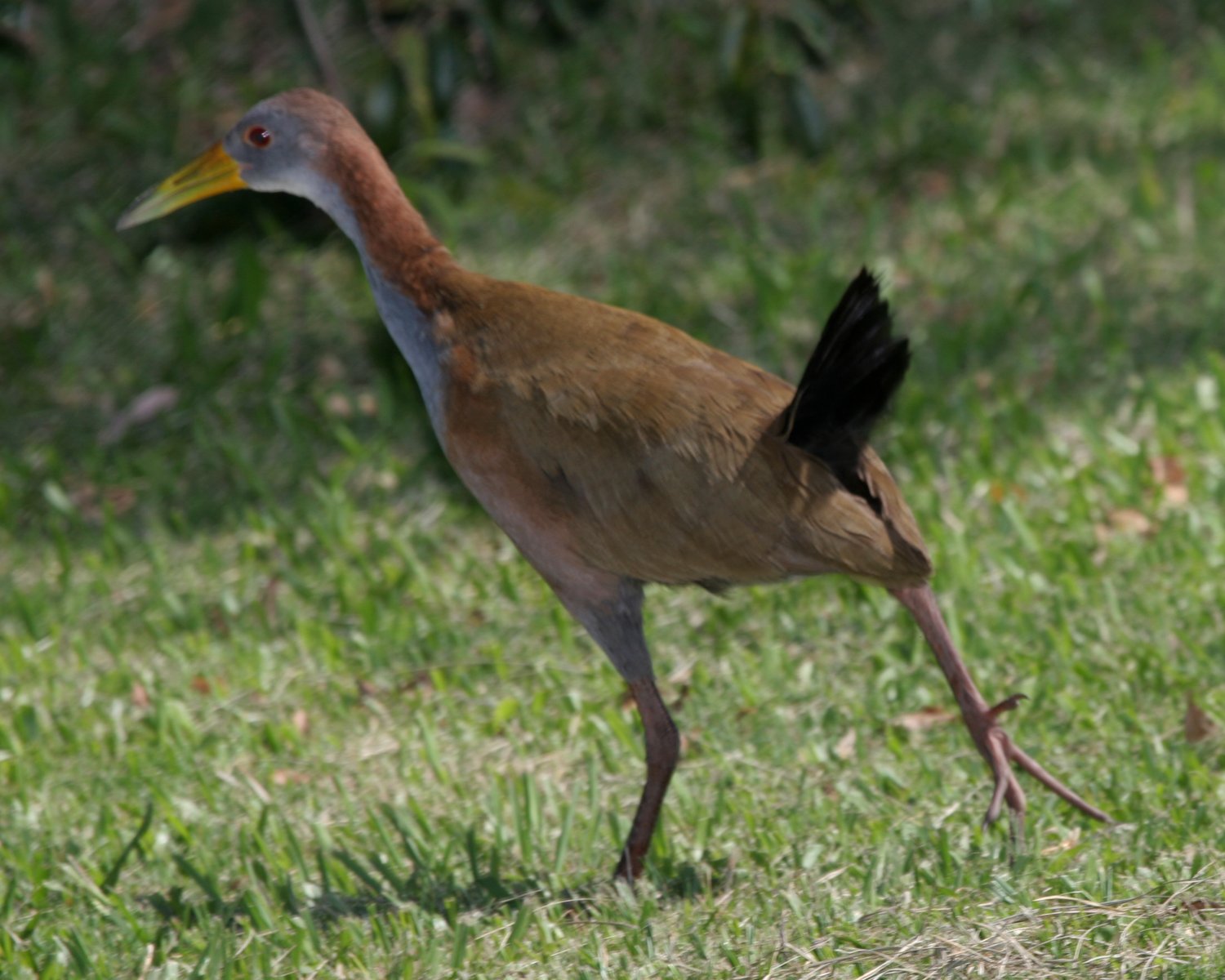
41–45 cm, with a long, strong, mustard-yellow bill, a red iris and long red legs. The face, throat and foreneck are bluish grey, with a white chin. The hindneck is rufous, the back olive-brown. The breast, flanks and belly are pinkish brown; the rear body, rump and tail are black. The sexes are alike.
Confusion species
Grey-cowled Wood Rail Aramides cajaneus is smaller, with a grey neck and a black belly behind the rufous breast, and a green bill with a yellow tip. Limpkin Aramus guarauna is larger and brown with white streaks, with a long, slightly decurved bill.
Habitat
Marshes with dense vegetation, lightly wooded swamps, gallery forest and pastures and fields near water and cover, in the lowlands. It walks on the ground, feeding on invertebrates, small vertebrates, seeds and fruit. The nest is a cup of plant material low in a shrub or tree.
Where the bird is most at home, classified by the vegetation units of the Andes and the west coast.


Range and movements
In Bolivia only in the east, in the lowlands bordering Brazil and Paraguay; local there. Absent from Colombia, Ecuador, Peru and the Galápagos. Outside the guide area in central and south-eastern Brazil, Paraguay, Uruguay and north-eastern Argentina.
- Resident
- dark = core range, pale = thinly spread
How and when to look
Listen at dusk near marshes and gallery forest in eastern Bolivia for the joint screaming; birds then sometimes come to the edge of open water and pasture.
Conservation status
Least Concern. The population is thought to be declining through loss of wetlands, and the species is also kept in captivity.
Scientific name
Aramides ypecaha | (Vieillot, 1819)
Vieillot described the species in 1819 as Rallus ypecaha; because it was later moved to another genus, the author and year stand in brackets. The genus Aramides was introduced in 1845 by Pucheran. The genus name combines the genus name Aramus (Limpkin) with Greek -oidēs, 'resembling'. The species name comes from Ypacahá, the name used by Félix de Azara in his work of 1802–1805, after the Guaraní name Ihpaká'á for this rail. The specimen the first description was based on came from Paraguay.