All species › Cranes, rails and allies › Rails, gallinules and coots › Uniform Crake
Uniform Crake | Amaurolimnas concolor
Effen bosral | Rascón café | Saracura-lisa
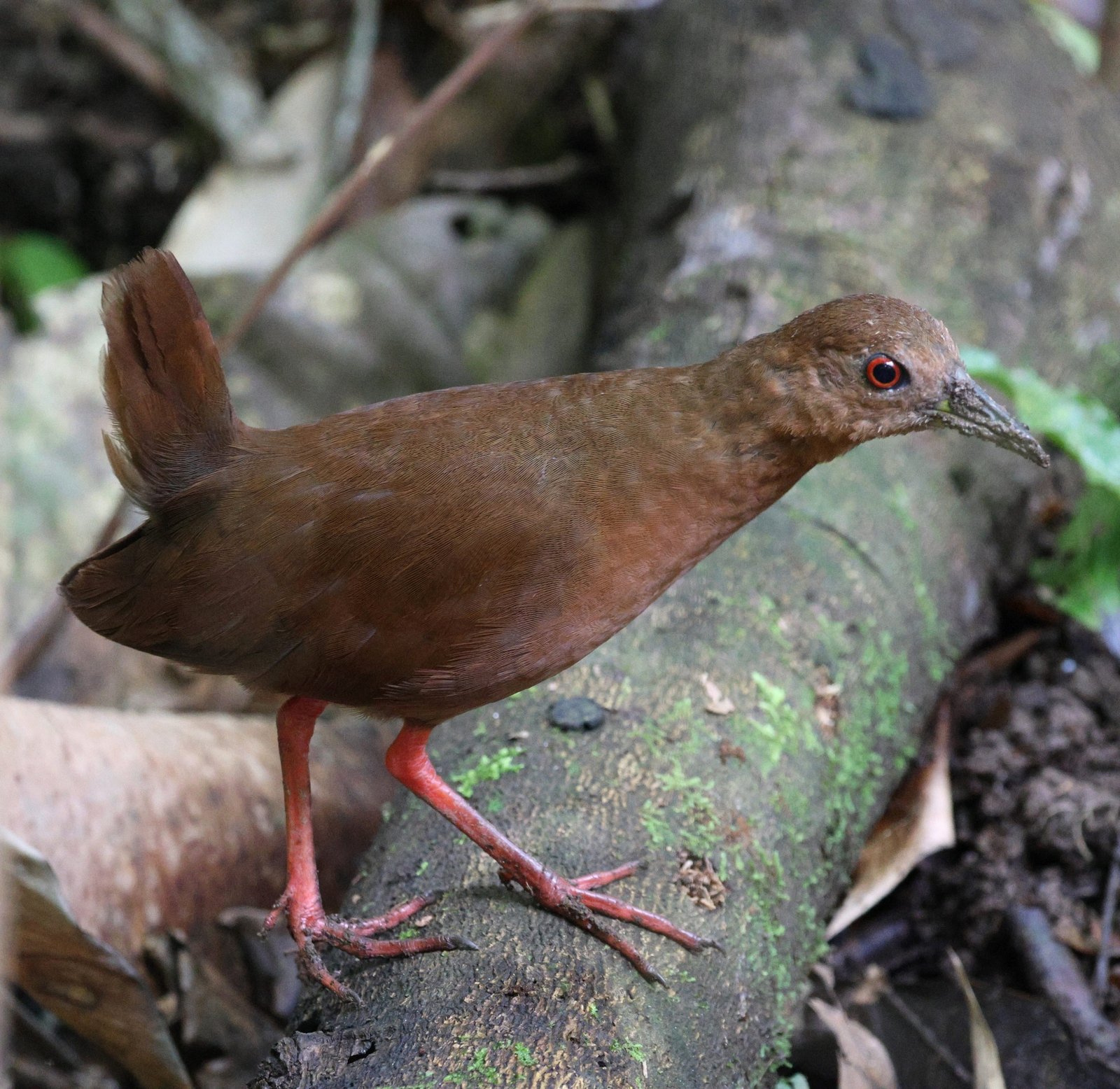
The Uniform Crake is a medium-sized, evenly rufous-brown rail of the floor of swamp forest and forest along streams. It lives hidden in dense undergrowth and is mostly heard. Its plumage lacks any pattern, which separates it from other rails in the same forest.
Voice
A series of clear, loud whistles that accelerate and rise in pitch and then fade; mainly in the early morning and the evening.
Recording: Fabio Schunck — CC BY-NC-SA 4.0 · xeno-canto
Identification
20–23 cm. The upperparts are warm rufous-brown, the underparts slightly paler and more reddish, the throat paler brown. The bill is greenish yellow, the iris red to orange and the legs red. The sexes are alike; juveniles are duller and darker brown.
Confusion species
Chestnut-headed Crake Anurolimnas castaneiceps has a chestnut head and breast that contrast with a dark olive-brown to blackish body. Rufous-necked Wood Rail Aramides axillaris is much larger, with a grey back and a black rear belly. Russet-crowned Crake Rufirallus viridis is smaller, with a grey face, and lives in open, grassy terrain.
Habitat
Dense undergrowth of swamp forest, várzea, palm swamps and forest along streams in the lowlands, locally up to about 1000 m. It searches leaf litter and mud for insects, snails, small frogs and seeds. The nest is a cup of leaves low in dense vegetation.
Where the bird is most at home, classified by the vegetation units of the Andes and the west coast.


Range and movements
In Colombia in the Pacific lowlands and locally in Amazonia. In Ecuador in the north-west and in the Amazonian lowlands. In Peru in the Amazonian lowlands. In Bolivia in the northern and eastern lowlands. Absent from the Galápagos. Outside the guide area from southern Mexico to Panama, and in Venezuela, the Guianas and Brazil.
- Resident
- dark = core range, pale = thinly spread
How and when to look
Listen in the early morning in swampy lowland forest and along forest streams for the whistled series; the bird sometimes walks across a forest trail or an opening near water.
Conservation status
Least Concern. The species depends on humid forest and disappears where it is cleared; the Jamaican subspecies is extinct.
Scientific name
Amaurolimnas concolor | (Gosse, 1847)
Gosse described the species in 1847 as Rallus concolor; because it was later moved to another genus, the author and year stand in brackets. The genus Amaurolimnas was introduced in 1893 by Sharpe. The genus name comes from Greek amauros, 'dark, dusky', and New Latin limnas, 'rail'. The species name is Latin concolor, 'uniform in colour'. The specimen the first description was based on came from Jamaica.