All species › Cranes, rails and allies › Rails, gallinules and coots › Paint-billed Crake
Paint-billed Crake | Mustelirallus erythrops
Roodsnavelporseleinhoen | Polluela piquirroja | Turu-turu
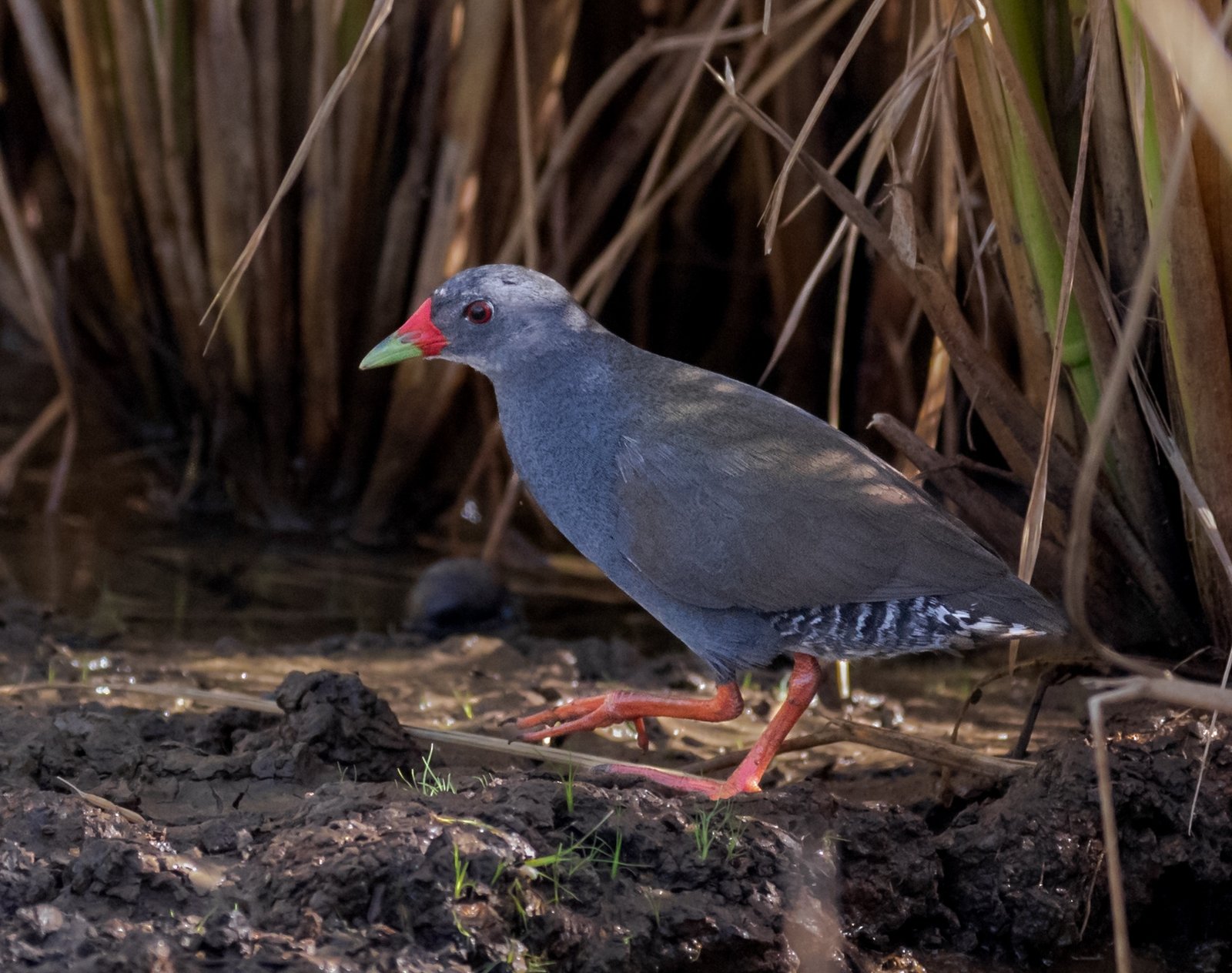
The Paint-billed Crake is a small rail with a greenish-yellow bill with a red base and red legs. It lives in marshes, wet pastures and fields, both along the Peruvian coast and in the lowlands east of the Andes, and has also become established on the Galápagos. Birds wander and sometimes turn up far outside the usual range.
Voice
A long, rattling series of grunting notes that accelerates and fades, and short, sharp calls; mainly at dusk and at night.
No recording with a suitable Creative Commons licence is available for this species yet.
Identification
18–20 cm. The upperparts are plain olive-brown; the face, neck and breast slate-grey. The flanks, rear belly and undertail coverts are black with narrow white bars. The bill is greenish yellow with a bright red base, and the legs are red. The sexes are alike; juveniles are duller, with less red at the base of the bill.
Confusion species
Colombian Crake Mustelirallus colombianus lacks the barring on the flanks and has a cinnamon rear belly. Ash-throated Crake Mustelirallus albicollis is larger, with streaked upperparts and no red base to the bill. On the Galápagos, Galapagos Crake Laterallus spilonota is smaller and blackish, with white speckles.
Habitat
Marshes, wet pastures, ditches, rice fields and irrigated land, from the lowlands into the lower valleys; on the Galápagos in damp fields and pastures in the highlands. It searches dense vegetation for insects and other small invertebrates. The nest is a cup of grass in dense vegetation.
Where the bird is most at home, classified by the vegetation units of the Andes and the west coast.


Range and movements
In Colombia and Ecuador scarce and local. In Peru mainly along the coast and locally in the Amazonian lowlands. In Bolivia in the lowlands, possibly partly as a migrant. On the Galápagos on the larger islands with humid highlands, such as Santa Cruz, San Cristóbal, Floreana and Isabela. Outside the guide area in Venezuela, the Guianas, Brazil, Paraguay and Argentina.
- Resident
- dark = core range, pale = thinly spread
How and when to look
Search damp fields and pastures in the highlands of Santa Cruz on the Galápagos, and marshes and rice fields along the Peruvian coast. The bird is mainly active at dusk and then sometimes comes out onto muddy edges.
Conservation status
Least Concern. The species benefits locally from irrigation and rice growing; on the Galápagos introduced predators are a possible threat.
Scientific name
Mustelirallus erythrops | (Sclater, 1867) (GBIF: Neocrex erythrops)
Sclater described the species in 1867 as Porzana erythrops; because it was later moved to another genus, the author and year stand in brackets. The genus Mustelirallus was introduced in 1858 by Bonaparte. The genus name combines the specific name of Crex mustelina Lichtenstein, 1823 (a synonym of Mustelirallus albicollis), with the genus Rallus, 'rail'. Latin mustelinus means 'weasel-like', from mustela, 'weasel'. The species name comes from Greek eruthros, 'red', and ōps, 'face', after the red base of the bill. The specimen the first description was based on came from Lima, Peru.