All species › Hoatzin › Hoatzin › Hoatzin
Hoatzin | Opisthocomus hoazin
Hoatzin | Hoatzín | Cigana
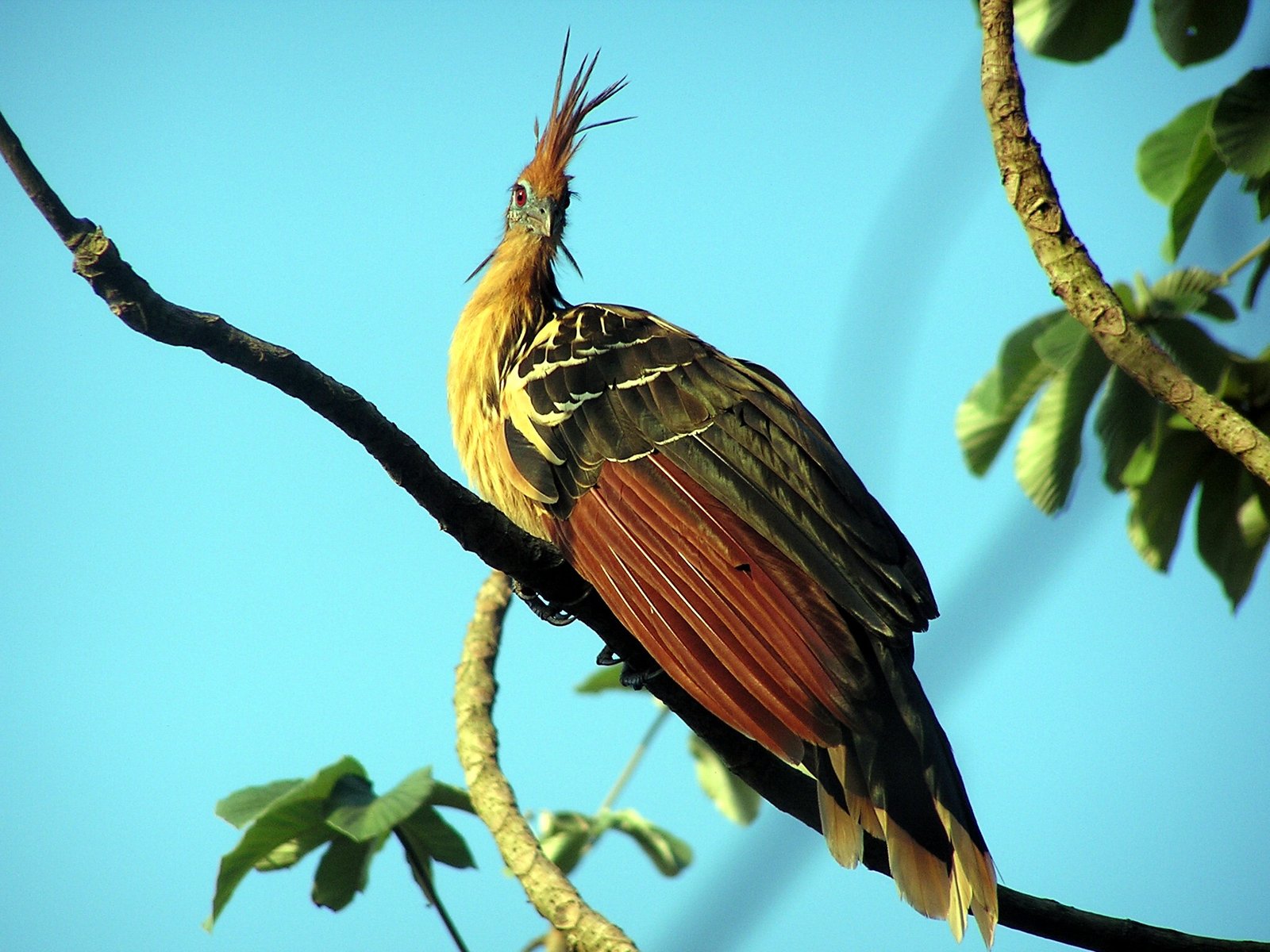
The Hoatzin is a pheasant-like bird of South America with a scruffy crest, a blue face and red eyes, living in noisy groups in the waterside vegetation of Amazonian lakes and rivers. It eats almost nothing but leaves, which are fermented in its large crop, giving the bird a musty smell. It is the only species in its own family and order.
Voice
Hoarse hissing and wheezing sounds, rasping grunts and grating croaks, especially when disturbed and when the group becomes agitated. No true song.
Recording: Jacob Wijpkema — CC BY-NC-SA 4.0 · xeno-canto
Identification
62–70 cm, with a small head on a long neck, a long, broad tail and short, rounded wings. The head bears a ragged crest of long, rufous feathers. The face is bare and bright blue, the eyes red. The upperparts are dark bronzy brown with whitish streaks on the neck and mantle and pale fringes to the wing coverts. The throat and breast are buff, the belly and primaries chestnut. The tail is dark with a broad, pale terminal band. The sexes are alike. Chicks have two small claws on each wing, with which they climb through the branches.
Confusion species
There is little scope for confusion. Chachalacas such as Speckled Chachalaca Ortalis guttata are plainer brown, without a crest or blue face, and live more at forest edges than in waterside vegetation over the water.
Habitat
Dense shrubs and low trees along the shores of oxbow lakes, slow rivers, streams and marshes in the lowlands, especially in flooded forest and where plants such as Montrichardia and shrubby aroids stand over the water. Also in palm swamps and in gallery forest along rivers in savanna country. It eats leaves, buds and fruit of waterside plants. Its flight is heavy and clumsy, usually over short distances only. It lives in groups; the nest is a platform of twigs over the water, and when threatened the chicks drop into the water and later climb back up using bill, feet and wing claws.
Where the bird is most at home, classified by the vegetation units of the Andes and the west coast.


Range and movements
In Colombia in the eastern lowlands, in the Amazon and Orinoco basins. In Ecuador in the Amazonian lowlands. In Peru in the Amazonian lowlands. In Bolivia in the northern and eastern lowlands, including the savannas of the Beni. Outside the guide area in Venezuela, the Guianas and Amazonian Brazil.
- Resident
- dark = core range, pale = thinly spread
How and when to look
Usually seen on a boat trip on an oxbow lake or slow river, where groups of Hoatzins sit hissing in the waterside shrubs, for example around Tambopata and Manu in Peru and in Cuyabeno in Ecuador. They usually let a boat approach closely.
Conservation status
Least Concern. Common and widespread; it is little hunted because its meat has an unpleasant taste and smell.
Scientific name
Opisthocomus hoazin | (Müller, 1776)
Müller described the species in 1776 as Phasianus Hoazin; because it was later moved to another genus, the author and year stand in brackets. The genus Opisthocomus was introduced in 1811 by Illiger. The genus name comes from Greek opisthokomos, 'long hair behind', referring to the large crest. The species name goes back to Huactzin, a Nahuatl name for a large bird that was probably not the hoatzin but the laughing falcon (Herpetotheres). Buffon used the form Hoazin. The specimen the first description was based on came from Cayenne, French Guiana.