All species › Passerines › Tyrant flycatchers and allies › Lesser Shrike-Tyrant
Lesser Shrike-Tyrant | Agriornis murinus
Patagonische klauwiertiran | Gaucho chico | Gaúcho-pequeno
The Lesser Shrike-Tyrant is the smallest shrike-tyrant, a grey-brown flycatcher that breeds in the dry scrub and steppe of Argentina. In the austral winter it moves north and then reaches the lowlands of south-eastern Bolivia. It forages mainly on the ground and in low shrubs.
Voice
Usually silent in the wintering area; gives a soft, short whistle.
Recording: David Bell — CC BY-NC-SA 4.0 · xeno-canto
Identification
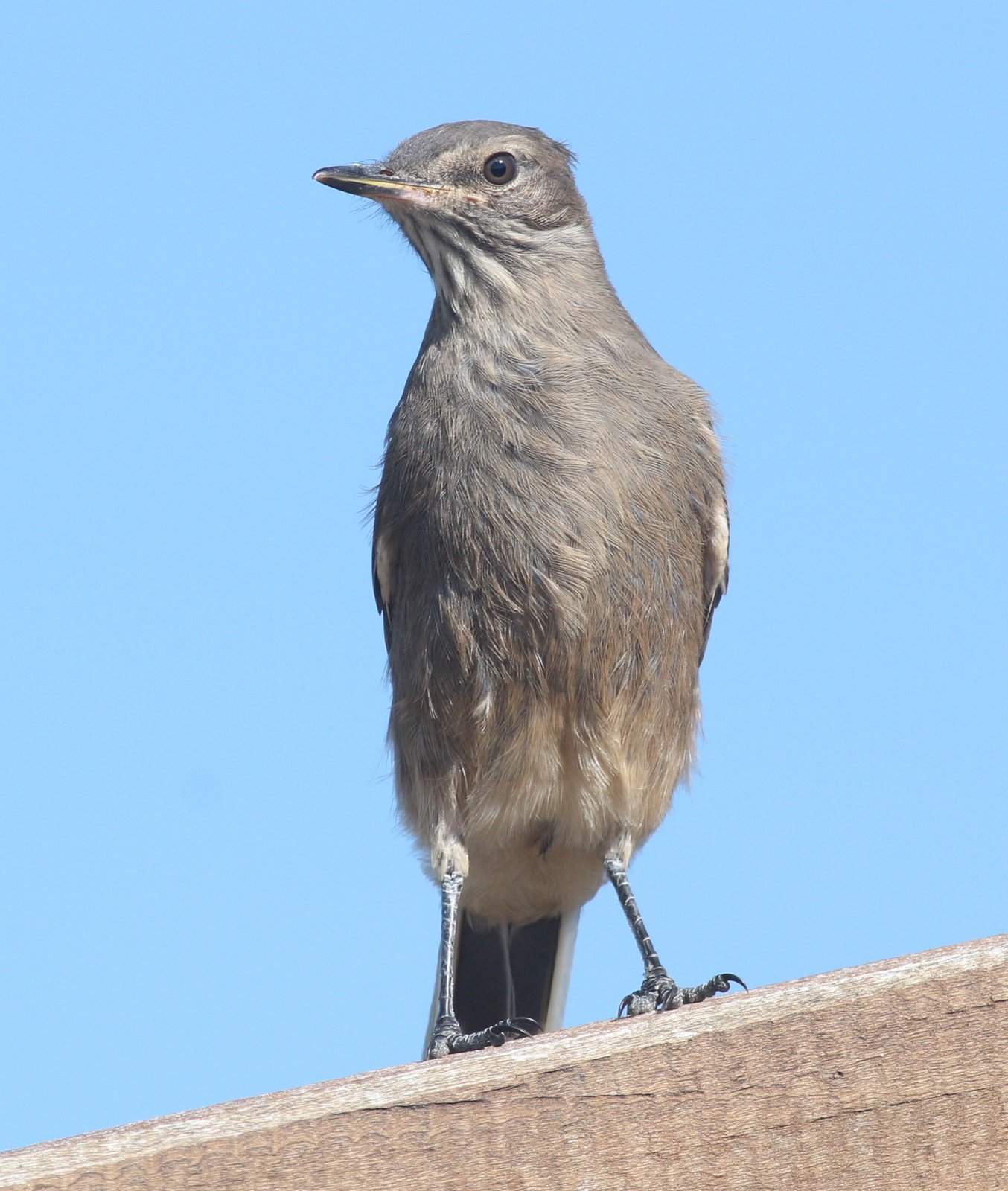
18–19 cm, with a fairly small, slightly hooked, black bill. The upperparts are mouse-grey to greyish brown, with a short, whitish supercilium. The throat is white with fine dark streaks, the breast pale greyish brown and the belly whitish. The wings are dark brown with pale edges. The tail is dark; the outermost feather has a white outer web. The sexes are alike.
Confusion species
Grey-bellied Shrike-Tyrant Agriornis micropterus is much larger, with a heavier bill with a pale lower mandible and no clear supercilium. Grey Monjita Nengetus cinereus is greyer and larger, with a black-and-white wing pattern. White Monjita Xolmis irupero is largely white. Ground tyrants of the genus Muscisaxicola have longer legs, a smaller, straight bill and walk a lot.
Habitat
In the wintering area dry Chaco scrub, open dry woodland, savanna and pasture with scattered shrubs in the lowlands, up to about 1000 m. It searches for insects on the ground from a low lookout. It breeds in Argentina in dry scrub and steppe; the nest is low in a shrub.
Where the bird is most at home, classified by the vegetation units of the Andes and the west coast.


Range and movements
Bolivia: scarce winter visitor in the lowlands of the south-east, mainly in the Chaco of Santa Cruz, Chuquisaca and Tarija, during the austral winter. Absent from Colombia, Ecuador, Peru and the Galápagos. Outside the guide area it breeds in Argentina and also winters in Paraguay and northern Argentina.
- Summer visitor (c. Apr–Sep)
- dark = core range, pale = thinly spread
How and when to look
In the austral winter search the open Chaco of south-eastern Bolivia for a small grey-brown flycatcher with a white supercilium that drops to the ground from a low shrub.
Conservation status
Least Concern. In the guide area the species is a scarce winter visitor.
Scientific name
Agriornis murinus | (d'Orbigny, ACVMD & de Lafresnaye, 1837)
D'Orbigny, ACVMD & de Lafresnaye described the species in 1837 as P[epoaza] Murina; because it was later moved to another genus, the author and year stand in brackets. The genus Agriornis was introduced in 1839 by Gould. The genus name comes from Greek agrios, 'wild, fierce', and ornis, 'bird'. The species name comes from Latin murinus, 'of mice', i.e. mouse-grey, referring to the plumage. The specimen the first description was based on came from Río Negro, Argentina.