All species › Passerines › Antbirds › Long-winged Antwren
Long-winged Antwren | Myrmotherula longipennis
Langvleugelmiersluiper | Hormiguerito alilargo | Choquinha-de-asa-comprida
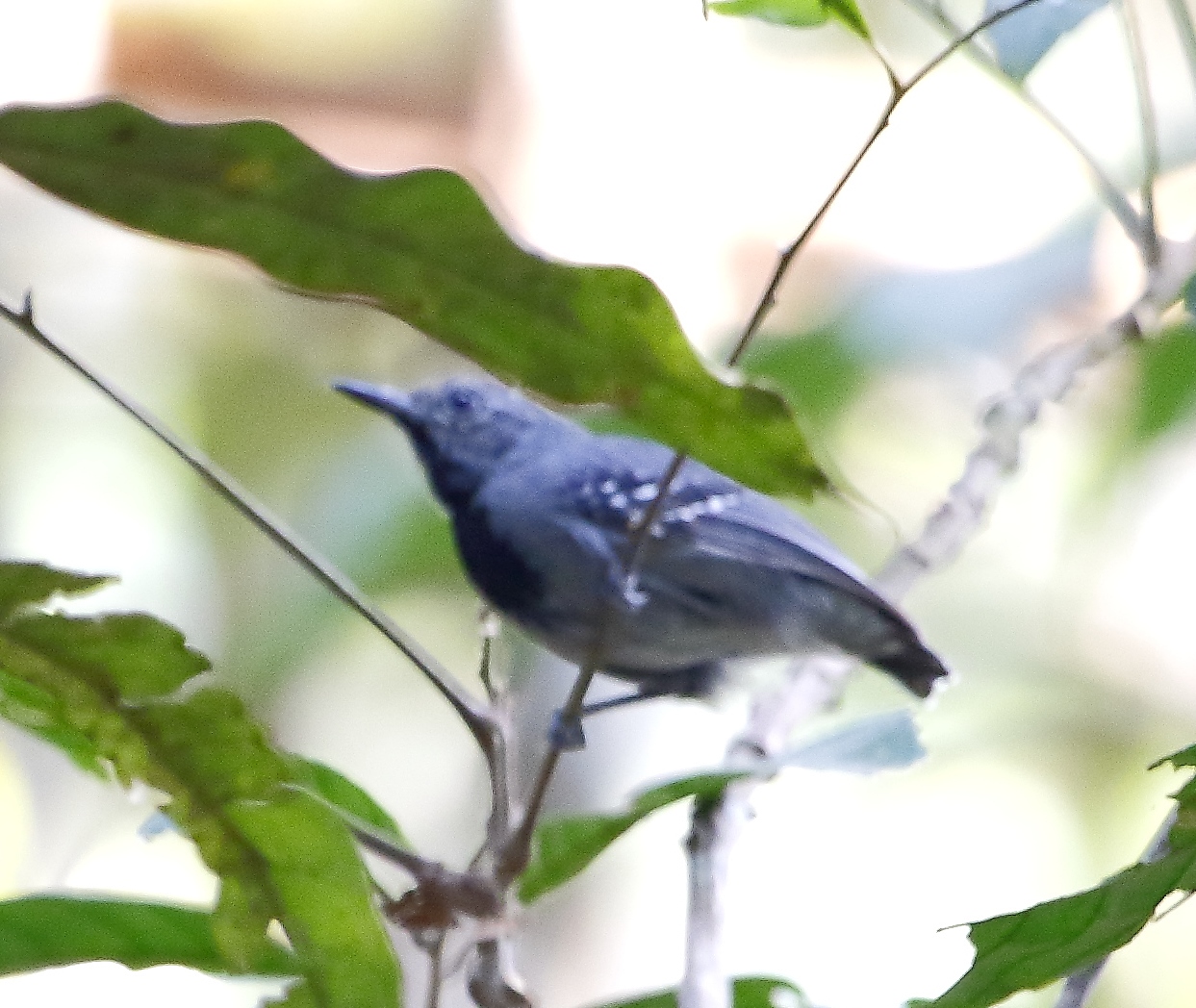
The Long-winged Antwren is one of the commonest grey antwrens of the Amazonian lowlands. Pairs are a regular part of the understorey mixed flocks in terra firme forest, which are often led by antshrikes of the genus Thamnomanes. The name refers to the relatively long wings.
Voice
The song is a short series of clear notes that rise gradually. The call is a short, descending whistle.
Recording: Jacob Wijpkema — CC BY-NC-SA 4.0 · xeno-canto
Identification
9–10 cm, with a fairly short tail and relatively long wings. The male is grey, with a black throat and upper breast and blackish wing coverts with white tips. The female is olive-brown to greyish brown above and warm ochre-yellow below, with a paler throat; the wing coverts have faint pale tips.
Confusion species
Grey Antwren Myrmotherula menetriesii has a shorter tail and often forages higher in the forest; the female is grey above instead of brown. White-flanked Antwren Myrmotherula axillaris has a longer tail and white flank plumes that it often displays, and the male is blackish below. Ihering's Antwren Myrmotherula iheringi in south-eastern Peru and northern Bolivia lives mainly in bamboo. Rio Suno Antwren Myrmotherula sunensis is scarce and has a shorter tail.
Habitat
Understorey and lower middle storey of humid terra firme forest in the lowlands and foothills, up to about 1000 m. Pairs glean insects from leaves and thin twigs, almost always in mixed flocks.
Where the bird is most at home, classified by the vegetation units of the Andes and the west coast.


Range and movements
Colombia: in the lowlands east of the Andes. Ecuador: in the eastern lowlands. Peru: in the eastern lowlands throughout the country. Bolivia: in the north. Absent west of the Andes and from the Galápagos. Outside the guide area in southern Venezuela, the Guianas and Brazilian Amazonia.
- Resident
- dark = core range, pale = thinly spread
How and when to look
Follow a mixed flock in terra firme forest; such flocks can be recognised by the loud calls of the Thamnomanes antshrikes. Pairs of Long-winged Antwrens forage within them a few metres above the ground.
Conservation status
Least Concern. Common in extensive lowland forest; locally declining through deforestation.
Scientific name
Myrmotherula longipennis | Pelzeln, 1868
Pelzeln described the species in 1868 and placed it straight away in the genus where it still stands. The genus Myrmotherula was introduced in 1858 by Sclater. The genus name is a diminutive of Myrmothera (Greek murmos, 'ant', and thēras, 'hunter'): little ant-hunter. The species name comes from Latin longus, 'long', and penna, 'feather, wing'. The specimen the first description was based on came from Marabitanas, Rio Negro, Amazonas, Brazil.