All species › Cranes, rails and allies › Rails, gallinules and coots › Mangrove Rail
Mangrove Rail | Rallus longirostris
Grijze ral | Rascón manglero | Saracura-matraca
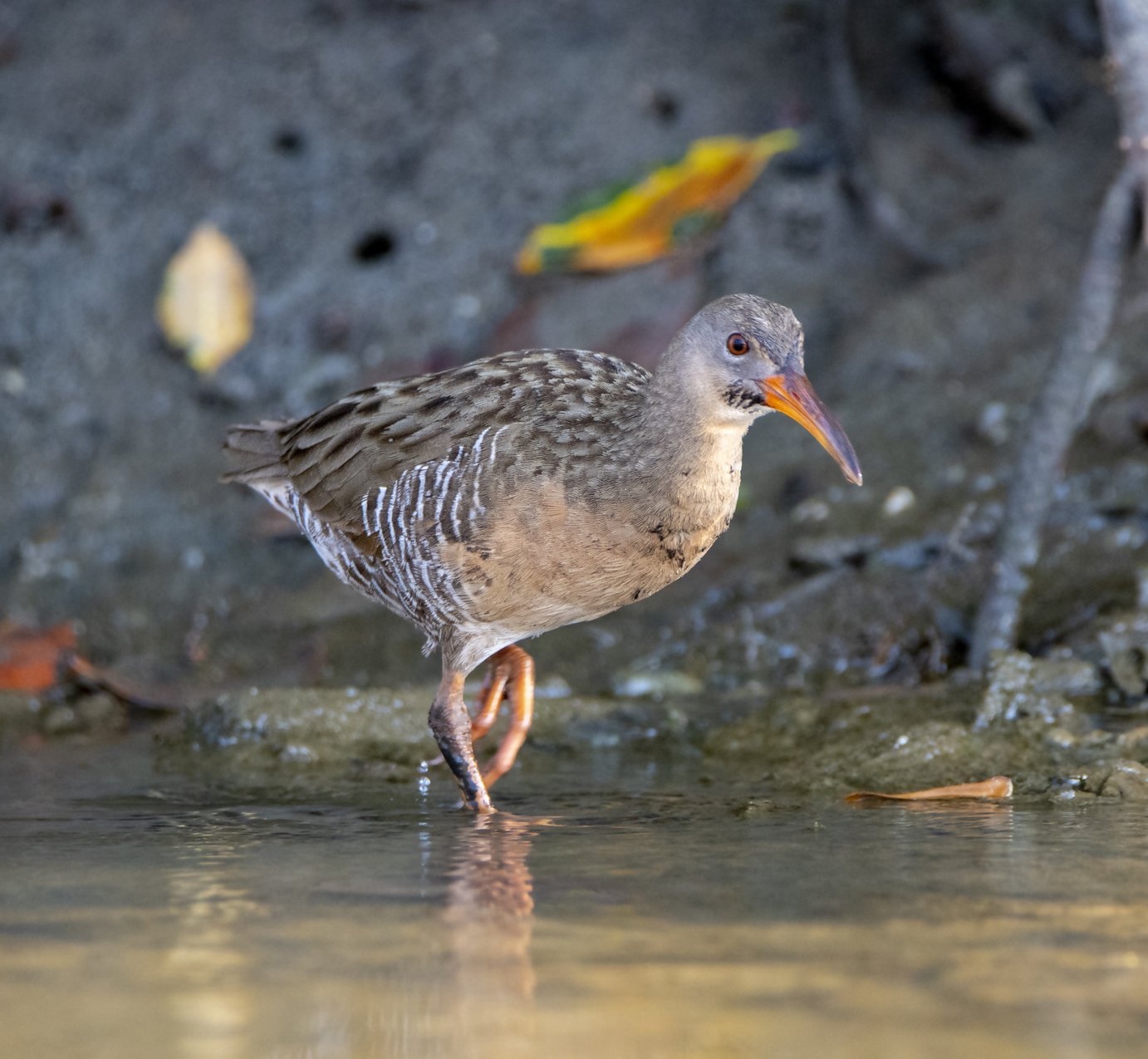
The Mangrove Rail is a large, long-billed rail of coastal mangroves. It lives among the roots and on the mudflats of the intertidal zone and is mostly heard, giving a loud, rattling call. It was formerly included in Clapper Rail.
Voice
A loud, dry, rattling series, roughly kek-kek-kek-kek, first accelerating and then slowing, often answered by other birds, mainly at the turn of the tide and at dusk.
Recording: Iván Lau — CC BY-NC-SA 4.0 · xeno-canto
Identification
32–36 cm, with a long, slightly decurved bill with a yellow-orange base. The upperparts are greyish brown with dark feather centres. The cheeks are grey, the throat white, the breast and neck cinnamon to greyish. The flanks and belly are barred black and white, the undertail coverts white. The legs are greyish brown to orangish. The sexes are alike; juveniles are darker and less clearly barred.
Confusion species
Blackish Rail Pardirallus nigricans is uniformly dark grey and brown, without barring, with a green bill and red legs, and lives in freshwater marshes. Spotted Rail Pardirallus maculatus is blackish with white spots and bars. Rufous-necked Wood Rail Aramides axillaris has a rufous head and neck and a black rear, and a shorter bill.
Habitat
Mangroves, tidal creeks, mudflats and salt marshes along the coast, at sea level. At low tide it searches the mud for crabs, other crustaceans, molluscs and insects. The nest is a cup of plant material, hidden among mangrove roots or in dense vegetation just above the high-water line.
Where the bird is most at home, classified by the vegetation units of the Andes and the west coast.


Range and movements
In Colombia along the Pacific and Caribbean coasts, in mangroves. In Ecuador along the whole coast, mainly in the large mangrove areas in the north and around the Gulf of Guayaquil. In Peru only in the extreme north-west (Tumbes). Absent from Bolivia and the Galápagos. Outside the guide area along the coasts of Venezuela, Trinidad, the Guianas and Brazil.
- Resident
- dark = core range, pale = thinly spread
How and when to look
Listen on a rising or falling tide along mangrove creeks, for example near Tumbes or in the mangroves of the Gulf of Guayaquil; at low tide birds sometimes walk over open mud at the edge of the roots.
Conservation status
Least Concern. Dependent on mangroves, which are locally cleared for shrimp ponds.
Scientific name
Rallus longirostris | Boddaert, 1783
Boddaert described the species in 1783 and placed it straight away in the genus where it still stands. The genus Rallus was introduced in 1758 by Linnaeus. The genus name is New Latin rallus, 'rail', from Old French rasle; Linnaeus introduced the genus in 1758. The species name comes from Latin longus, 'long', and rostrum, 'bill'. The specimen the first description was based on came from Cayenne, French Guiana.