All species › Parrots › African and New World parrots › Mealy Amazon
Mealy Amazon | Amazona farinosa
Grote amazone | Loro corona azul | Papagaio-moleiro
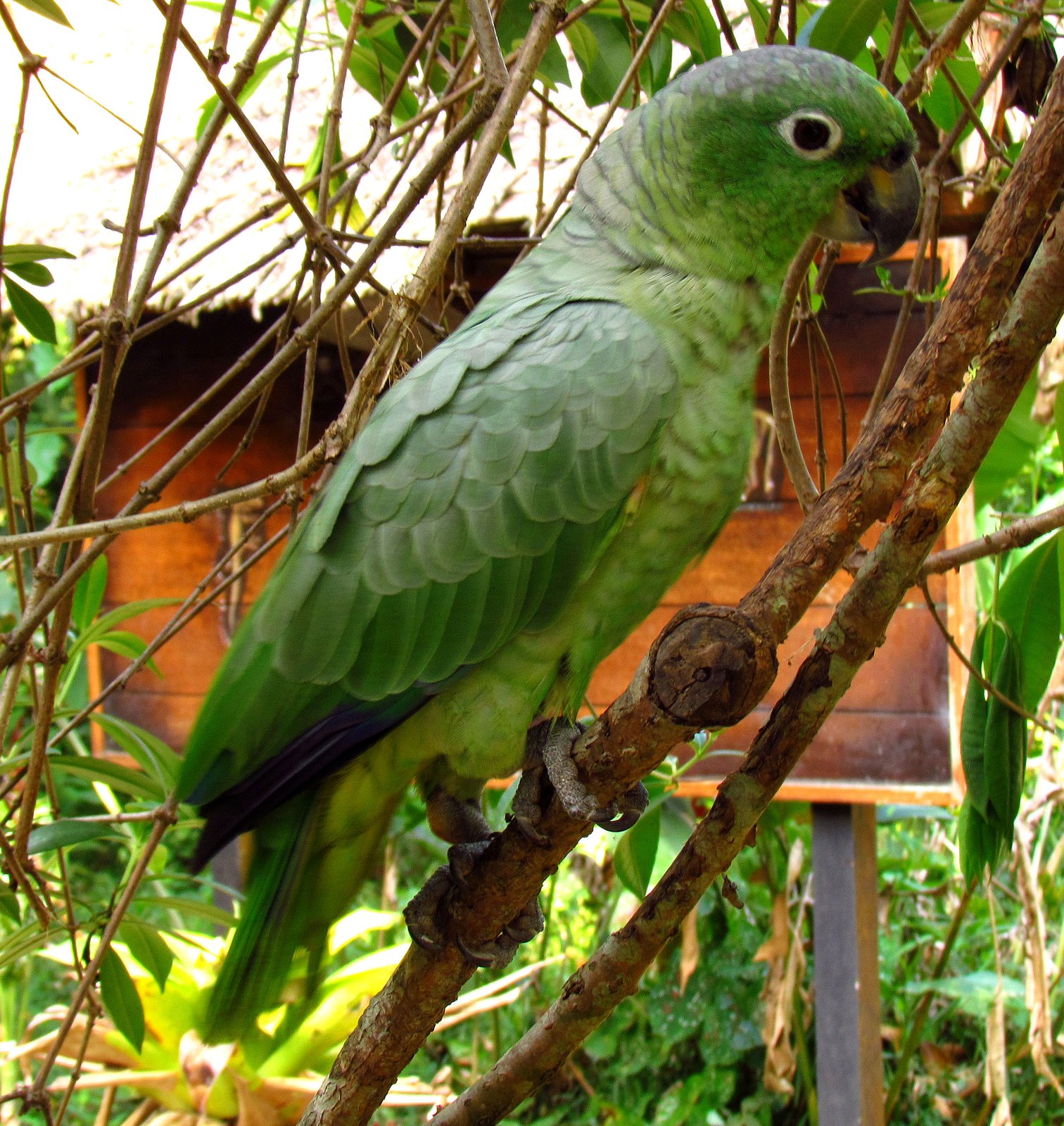
The Mealy Amazon is the largest amazon parrot of the guide area, a heavy, green parrot with a powdery look. It lives in humid lowland forest on both sides of the Andes. Pairs fly high over the forest with slow, shallow wingbeats, calling loudly.
Voice
A loud, harsh and varied series of calls, including a repeated chok-chok and harsh, rolling cries; flocks are noisy at the roost.
Recording: Tristan Guillebot de Nerville — CC BY-NC-SA 4.0 · xeno-canto
Identification
38–40 cm, with a short, square tail. The plumage is green, with a greyish-white, powdery bloom on the back and nape. There is a broad, bare white ring around the eye. There is sometimes a small yellow patch on the crown. The bend of the wing is green or has some red, the speculum on the secondaries is red, and the primaries have dark blue tips. The tail has a yellowish-green terminal band. The bill is horn-coloured. The sexes are alike.
Confusion species
Yellow-crowned Amazon Amazona ochrocephala is smaller, with a more distinct yellow crown and a narrow eye-ring. Orange-winged Amazon Amazona amazonica is smaller, with yellow and blue on the head and an orange speculum. Kawall's Amazon Amazona kawalli has a bare white patch at the base of the bill, a narrower eye-ring and red at the base of the tail, and lacks the powdery back. Scaly-naped Amazon Amazona mercenarius is smaller, with a scaly nape, and lives higher in montane forest.
Habitat
Humid lowland and foothill forest on terra firme and in várzea, also forest edges and tall secondary growth, from sea level to about 1100 m. It eats fruit, seeds and nuts high in the canopy. It nests in cavities high in large trees.
Where the bird is most at home, classified by the vegetation units of the Andes and the west coast.


Range and movements
In Colombia in the Pacific lowlands, in the north and the Magdalena valley, and in Amazonia. In Ecuador in the north-west and in the eastern lowlands. In Peru in the Amazonian lowlands. In Bolivia in the northern and central lowlands. Absent from the Galápagos. Outside the guide area in eastern Panama, Venezuela, the Guianas, and Amazonia and the Atlantic Forest of Brazil.
- Resident
- dark = core range, pale = thinly spread
How and when to look
Early in the morning, watch from a canopy tower, riverbank or clearing for pairs flying high over the forest. The loud calls carry far.
Conservation status
Not Evaluated in its current taxonomic limits. The species depends on large, continuous forest and declines where it is cleared; it is also trapped for the bird trade.
Scientific name
Amazona farinosa | (Boddaert, 1783)
Boddaert described the species in 1783 as Psittacus farinosus; because it was later moved to another genus, the author and year stand in brackets. The genus Amazona was introduced in 1830 by Lesson. The genus name is a Latinised form of Amazone, the name the French naturalist Buffon gave these parrots in the 18th century, believing they came from the Amazon jungles. The species name comes from Latin farinosus, 'mealy, powdered', for the greyish, powdery bloom on the plumage. The specimen the first description was based on came from Cayenne, French Guiana.