All species › Parrots › African and New World parrots › Turquoise-fronted Amazon
Turquoise-fronted Amazon | Amazona aestiva
Blauwvoorhoofdamazone | Amazona frentiazul | Papagaio-verdadeiro
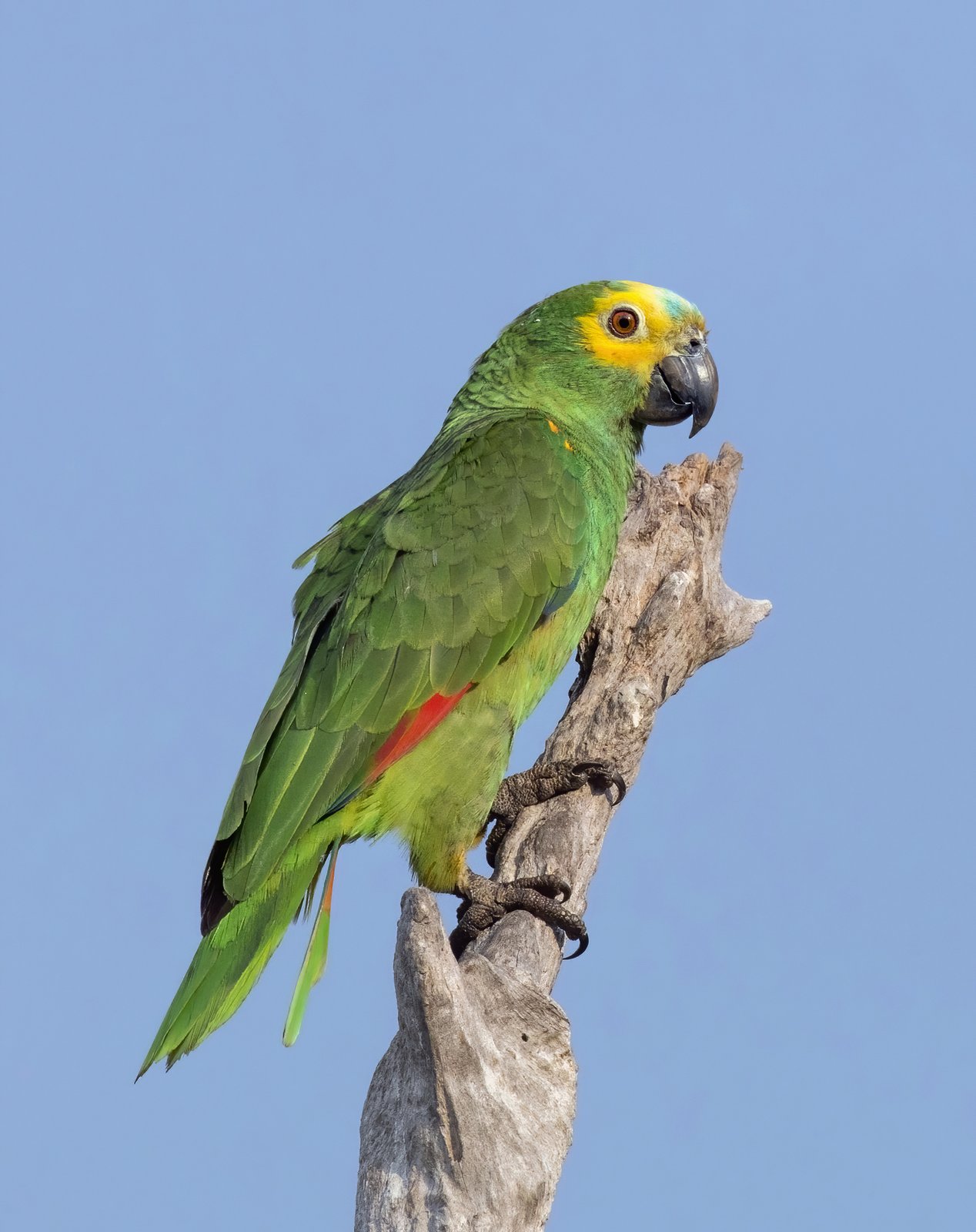
The Turquoise-fronted Amazon is a large amazon parrot with a blue forehead and a yellow face, of the dry forests and savannas of central South America. In the guide area it occurs only in eastern and southern Bolivia. It is among the parrots most heavily trapped for the bird trade.
Voice
Loud, harsh, rolling calls, often in flight, and a varied repertoire of whistles and chattering notes.
Recording: JAYRSON ARAUJO DE OLIVEIRA — CC BY-NC-SA 4.0 · xeno-canto
Identification
37 cm, with a short, rounded tail. The plumage is green, with dark feather edges. The forehead and lores are turquoise blue, the face and crown yellow, to a varying extent. The wing has a red speculum; in the subspecies xanthopteryx, which lives in Bolivia, the bend of the wing is yellow or yellow mixed with red, in the nominate form red. The bill is dark. The sexes are alike; juveniles have less blue and yellow on the head.
Confusion species
Yellow-crowned Amazon Amazona ochrocephala lacks the blue forehead, has a red bend of the wing and lives mainly in more humid forest in northern Bolivia. Tucuman Amazon Amazona tucumana is smaller, with a red forehead and a scaly look, and lives in montane forest. Scaly-headed Parrot Pionus maximiliani is smaller, with a dark head and red undertail coverts.
Habitat
Chaco and Chiquitano dry forest, savanna with groves, gallery forest and palm woodland, mainly in the lowlands, locally up to about 1600 m on the lower Andean slopes. It eats fruit, seeds and flowers, also in fields and plantations. It nests in tree cavities. Outside the breeding season flocks wander and gather at communal roosts.
Where the bird is most at home, classified by the vegetation units of the Andes and the west coast.


Range and movements
In Bolivia in the eastern and southern lowlands, mainly in Santa Cruz, southern Beni, Chuquisaca and Tarija. Absent from Colombia, Ecuador, Peru and the Galápagos. Outside the guide area in eastern and central Brazil, Paraguay and northern Argentina.
- Resident
- dark = core range, pale = thinly spread
How and when to look
Search the Chiquitano dry forest and the Chaco of Santa Cruz in the morning and evening for pairs and flocks flying over, calling loudly.
Conservation status
Near Threatened. The species is trapped on a large scale for the bird trade, and the dry forest and savanna it lives in are being converted to farmland.
Scientific name
Amazona aestiva | (Linnaeus, 1758)
Linnaeus described the species in 1758 as Psittacus aestivus; because it was later moved to another genus, the author and year stand in brackets. The genus Amazona was introduced in 1830 by Lesson. The genus name is a Latinised form of Amazone, the name the French naturalist Buffon gave these parrots in the 18th century, believing they came from the Amazon jungles. The species name comes from Latin aestivus, 'of summer'; why Linnaeus chose this name is unclear. The specimen the first description was based on came from Southern Brazil.