All species › Parrots › African and New World parrots › Yellow-crowned Amazon
Yellow-crowned Amazon | Amazona ochrocephala
Geelvoorhoofdamazone | Amazona coroniamarilla | Papagaio-campeiro
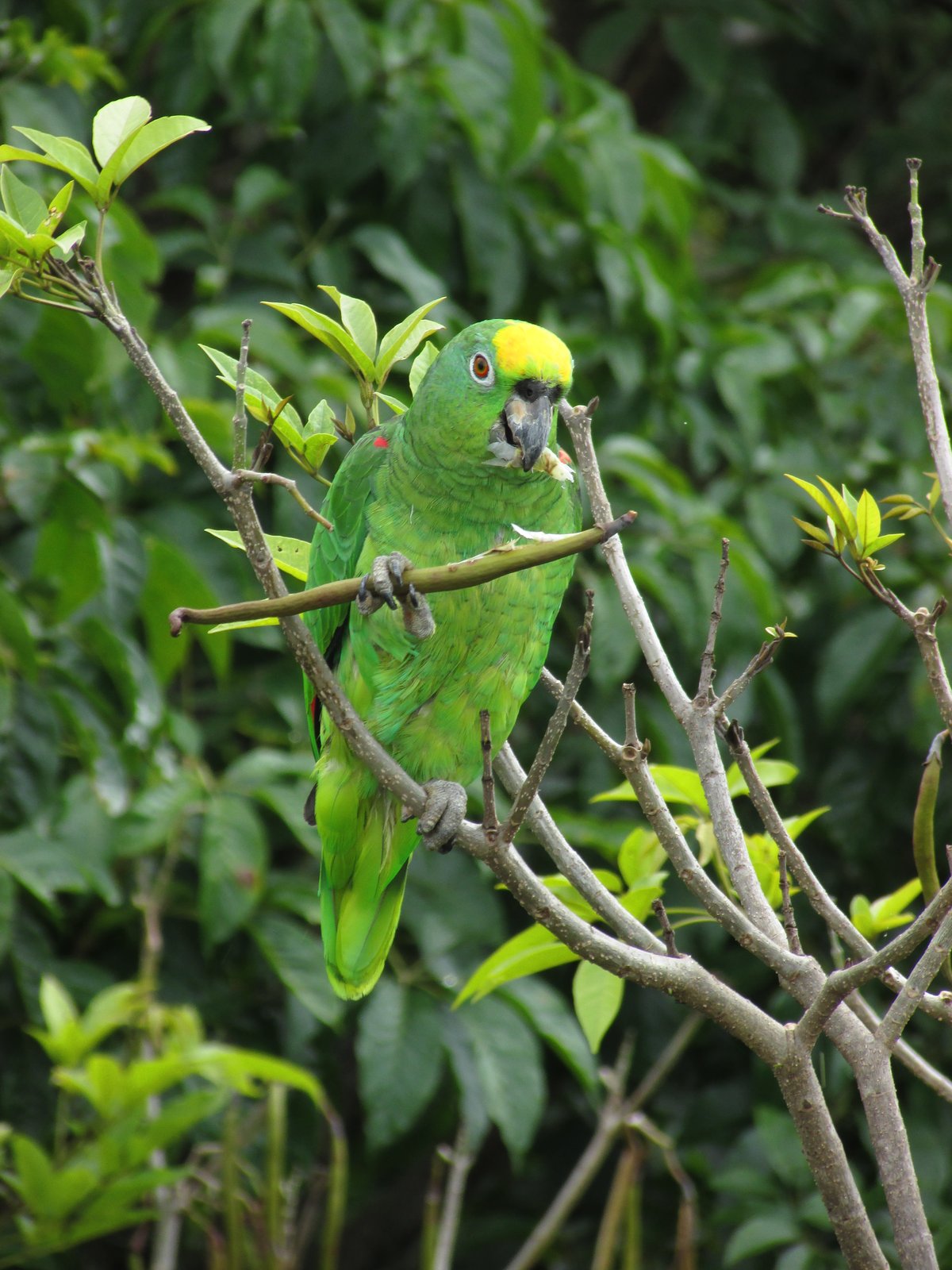
The Yellow-crowned Amazon is a large, green amazon parrot with a yellow patch on the forehead and crown. It is widespread in the lowlands east of the Andes and in northern Colombia. Pairs fly high over the forest with fast, shallow wingbeats, calling loudly.
Voice
A loud, rolling, harsh call, often repeated two or three times, in flight and at the roost; also varied whistles and chattering notes.
Recording: Jacob Wijpkema — CC BY-NC-SA 4.0 · xeno-canto
Identification
35 cm, with a short, square tail. The plumage is green. The forehead and forecrown are yellow; the extent of yellow varies by subspecies and individual, and in the Amazonian subspecies nattereri the head is bluish green with little yellow. The bend of the wing and the speculum on the secondaries are red, and the primaries have blue tips. The bill is dark with a pale patch at the base of the upper mandible. The sexes are alike; juveniles have less yellow.
Confusion species
Orange-winged Amazon Amazona amazonica is smaller, with blue and yellow on the head, an orange speculum and a pale bill. Mealy Amazon Amazona farinosa is larger, with a broad white eye-ring and a powdery back. Festive Amazon Amazona festiva has a blue brow and throat and a red rump, without red on the wing. Turquoise-fronted Amazon Amazona aestiva has a blue forehead and lives in eastern and southern Bolivia.
Habitat
Várzea and gallery forest, forest edges, river islands, palm swamps, savanna with groves and semi-open country, from the lowlands to about 800 m. It eats fruit, seeds, nuts and flowers. It nests in cavities in trees or dead palms.
Where the bird is most at home, classified by the vegetation units of the Andes and the west coast.


Range and movements
In Colombia in the Caribbean lowlands, the Magdalena valley, the Llanos and Amazonia. In Ecuador in the eastern lowlands. In Peru in the Amazonian lowlands. In Bolivia in the north, in Pando and Beni. Absent west of the Andes in Ecuador and Peru and from the Galápagos. Outside the guide area in Panama, Venezuela, the Guianas and Brazilian Amazonia.
- Resident
- dark = core range, pale = thinly spread
How and when to look
Search along large rivers and on river islands in the Amazonian lowlands, and in the Colombian Llanos, for pairs flying high overhead early in the morning. Fruiting trees and palms along the banks attract small groups.
Conservation status
Least Concern. The species is trapped locally for the bird trade and disappears where riverine forest is cleared.
Scientific name
Amazona ochrocephala | (Gmelin, 1788)
Gmelin described the species in 1788 as Psittacus ochrocephalus; because it was later moved to another genus, the author and year stand in brackets. The genus Amazona was introduced in 1830 by Lesson. The genus name is a Latinised form of Amazone, the name the French naturalist Buffon gave these parrots in the 18th century, believing they came from the Amazon jungles. The species name comes from Greek ōkhros, 'yellow', and kephalē, 'head', for the yellow crown. The specimen the first description was based on came from Venezuela.