All species › Passerines › Antbirds › Moustached Antwren
Moustached Antwren | Myrmotherula ignota
Griscoms miersluiper | Hormiguerito bigotudo | Choquinha-de-bico-curto
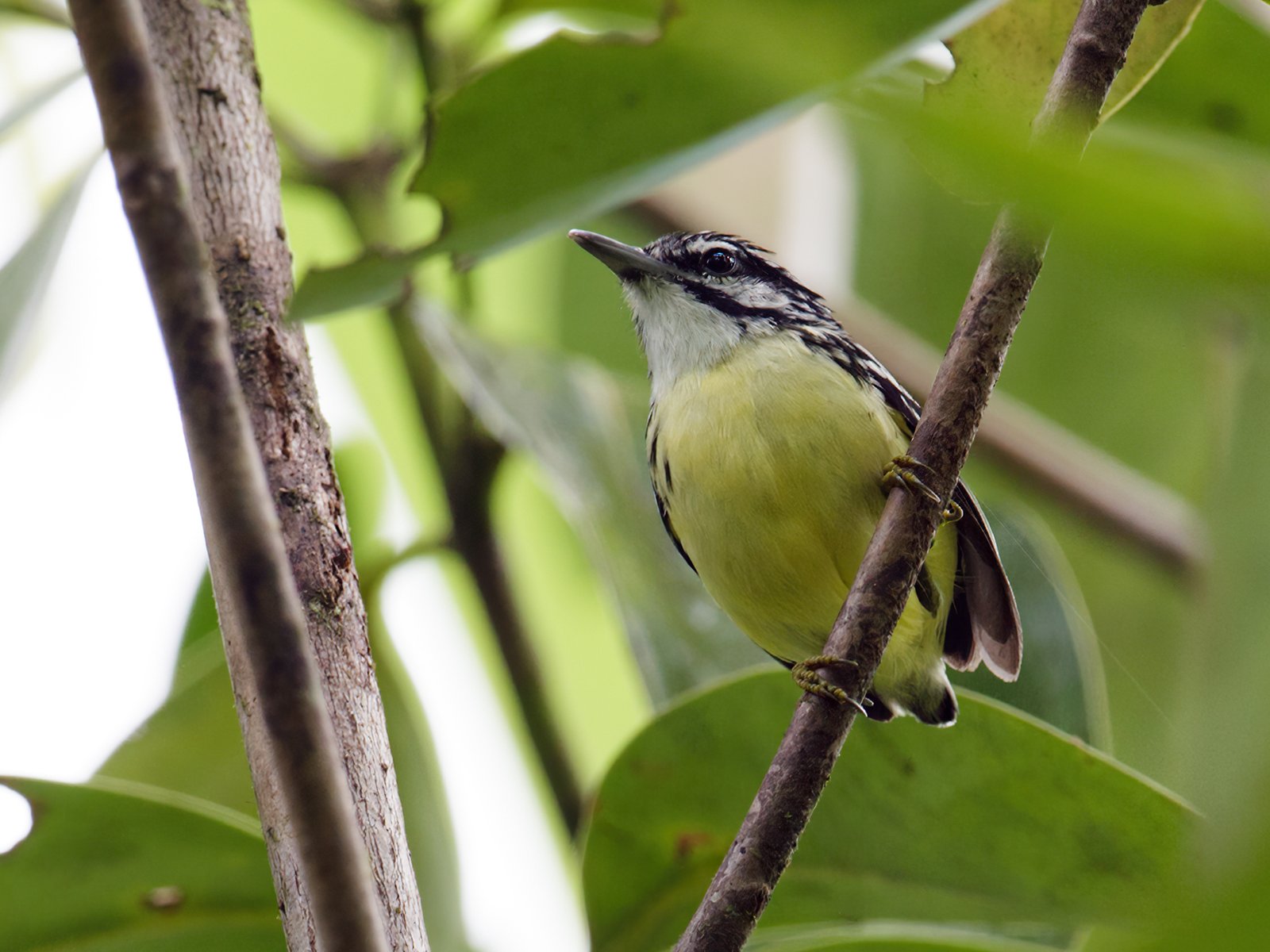
The Moustached Antwren is a very small, short-tailed antwren with black-and-white streaked upperparts, a yellow belly and a black malar stripe. It occurs in two separate areas: west of the Andes in the Chocó and in the western Amazon. It lives high in the canopy.
Voice
The song is a series of clear, even whistles that speed up slightly, without the marked rise of the Pygmy Antwren. The call is a soft, high tsee.
Recording: Juan Freile — CC BY-NC-SA 4.0 · xeno-canto
Identification
8 cm, with a short bill and a very short tail. The male is black above with white streaks and white wing bars; the throat is white with a distinct black malar stripe, the rest of the underparts yellow. The female has a buff-tinged head and throat.
Confusion species
Pygmy Antwren Myrmotherula brachyura, only east of the Andes, lacks the distinct malar stripe, has a slightly longer bill and an accelerating, rising song. Pacific Antwren Myrmotherula pacifica west of the Andes has white underparts streaked black without yellow and lives low at forest edges.
Habitat
Canopy and edges of humid lowland rainforest, tall secondary forest and vines along gaps, up to about 900 m. It forages in pairs in fine foliage for small insects, often with mixed flocks. The nest is a small, suspended cup.
Where the bird is most at home, classified by the vegetation units of the Andes and the west coast.


Range and movements
Colombia: west of the Andes in the Chocó and the north, and in the southeast. Ecuador: in the northwest and in the eastern lowlands. Peru: in the northeast. Absent from Bolivia and the Galápagos. Outside the guide area in eastern Panama and western Amazonian Brazil.
- Resident
- dark = core range, pale = thinly spread
How and when to look
In northwestern Ecuador or the Chocó listen for the song from the canopy; in the Amazon the black malar stripe separates it from Pygmy Antwren.
Conservation status
Least Concern. Fairly common; tolerates forest edges and secondary forest, but disappears where forest is cleared entirely.
Scientific name
Myrmotherula ignota | Griscom, 1929
Griscom described the species in 1929 and placed it straight away in the genus where it still stands. The genus Myrmotherula was introduced in 1858 by Sclater. The genus name is a diminutive of Myrmothera (Greek murmos, 'ant', and thēras, 'hunter'): little ant-hunter. The species name is Latin ignotus, 'unknown'. The specimen the first description was based on came from Jesusito, Darién, Panama.