All species › Passerines › Antbirds › Pygmy Antwren
Pygmy Antwren | Myrmotherula brachyura
Dwergmiersluiper | Hormiguerito pigmeo | Choquinha-miúda
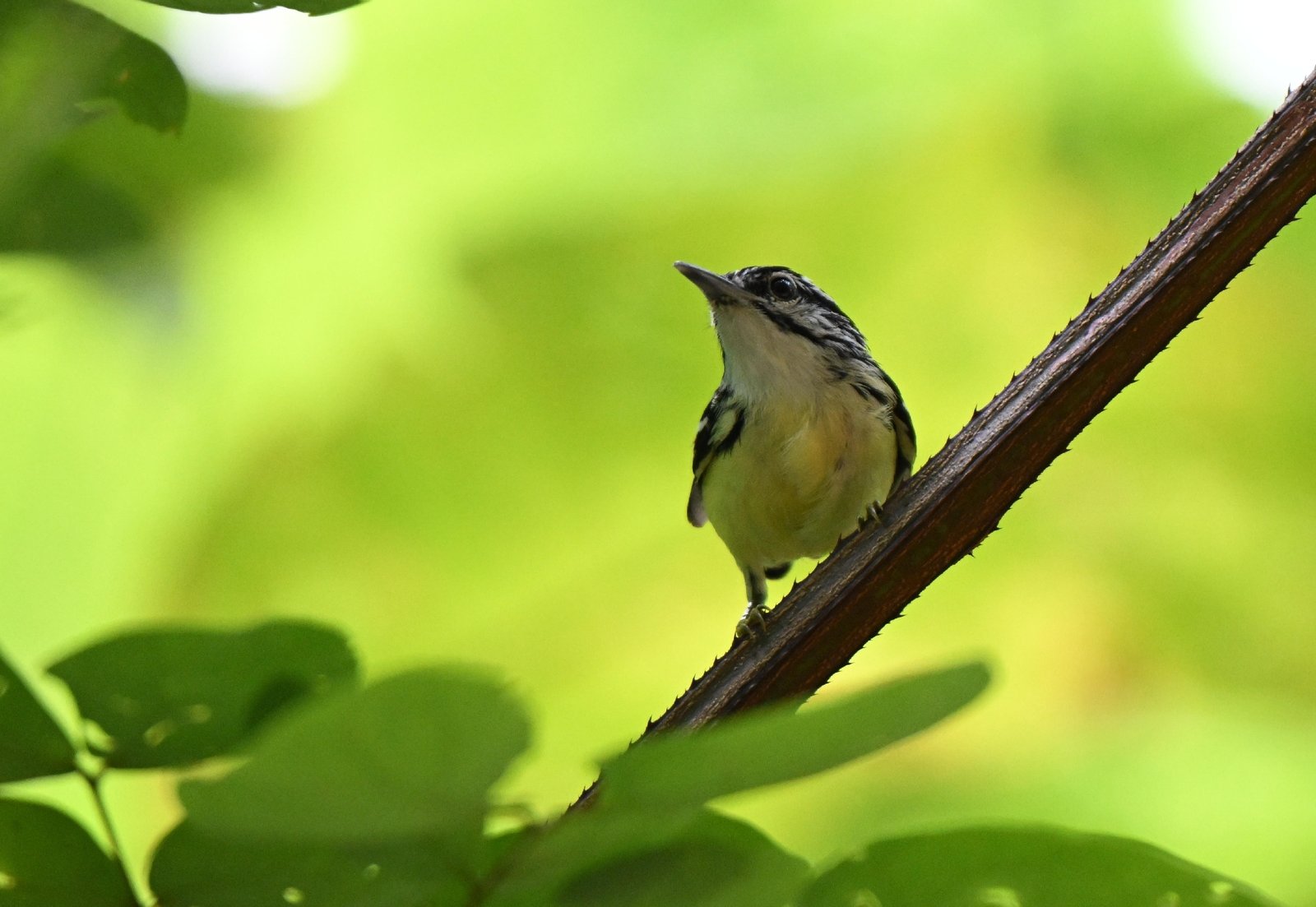
The Pygmy Antwren is one of the smallest antbirds: a short-tailed, black-and-white streaked bird with a yellow belly. It lives high in the trees of lowland rainforest and forest edges throughout the Amazon. Pairs often give their accelerating song from the canopy.
Voice
The song is an accelerating, slightly rising series of clear notes, dee-dee-dee-di-di-dididididi. The call is a soft chee.
Recording: JAYRSON ARAUJO DE OLIVEIRA — CC BY-NC-SA 4.0 · xeno-canto
Identification
8 cm, with a very short tail. The male is black above with white streaks and has two white wing bars. The throat is white and the rest of the underparts lemon yellow; a black malar stripe is absent or faint. The female resembles the male but has a buff-tinged head.
Confusion species
Moustached Antwren Myrmotherula ignota is very similar, but has a distinct black malar stripe, a shorter bill and a different song. Yellow-throated Antwren Myrmotherula ambigua has a yellow throat and lives in the far northeast. Amazonian Streaked Antwren Myrmotherula multostriata has white underparts streaked black and lives low along water.
Habitat
Canopy and mid-storey of humid lowland rainforest, várzea, forest edges, gaps and tall secondary forest, mostly below 1000 m. It forages in pairs in fine foliage and vines for small insects, often with canopy mixed flocks. The nest is a small, deep cup suspended in the fork of a branch.
Where the bird is most at home, classified by the vegetation units of the Andes and the west coast.


Range and movements
Colombia: in the lowlands east of the Andes. Ecuador: in the eastern lowlands. Peru: throughout the Amazon lowlands. Bolivia: in the northern and central lowlands. Absent from the Galápagos. Outside the guide area in Venezuela, the Guianas and Amazonian Brazil.
- Resident
- dark = core range, pale = thinly spread
How and when to look
Listen for the accelerating song along forest edges, gaps and at canopy towers in the lowlands; the birds usually stay high in the canopy.
Conservation status
Least Concern. Common and widespread; tolerates forest edges and secondary forest.
Scientific name
Myrmotherula brachyura | (Hermann, 1783)
Hermann described the species in 1783 as Muscic[apae] brachyurae; because it was later moved to another genus, the author and year stand in brackets. The genus Myrmotherula was introduced in 1858 by Sclater. The genus name is a diminutive of Myrmothera (Greek murmos, 'ant', and thēras, 'hunter'): little ant-hunter. The species name comes from Greek brakhus, 'short', and -ouros, 'tailed': short-tailed. The specimen the first description was based on came from Cayenne, French Guiana.