All species › Passerines › Antbirds › Pearly Antshrike
Pearly Antshrike | Megastictus margaritatus
Parelmierklauwier | Batará perlado | Choca-pintada
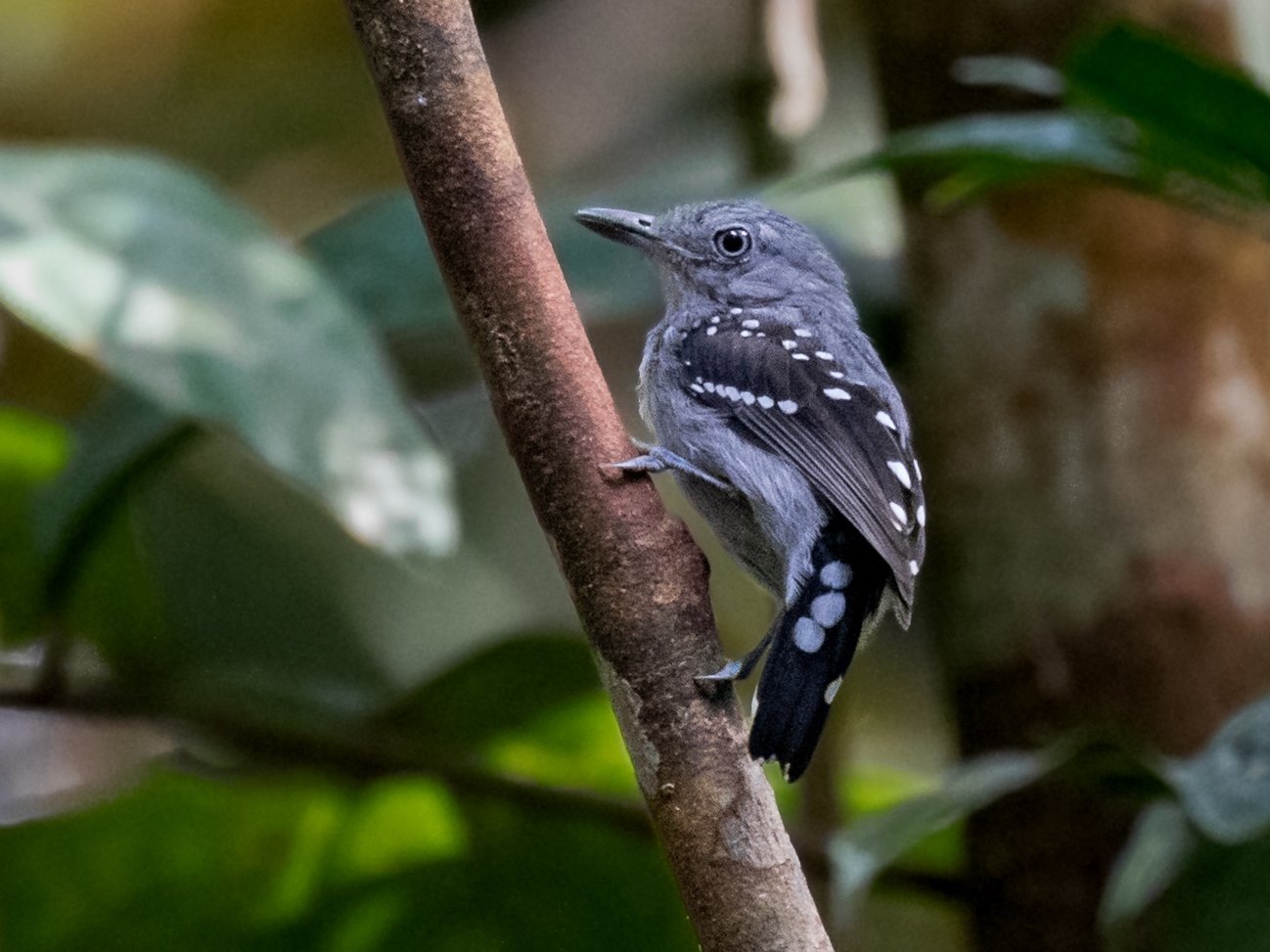
The Pearly Antshrike is a small antshrike with large, round white spots on the wings, buff in the female, which give it its name. It is the only species in the genus Megastictus and has a disjunct distribution: one population in north-western Amazonia and another south of the Amazon in Brazil. It lives mainly in forest on poor sandy soils.
Voice
The song consists of a few slow, slurred whistles rising and falling, followed by a faster series of flat, raspy notes. Alarm and contact calls are upslurred whistles; in disputes a hard rattle.
Recording: Ross Gallardy — CC BY-NC-SA 4.0 · xeno-canto
Identification
12–13 cm, with a fairly short, hook-tipped bill. The male is grey on the head, back and underparts, paler on the chin, throat and centre of the belly; the wings are black with large, round white spots on the coverts and tertials, the tail is black with white tips and the uppertail coverts are white-tipped. The female is yellowish brown above, with pale buff spots in the same places, and cinnamon-ochraceous below, palest on the throat and centre of the belly.
Confusion species
Spot-winged Antshrike Pygiptila stellaris has a shorter tail and smaller white dots on the wings and lives in the canopy. Dot-winged Antwren Microrhopias quixensis is smaller and black (male) or black and rufous (female), with a long, white-tipped tail. Cinereous Antshrike Thamnomanes caesius is larger and lacks the white wing spots.
Habitat
Understorey of evergreen forest and adjacent secondary woodland, in most areas preferably on sandy soils; in Ecuador mainly in terra firme forest, also at the edges of lagoons, but not in riverine forest. In the guide area mostly below 300–400 m. It forages singly, in pairs or in family groups 2–6 m up and rarely joins mixed flocks; it catches insects with upward sallies, in the air or by hover-gleaning foliage. The only described nest was a cup of plant fibres, rootlets and dead leaves, low in a sapling.
Where the bird is most at home, classified by the vegetation units of the Andes and the west coast.


Range and movements
Colombia: in the south-east, in the Amazonian lowlands. Ecuador: in the eastern lowlands. Peru: in the north-east (Loreto), including white-sand forest near Iquitos. Absent from Bolivia and the Galápagos. Outside the guide area in southern Venezuela and Amazonian Brazil.
- Resident
- dark = core range, pale = thinly spread
How and when to look
Search forest on sandy soils, such as the white-sand forest of Allpahuayo-Mishana near Iquitos. Birds often sit still in the understorey and give themselves away by their whistles.
Conservation status
Least Concern. Its tie to forest on poor sandy soils makes it local; deforestation is the main threat.
Scientific name
Megastictus margaritatus | (Sclater, 1855)
Sclater described the species in 1855 as Myrmeciza margaritata; because it was later moved to another genus, the author and year stand in brackets. The genus Megastictus was introduced in 1909 by Ridgway. The genus name comes from Greek megas, 'large', and stiktos, 'spotted', after the large pale spots on the wings. The species name comes from Latin margaritatus, 'adorned with pearls', after the round pale wing spots. The specimen the first description was based on came from Chamicuros, Loreto, Peru.