All species › Passerines › Antbirds › Jet Antbird
Jet Antbird | Cercomacra nigricans
Rouwmiervogel | Hormiguero azabache | Chororó-azeviche
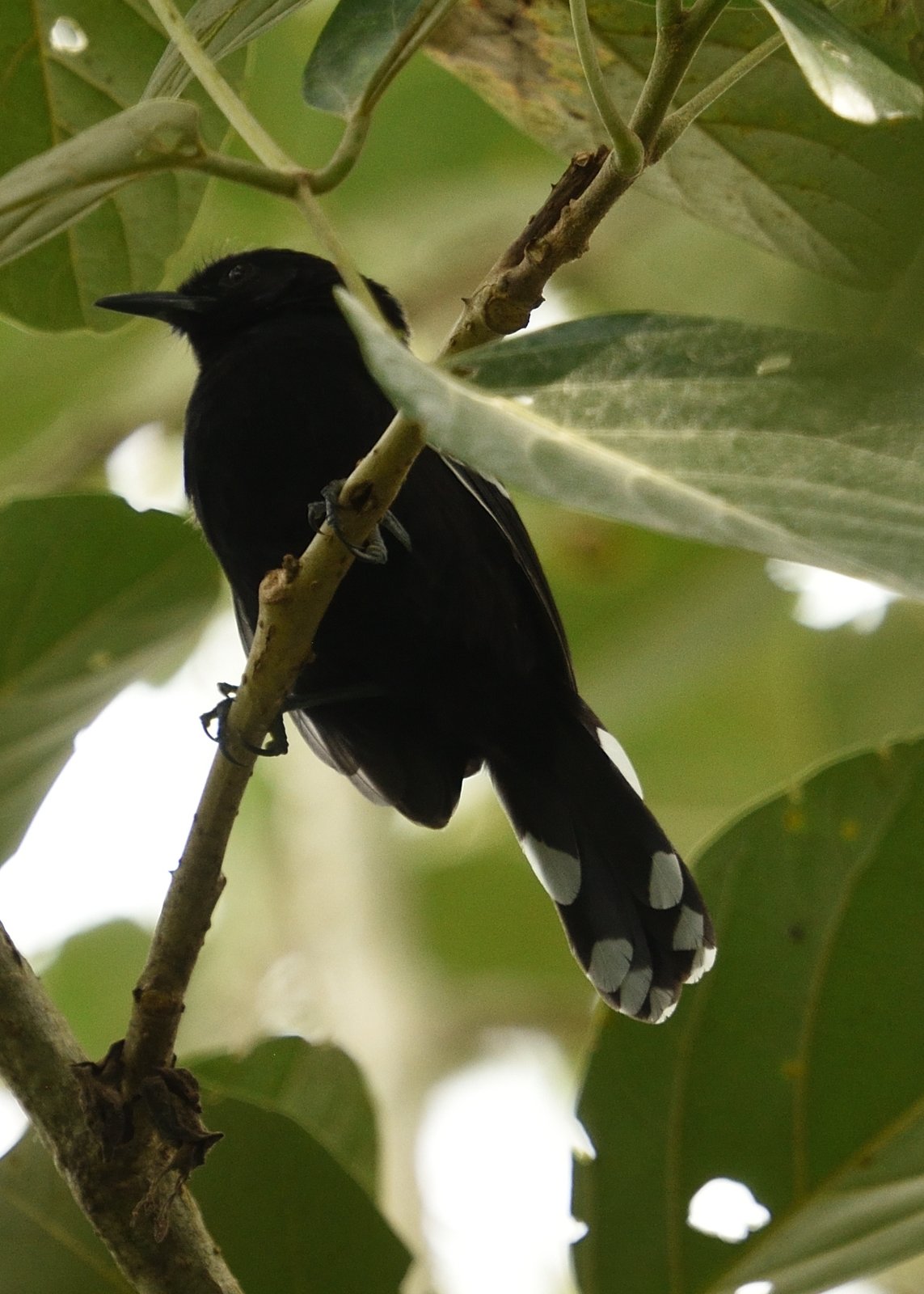
The Jet Antbird is a black antbird of dense vine tangles and shrubbery at forest edges north and west of the Andes. It lives in pairs low in the vegetation, often near water or swampy spots, and usually gives itself away by its harsh, paired song. Of the antbirds of this type in the guide area, the male is the blackest and has the broadest white tail tips.
Voice
The male's song is a series of four or more paired notes, each pair a sharp, short note followed by a longer, burry one: tchuk-kerr tchuk-kerr tchuk-kerr. The female often answers with a series of her own. The call is a harsh chak, usually repeated in series.
Recording: Arcadio Marin — CC BY-NC-SA 4.0 · xeno-canto
Identification
15 cm, with a fairly long, rounded tail. The male is almost entirely black, with white edges to the wing coverts, a white patch between the scapulars (often hidden) and broad white tips to the tail feathers. The female is blackish grey, with the same white pattern on wing and tail, a pale eye-ring, fine white streaks on the throat and breast and pale barring on the lower belly. Young males are at first dull brownish and then resemble the female for a time.
Confusion species
Dusky Antbird Cercomacroides tyrannina is smaller; the male is grey rather than black and lacks the broad white tail tips, and the female is olive-brown with ochre-brown underparts. Parker's Antbird Cercomacroides parkeri lives higher, in montane forest above about 1000 m; the male lacks broad white tail tips and the female is orange-brown below. Blue-lored Antbird Hafferia immaculata is larger, with blue bare skin around the eye and no white wing markings.
Habitat
Dense vine tangles and shrubbery at the edges of humid and drier forest, in old secondary forest and in riparian growth, usually near water or swampy spots. From sea level to about 500 m in Ecuador and to 1500 m in Colombia. It gleans insects and spiders from leaves and twigs, low to mid-height in the vegetation, mostly in pairs. The nest is a deep, hanging cup in dense growth.
Where the bird is most at home, classified by the vegetation units of the Andes and the west coast.


Range and movements
Colombia: in the north and west, including the Caribbean lowlands and the Magdalena valley, and from the centre of the country north-east to Venezuela. Ecuador: in the western lowlands over most of the length of the country. Absent from Peru, Bolivia and the Galápagos. Outside the guide area in central Panama and in Venezuela, with a separate population along the Orinoco.
- Resident
- dark = core range, pale = thinly spread
How and when to look
Search forest edges with dense vine tangles near streams and swampy spots in western Ecuador and northern Colombia. Listen for the burry, paired song; pairs often show briefly at the edge of the thicket.
Conservation status
Least Concern. Fairly common in suitable habitat; the species tolerates secondary forest, but loss of forest and riparian growth reduces the population locally.
Scientific name
Cercomacra nigricans | Sclater, 1858
Sclater described the species in 1858 and placed it straight away in the genus where it still stands. He introduced the genus Cercomacra in that same work. The genus name combines Greek kerkos, 'tail', and makros, 'long'. The species name nigricans is Latin for 'blackish'. The specimen the first description was based on came from Santa Marta, Colombia.