All species › Passerines › Antbirds › Mato Grosso Antbird
Mato Grosso Antbird | Cercomacra melanaria
Matogrossomiervogel | Hormiguero de Mato Grosso | Chororó-do-pantanal
The Mato Grosso Antbird is an antbird of gallery forest and dry forest in the interior of South America, from eastern Bolivia to the Pantanal. In the guide area it occurs only in the Bolivian lowlands. Pairs sing in duet: a very low, dry, froglike note from the male, answered by a high call from the female.
Voice
The male gives a very low, dry, froglike kruk-kruk, often answered by the high, strident call of the female.
Recording: Jacob Wijpkema — CC BY-NC-SA 4.0 · xeno-canto
Identification
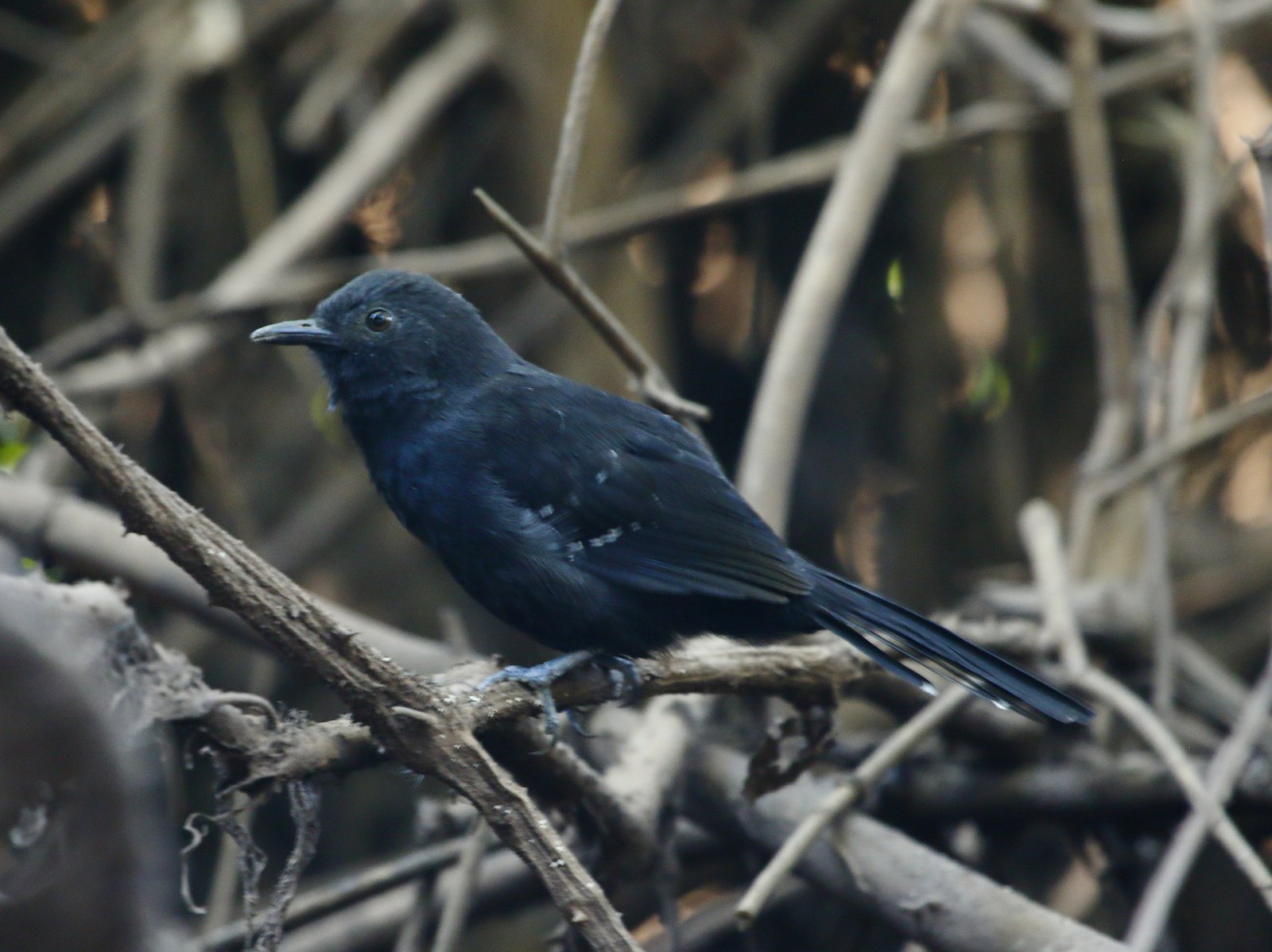
16 cm, with a long tail. The male is almost entirely black, with white edges to the outer scapulars, a white patch between the scapulars, white tips to the wing coverts and tail feathers and white inner edges to the flight feathers. The female has an olive-grey head and upperparts with a white patch between the scapulars, dark grey wings and tail with white tips to the coverts and tail feathers, and pale olive-grey underparts, whiter on the throat and centre of the breast.
Confusion species
Black Antbird Cercomacroides serva has a shorter tail and lives in the understorey of humid Amazonian forest; the female is rufous below. Grey Antbird Cercomacra cinerascens lives high in vine tangles of humid forest; the male is grey and the female olive-yellow below. Manu Antbird Cercomacra manu lives in bamboo in north-western Bolivia; the male is dark grey rather than black.
Habitat
Gallery forest, tropical deciduous forest and seasonally flooded savanna woodland, usually near water, up to about 800 m; part of the population lives in dry Chaco forest. It keeps to dense undergrowth with vine tangles, searching for insects and other arthropods. Usually in pairs. Little is known about its breeding.
Where the bird is most at home, classified by the vegetation units of the Andes and the west coast.


Range and movements
Colombia: absent. Ecuador: absent. Peru: absent. Bolivia: in the central lowlands (Beni and Cochabamba) and in far eastern Santa Cruz. Absent from the Galápagos. Outside the guide area in south-western Brazil (Mato Grosso and Mato Grosso do Sul, including the Pantanal) and northern Paraguay.
- Resident
- dark = core range, pale = thinly spread
How and when to look
In eastern Santa Cruz or the Beni lowlands, search dense, vine-covered undergrowth along rivers and in gallery forest; listen for the duet of the low froglike call and the high reply.
Conservation status
Least Concern. Locally fairly common; conversion of dry forest and gallery forest to farmland and pasture is the main threat.
Scientific name
Cercomacra melanaria | (Ménétries, 1835)
Ménétries described the species in 1835 as Formicivora melanaria; because it was later moved to another genus, the author and year stand in brackets. The genus Cercomacra was introduced in 1858 by Sclater. The genus name combines Greek kerkos, 'tail', and makros, 'long'. The species name melanaria derives from Greek melas, 'black', and means 'blackish'. The specimen the first description was based on came from Cuiabá, Mato Grosso, Brazil.