All species › Passerines › Antbirds › Grey Antbird
Grey Antbird | Cercomacra cinerascens
Grijze miervogel | Hormiguero gris | Chororó-pocuá
The Grey Antbird is an antbird of the mid-storey and lower canopy of Amazonian forest. It lives in dense vine tangles, often 8 to 20 m above the ground, and usually gives itself away by its song. Its rhythmic, rasping song is one of the regular sounds of terra firme forest.
Voice
The song is a rasping, rhythmically repeated two-note phrase, in Peru rendered as djjj-HUR djjj-HUR djjj-HUR, in Ecuador more hiccuping; the song differs somewhat between subspecies. Calls are rattles, a sharp k-luck from the male and a sharp zhip and low nasal growl from the female.
Recording: JAYRSON ARAUJO DE OLIVEIRA — CC BY-NC-SA 4.0 · xeno-canto
Identification
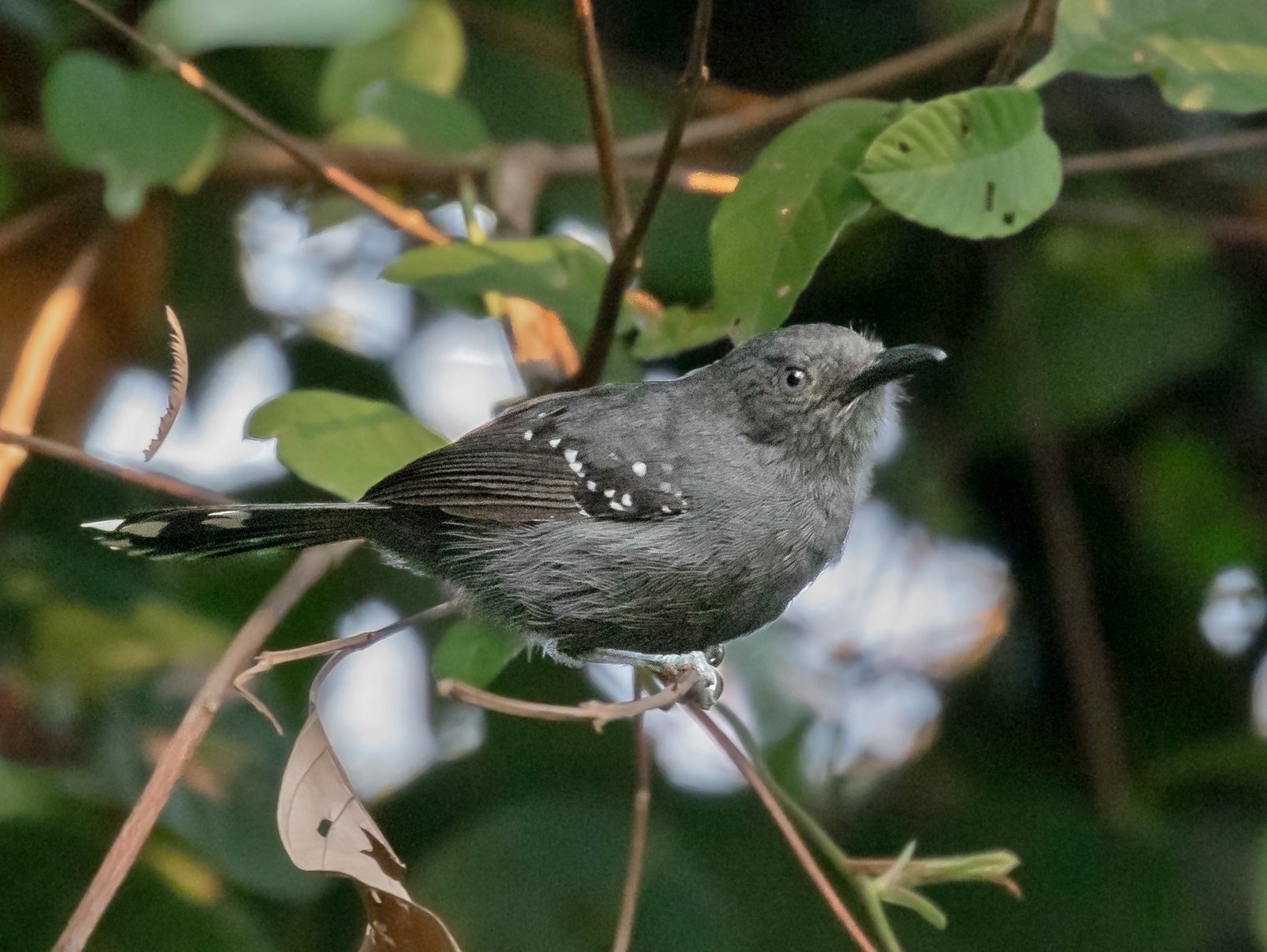
15 cm, with a fairly long tail. The male is dark grey, with a small white patch between the scapulars, faint white spots on the wing coverts and a blackish-grey tail with broad white tips. The female has an olive-brown crown and upperparts, a greyer rump, pale yellowish-olive tips to the wing coverts and a slaty tail with white tips; the throat and underparts are mostly olive-yellow, with darker flanks and undertail coverts.
Confusion species
Manu Antbird Cercomacra manu lives in bamboo, and the female is grey below. Black Antbird Cercomacroides serva lives lower in the understorey; the male is blacker and lacks the broad white tail tips, and the female is rufous below. Mato Grosso Antbird Cercomacra melanaria occurs in the guide area only in eastern Bolivia; the male is black.
Habitat
Dense vegetation and vine tangles in the mid-storey and lower canopy of humid terra firme forest, also in várzea and old secondary forest, from sea level to about 900 m, in Peru to 1150 m. It hops through vines and dense foliage and gleans insects from leaves and twigs, sometimes in mixed flocks. The nest is a deep, hanging cup in dense vegetation.
Where the bird is most at home, classified by the vegetation units of the Andes and the west coast.


Range and movements
Colombia: in the south-east, in the Amazonian lowlands. Ecuador: in the eastern lowlands. Peru: throughout the Amazonian lowlands. Bolivia: in the north-west and north-east. Absent from the Galápagos. Outside the guide area in southern Venezuela, the Guianas and Amazonian Brazil.
- Resident
- dark = core range, pale = thinly spread
How and when to look
In terra firme forest, listen for the rhythmic, rasping song from the vine tangles overhead; with patience the bird can be found among the vines in the mid-storey. A canopy tower gives a good view.
Conservation status
Least Concern. Widespread and fairly common in Amazonian forest; deforestation affects the population locally.
Scientific name
Cercomacra cinerascens | (Sclater, 1857)
Sclater described the species in 1857 as Formicivora cinerascens; because it was later moved to another genus, the author and year stand in brackets. The genus Cercomacra was introduced in 1858 by Sclater. The genus name combines Greek kerkos, 'tail', and makros, 'long'. The species name cinerascens is Latin for 'greyish, turning ash-grey'. The specimen the first description was based on came from Río Napo, Ecuador.