All species › Passerines › Antbirds › Manu Antbird
Manu Antbird | Cercomacra manu
Peruaanse miervogel | Hormiguero del Manu | Chororó-de-manu
The Manu Antbird is a specialist of Guadua bamboo in south-western Amazonia. The species was described only in 1990, from specimens taken in the Manu area. Pairs keep to dense bamboo stands and often sing in duet.
Voice
The male sings a slow series of deep, rich paired notes; the female answers with deep kl-doo notes, and pairs often sing in duet. The call is a descending series of high, hooting whistles.
Recording: Guilherme Melo — CC BY-NC-SA 4.0 · xeno-canto
Identification
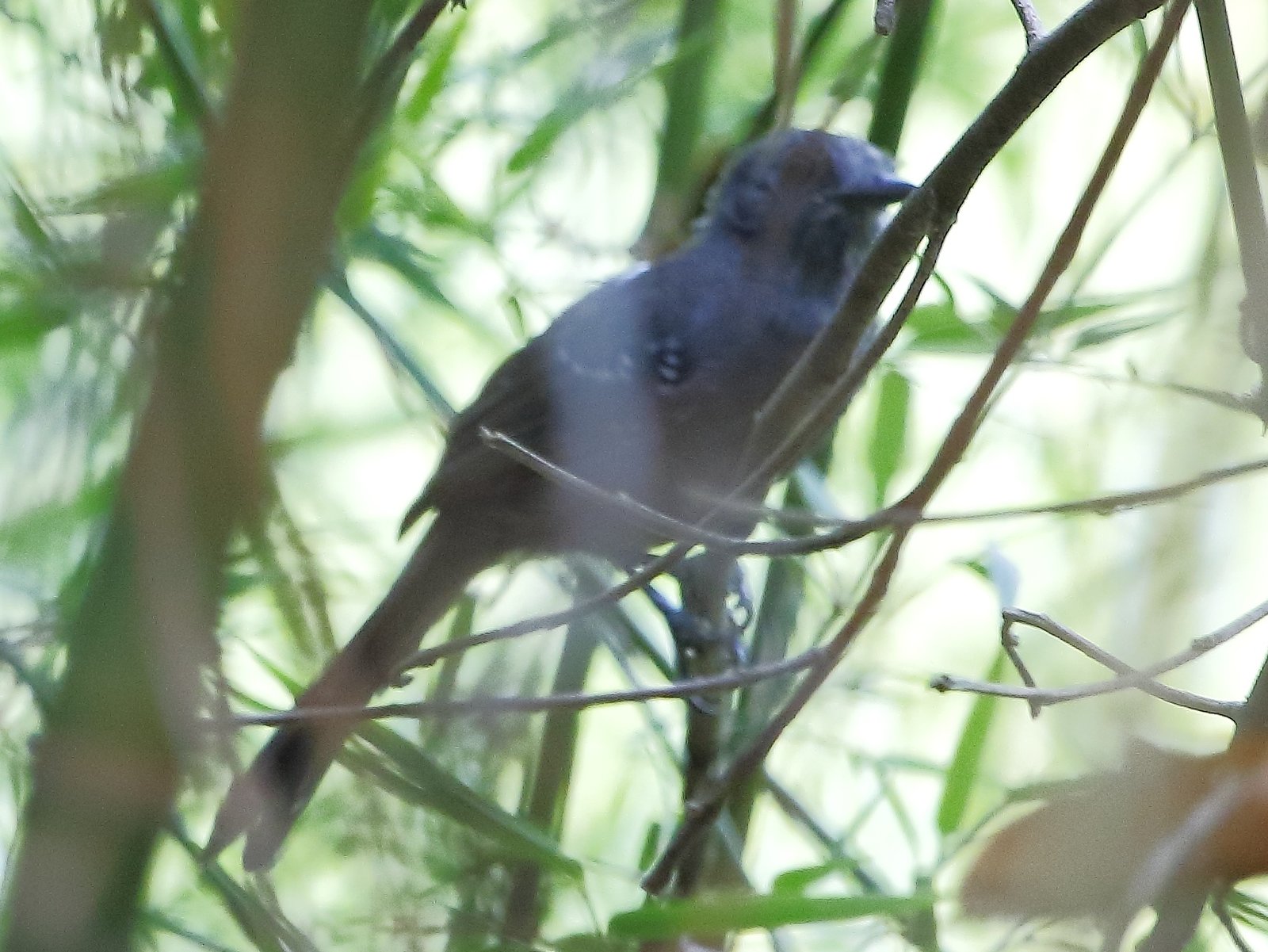
15 cm, with a fairly long tail. The male is very dark grey, paler grey on the face, flanks and undertail coverts, with white tips to the wing coverts and tail feathers and a mostly hidden white patch between the scapulars. The female has an olive-brown crown and back, blackish wing coverts with white tips and a dark grey-brown tail with white crescents near the tip; the face and underparts are plain grey, the throat finely streaked white. The iris is pale brown.
Confusion species
Black Antbird Cercomacroides serva lives lower in the understorey away from bamboo; the male is blacker and the female has rufous underparts. Blackish Antbird Cercomacroides nigrescens lives in rank growth along rivers and forest edges; the female is orange-brown below. Grey Antbird Cercomacra cinerascens lives higher in vine tangles, has broad white tail tips and a female with olive-yellow underparts.
Habitat
Almost exclusively in stands of Guadua bamboo at partly shaded forest edges, along watercourses and roads, from about 250 to 1350 m. It searches for insects and other arthropods among leaves and stems in the dense bamboo, usually a few metres above the ground. Little is known about its breeding.
Where the bird is most at home, classified by the vegetation units of the Andes and the west coast.


Range and movements
Colombia: absent. Ecuador: absent. Peru: in the south-east, in south-eastern Ucayali, northern Cusco and most of Madre de Dios. Bolivia: in the north-west (Pando and La Paz). Absent from the Galápagos. Outside the guide area in Acre and scattered further east in Amazonian Brazil.
- Resident
- dark = core range, pale = thinly spread
How and when to look
Search roads and riverbanks with Guadua bamboo in Madre de Dios, for example along the road to Manu or at Tambopata. The duet gives the birds away, which otherwise keep inside the dense bamboo.
Conservation status
Least Concern. The species is tied to bamboo and therefore patchily distributed, but bamboo forest covers large areas in south-western Amazonia.
Scientific name
Cercomacra manu | Fitzpatrick & Willard, 1990
Fitzpatrick & Willard described the species in 1990 and placed it straight away in the genus where it still stands. The genus Cercomacra was introduced in 1858 by Sclater. The genus name combines Greek kerkos, 'tail', and makros, 'long'. The species name refers to Manu in Peru (the river and the national park), not necessarily the type locality. The specimen the first description was based on came from upper Río Madre de Dios, Madre de Dios, Peru.