All species › Passerines › Antbirds › Common Scale-backed Antbird
Common Scale-backed Antbird | Willisornis poecilinotus
Schubrugmiervogel | Hormiguero dorsiescamado común | Rendadinho
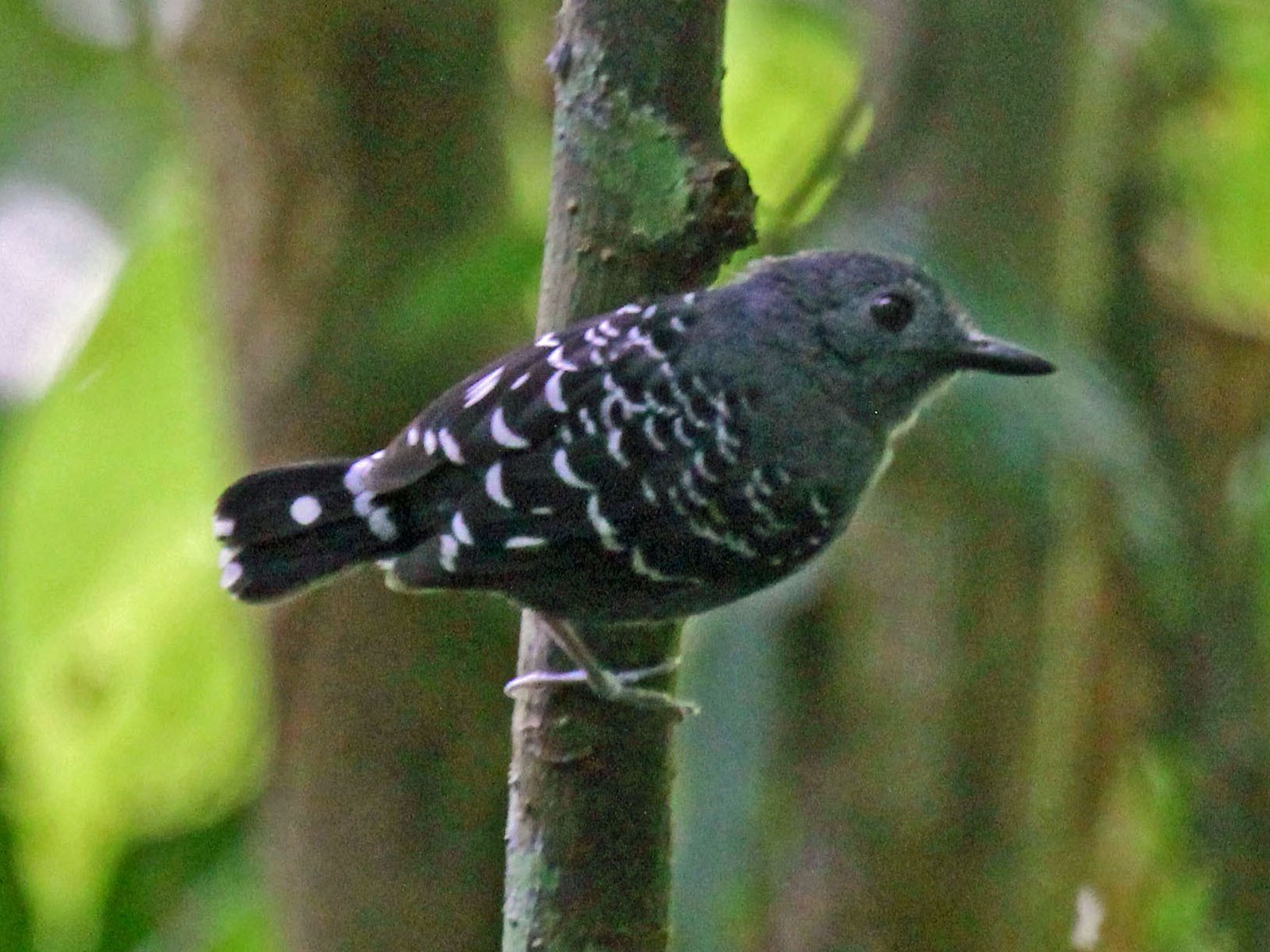
The Common Scale-backed Antbird is a small antbird of the Amazonian forest understorey, named for the male's black-and-white scaled back and wings. It regularly attends army ant swarms, but also forages on its own. It is one of the most widespread antbirds in the lowlands east of the Andes.
Voice
The song is a series of about ten to fifteen high, thin whistles that gradually rise in pitch. Calls are a short, dry chirr and soft ticks.
Recording: David Bradley — CC BY-NC-SA 4.0 · xeno-canto
Identification
13–14 cm, with a fairly short tail. The male is grey, with a black back and wing coverts whose feathers are fringed white, giving a scaled pattern; the tail is grey with black and white bands. The female has brown upperparts with buff scaling on the back and wings; the head and underparts vary by subspecies from rufous to greyish. Several subspecies occur in the guide area.
Confusion species
Spot-backed Antbird Hylophylax naevius has a black throat, buff spots on the back and a white, black-spotted breast. Dot-backed Antbird Hylophylax punctulatus has white dots on the back, a black throat and lives mainly in várzea and near water. Banded Antbird Dichrozona cincta walks on the ground, has a very short tail, a pale rump band and a breast band of black spots.
Habitat
Understorey of humid terra firme lowland forest and foothill forest, locally in transitional forest, up to about 1000 m. It forages low, often from vertical saplings, taking insects from leaves and the ground; it regularly attends army ant swarms and sometimes joins mixed flocks. Usually in pairs.
Where the bird is most at home, classified by the vegetation units of the Andes and the west coast.


Range and movements
Colombia: east of the Andes, from Meta and Guaviare to Amazonas. Ecuador: in the eastern lowlands and foothills. Peru: throughout the Amazonian lowlands. Bolivia: in the north. Absent from the Galápagos. Outside the guide area in southern Venezuela, the Guianas and Amazonian Brazil.
- Resident
- dark = core range, pale = thinly spread
How and when to look
In terra firme forest, listen for the rising series of high whistles and then search low among the saplings. At an army ant swarm the species is often seen together with other ant followers.
Conservation status
Least Concern. Widespread and fairly common in undisturbed forest; deforestation is a local threat.
Scientific name
Willisornis poecilinotus | (Cabanis, 1847)
Cabanis described the species in 1847 as Hypocnemis poecilonota; because it was later moved to another genus, the author and year stand in brackets. The genus Willisornis was introduced in 2007 by Agne & Pacheco. The genus name honours Edwin O'Neill Willis (1935–2015), an American ornithologist who studied the birds of Central and South America; Greek ornis means 'bird'. The species name comes from Greek poikilos, 'variegated', and nōtos, 'back', referring to the scaled back. The specimen the first description was based on came from Guyana.